What the Early Enemies of Christianity Admitted About the Resurrection
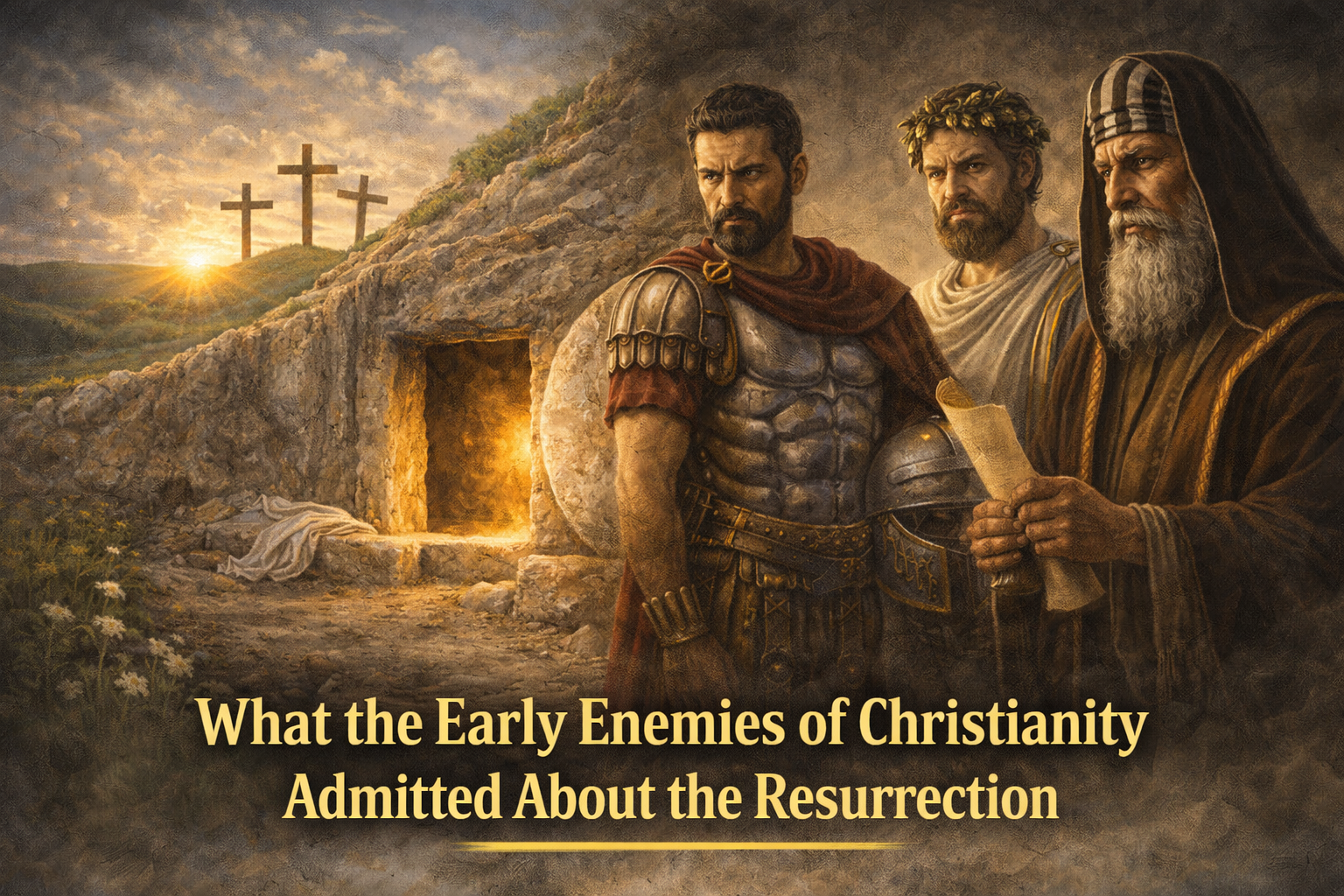
The most powerful evidence for the resurrection doesn’t come from believers. It comes from the people who had every reason to destroy it. The resurrection of Jesus Christ has hostile witnesses — people who were present, who had power and motive to crush the Christian movement in its cradle, and who were unable to deny the most basic facts of what had happened. What they admitted, and what they chose to argue instead, tells us everything.
The most powerful evidence for the resurrection doesn’t come from believers. It comes from the people who had every reason to destroy it.
In a courtroom, the most compelling testimony often comes not from friends of the accused but from hostile witnesses — people with no reason to help the defense, and every reason to undermine it. When even an enemy concedes a point, that concession carries enormous weight.
The resurrection of Jesus Christ has hostile witnesses. Not just skeptics writing centuries later, but people who were present, who had power and motive to crush the Christian movement in its cradle, and who were unable to deny the most basic facts of what had happened. What they admitted — and what they chose to argue instead — tells us everything.
The First Hostile Admission: The Tomb Was Empty
The earliest counter-argument to the resurrection is recorded in Matthew 28:11–15. The Jewish religious leaders — the very men who had arranged the crucifixion, who had posted Roman guards at the tomb to prevent tampering, who had the most to lose if the resurrection story spread — did not deny the empty tomb. They couldn’t. Instead, they bribed the guards to spread a cover story: the disciples had stolen the body while the soldiers slept.
Think carefully about what this concedes. The most powerful religious authorities in Jerusalem, with full access to the tomb’s location and Roman military assistance, were reduced to paying people to lie rather than simply pointing to a body. That is not the behavior of people who knew where the corpse was.
“And this story has been spread among the Jews to this day.” — Matthew 28:15
Matthew notes that this fabricated story was still circulating when he wrote his Gospel — meaning the admission it contains was still in living memory. The empty tomb was not disputed. Only its explanation was.
What the Roman and Jewish Historians Admitted
Roman Historian · Enemy of Christianity
Tacitus
c. 56–120 AD — Annals, written c. 116 AD
Tacitus despised Christianity and called it a “mischievous superstition.” He is exactly the kind of hostile witness whose testimony carries weight precisely because he had no interest in helping the Christian case. What he admits is significant: Jesus was a real person executed under Pontius Pilate, and the movement he started did not stay dead after the crucifixion — it “broke out again.” A Roman historian writing to a Roman audience, with no Christian sympathies, confirms the core historical framework.
The phrase “checked for the moment” is telling. Tacitus expected crucifixion to end a movement. It didn’t. He notes this as remarkable without explaining why.
Jewish Historian · Writing for Roman Audience
Josephus
c. 37–100 AD — Antiquities of the Jews, written c. 93 AD
The passage about Jesus in Josephus (the Testimonium Flavianum) has a complex scholarly history — the version in the main Greek text contains phrases most scholars believe were added by later Christian copyists. But the Arabic version quoted above, preserved by a 10th-century bishop quoting an earlier source, is widely regarded as closer to what Josephus actually wrote.
What Josephus — a Jewish historian writing to please Roman patrons, with no motive to promote Christianity — concedes: Jesus was real, was executed by Pilate, had genuine followers, and those followers claimed he appeared to them after three days. He doesn’t endorse the claim. He records it. That recording, from that source, is historically significant.
Roman Governor · State Correspondence
Pliny the Younger
c. 61–113 AD — Letter to Emperor Trajan, c. 112 AD
Pliny was writing to ask the Emperor how to handle Christians in his province — he had been executing them and wanted guidance. He’s not a sympathizer. What he inadvertently preserves for history is remarkable: within 80 years of the crucifixion, Christians across the Roman Empire were gathering before dawn on a fixed day (Sunday — the day of the resurrection) to worship Christ “as to a god.” This worship pattern traces directly back to the resurrection claim. Pliny is puzzled by it, but he records it accurately.
The fixed day of pre-dawn worship is a detail that makes no sense unless rooted in a specific historical event — the discovery of the empty tomb on the first day of the week.
Roman Emperor · Skeptic and Persecutor
Julian the Apostate
331–363 AD — Apostate Emperor, raised Christian, renounced the faith
This is significant by what it omits. Julian had access to the full resources of the Roman imperial archive, every motive to destroy Christianity, and brilliant classical education. If there had been solid evidence that the resurrection story was fabricated — forged documents, alternative accounts of what happened to the body, records of the disciples’ conspiracy — Julian would have used it. He didn’t, because it wasn’t there. His attacks on Christianity never touched the historical core.
The Most Powerful Hostile Witnesses: The Converts
Beyond external enemies, the resurrection has two internal hostile witnesses whose conversions are among the most historically striking facts surrounding Easter. These are men who had every reason to oppose the resurrection claim and no personal motivation to fabricate a conversion.
James, Brother of Jesus
During Jesus’ ministry, James was a skeptic — John 7:5 records that Jesus’ own brothers did not believe in him. A man does not invent a story about his brother rising from the dead. James became a pillar of the Jerusalem church (Galatians 1:19, 2:9) and was executed for his faith around 62 AD, as recorded by Josephus. Something happened between his skepticism and his martyrdom. Paul records it directly: Jesus appeared to James (1 Corinthians 15:7).
Paul of Tarsus
Paul was not a grieving disciple prone to wishful thinking. He was an educated Pharisee who considered Christianity a dangerous heresy and was actively hunting down Christians for imprisonment and execution (Acts 8:3, 9:1–2). His conversion on the Damascus road, his subsequent visit to Jerusalem to meet Peter and James (Galatians 1:18–19), and his willingness to die for what he saw — these require an explanation. He saw something. He never wavered about what it was.
Gary Habermas, who has spent decades cataloguing the historical evidence for the resurrection, notes that virtually all critical historians — including skeptics — accept the conversion of Paul and James as historical facts. The question they cannot answer is: what caused it?
The Pattern in What They Conceded
Look at what the enemies of early Christianity consistently admitted and what they consistently argued instead:
- They conceded: Jesus existed and was executed. No serious ancient source denied this. Even Tacitus, writing with contempt, confirms it.
- They conceded: The tomb was empty. The earliest counter-argument (stolen body) only makes sense if the emptiness was undeniable. Nobody pointed to a body.
- They conceded: The movement exploded after the crucifixion. Tacitus, Pliny, and the Jerusalem religious leaders all grapple with why a movement they expected to die didn’t die.
- They argued: Alternative explanations. The body was stolen. It was a superstition. The disciples were deluded. But not one ancient hostile source argued the most decisive thing — that the body was still in the tomb.
What you argue against reveals what you can’t deny. The enemies of Christianity argued against the explanation of the empty tomb because they couldn’t argue against the fact of it.
Why This Matters for Faith
Some Christians feel that apologetics is somehow less spiritual than simple faith. There’s a real concern underneath that — we don’t want to make the resurrection dependent on our ability to out-argue a skeptic. Faith is ultimately a gift, not a conclusion at the end of a syllogism.
But Peter didn’t think knowledge and faith were enemies. He commanded believers to always be prepared to give a reason for the hope they carry (1 Peter 3:15). Paul didn’t retreat from evidence — he pointed to 500 eyewitnesses still alive and checkable (1 Corinthians 15:6). The early church proclaimed the resurrection as a public, historical, verifiable event — not a private spiritual experience immune to examination.
The hostile witnesses matter because they demonstrate that the resurrection was not a story that grew in the dark, away from scrutiny, among people desperate to believe. It was proclaimed loudly, in the very city where it happened, to audiences that included people who wanted nothing more than to prove it false. And the best those people could do — the powerful, the educated, the motivated — was bribe some guards and spread a cover story.
“For we did not follow cleverly devised myths when we made known to you the power and coming of our Lord Jesus Christ, but we were eyewitnesses of his majesty.” — 2 Peter 1:16
The resurrection doesn’t need the enemies of Christianity to prove it. But it is worth noting — carefully, soberly — that they couldn’t disprove it. Two thousand years of motivated opposition, access to the historical record, and every reason to produce a body or a credible alternative, and the best answer anyone has ever managed is: the disciples must have stolen it.
That is not the response of people who had evidence. That is the response of people who had none.
He is risen. His enemies knew it then. The historical record confirms it now.
🙏 Closing Prayer
Lord Jesus, thank You that the truth of Your resurrection was not fragile. It was proclaimed into the teeth of opposition, examined by enemies who wanted it destroyed, and it stood. Give us the same confidence — not arrogance, but the settled assurance that comes from knowing what is true. Make us ready to give a reason for our hope, with gentleness and respect, to everyone who asks. Amen.
Key Scriptures: Matthew 28:11–15 · 1 Corinthians 15:1–8 · Acts 2:22–36 · 2 Peter 1:16 · 1 Peter 3:15 · Galatians 1:18–19 · John 7:5 · Acts 9:1–6
On eyewitness testimony — Luke 1:1–4 · Acts 1:3 · 1 John 1:1–3 · John 19:35; 21:24
On hostile witnesses within the New Testament — 1 Corinthians 15:7–9 · Acts 8:1–3 · Galatians 1:13–14
On defending the faith — 1 Peter 3:15 · Jude 3 · Colossians 4:5–6 · 2 Corinthians 10:5
Want to Go Deeper?
This post is part of a series on the historical evidence for the resurrection. Read it alongside our companion pieces — Why the World Keeps Trying to Explain Away the Empty Tomb and Easter vs. the Pagan Holiday Claims — for the full picture.
For further study on the non-Christian sources and hostile witnesses:
- The Historical Jesus — Gary Habermas. The most thorough treatment of non-Christian sources on Jesus and the resurrection.
- Jesus and the Eyewitnesses — Richard Bauckham. A landmark study on the eyewitness testimony behind the Gospels.
- The Case for the Resurrection of Jesus — Habermas & Licona. Accessible, rigorous, and built around exactly the kind of evidence examined in this post.
Subscribe to Mountain Veteran Ministries for more gospel-rooted, plainspoken content built for the questions real people are actually asking.
“Always be prepared to give an answer to everyone who asks you to give the reason for the hope that you have. But do this with gentleness and respect.” — 1 Peter 3:15