When Doctrine and Traditions Go Too Far
How the Good News Can Get Buried Beneath Good Intentions — and How to Find Your Way Back to Christ
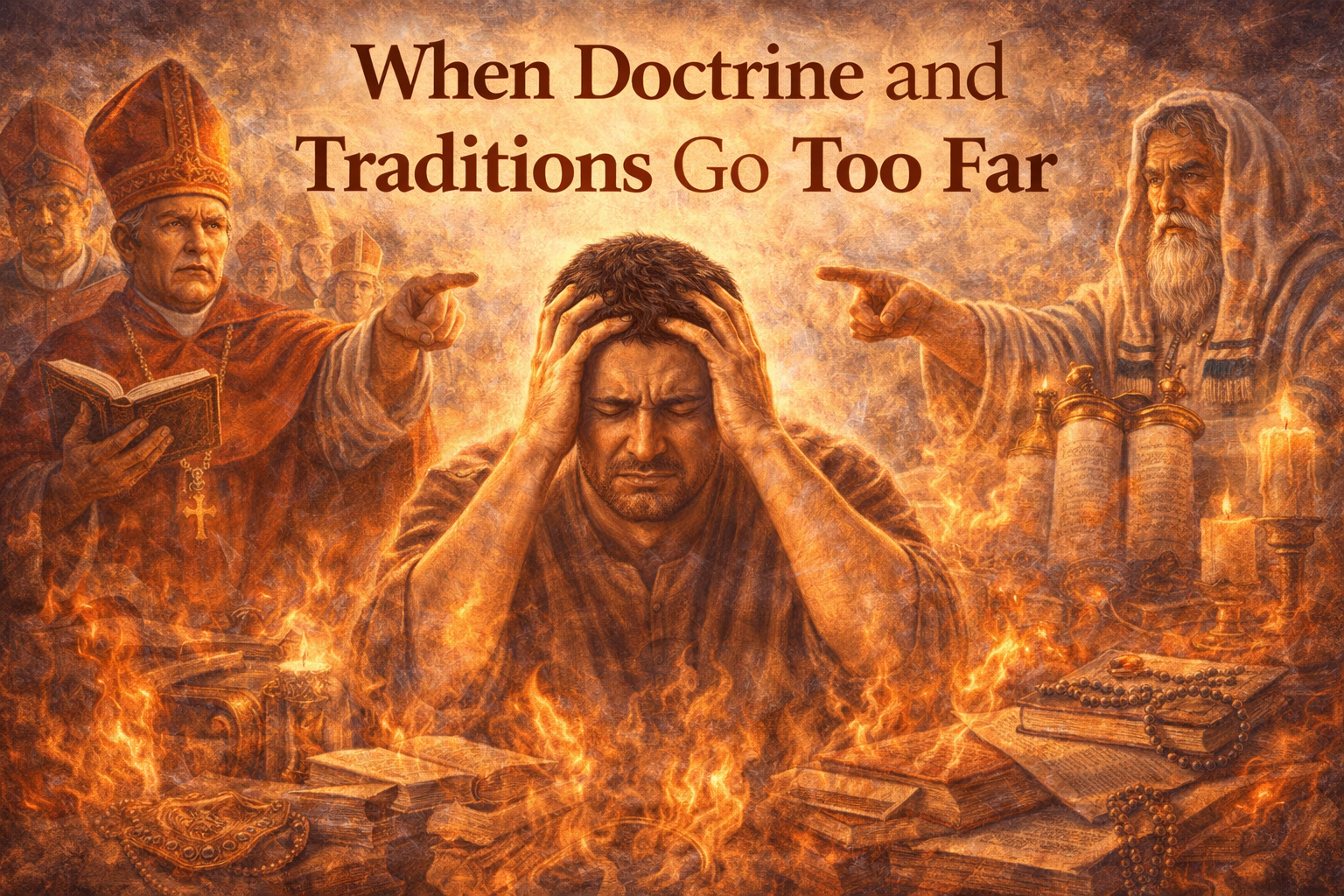
Doctrine and tradition are vital to the Christian faith. Doctrine grounds us in truth. Tradition connects us to the historical witness of believers who came before. These are genuinely good things. But sometimes good things go too far — and when doctrine becomes rigid dogma or when tradition overshadows the message of grace, we risk turning the living gospel into a lifeless religion.
Jesus ran into this problem directly. The Pharisees of His day were so wrapped up in their rules and rituals that they missed the Messiah standing in front of them. Paul warned the early church against being taken captive by human traditions (Colossians 2:8). And throughout Christian history there have been seasons when the church clung more to man-made customs than to Christ Himself.
So where is the line? The answer lies in returning, again and again, to the heart of the gospel: Christ crucified and risen, grace over legalism, love over ritual. The faith was never meant to be locked inside rules — it was meant to be lived in real relationship with God and neighbor.
“You nullify the word of God by your tradition that you have handed down.” — Mark 7:13
The Value of Doctrine and Tradition — and Where They Go Wrong
What They Are For
Doctrine Is the Foundation. Tradition Is the Connection.
Doctrine gives us structure. Without it we would be like a house without a foundation — susceptible to every false teaching that comes along (2 Timothy 3:16–17). It protects us and helps us rightly understand and apply the Word of truth. Tradition, meanwhile, anchors us to our spiritual heritage. Singing old hymns, observing the church calendar, kneeling in prayer — these practices shape our spiritual identity and keep us connected to the saints who came before us.
Both are legitimate gifts to the Church. The problem is not their existence but their elevation.
When we confuse doctrine with infallibility — treating every theological position we hold as beyond question — or elevate tradition to the same level as Scripture itself, we start building fences around God that He never asked for. Instead of freeing people with the good news, we fence them in with good intentions that have gone too far. The moment we start saying “real Christians must believe exactly like this” about secondary issues, we should pause and ask: are we defending truth, or defending our way of doing things?
Warning Signs That We’ve Gone Too Far
Here are four patterns that suggest doctrine or tradition may be burying the gospel rather than serving it.
These patterns do not preserve the faith — they choke it. When good practices become ultimate priorities, they become idols in disguise.
Three Moments in Church History
What Jesus Said About It
Jesus did not discard tradition — He fulfilled and deepened the Law. But He consistently refused to let tradition block access to the Father, and He reserved His harshest words for the people who used religion as a tool of exclusion rather than invitation.
Jesus loved the Law — but never more than He loved people. He consistently elevated grace above ritual, compassion above condemnation, and relationship above regulation. When we follow Him, we follow a Savior who did not tear down the system but restored its purpose.
Finding the Balance — Three Questions Worth Asking
The goal is not to throw out doctrine or dismiss tradition. The goal is to test everything against the gospel (1 Thessalonians 5:21) and ask honestly whether what we are holding serves Christ or serves us.
The goal is not the purest doctrine or the oldest tradition. The goal is to know Jesus and make Him known. Every doctrine should lead to deeper worship, and every tradition should shine light on Christ — not on the institution or the community that maintains it.
Sometimes the most spiritually honest thing a church can do is ask: is this about Christ — or about control? That question alone, taken seriously, could spark a much-needed revival in congregations across the country.
Where Different Churches Land Today
Three Tendencies — None of Them Fully Adequate
Precision Without Grace, Comfort Without Truth, or Drift Without Anchor
Some churches lean toward doctrinal precision so tight that it leaves no room for grace. They fear compromise so intensely that compassion gets lost along the way. Truth without warmth drives people away from the very gospel it claims to protect.
Others lean so heavily into tradition or cultural norms that they lose sight of the living Christ. They celebrate the past — which is not wrong — but do so at the expense of the present work of the Spirit. The church becomes a museum rather than a mission.
Still others have discarded both doctrine and tradition and fallen into spiritual confusion — tossed by every new idea, lacking the anchor of truth that doctrine provides.
What is needed is neither of the extremes. It is a grace-and-truth approach: doctrine held with conviction and with humility, tradition held richly and held loosely, and a Christ-centered focus that keeps the main thing the main thing. When Jesus is genuinely at the center, everything else — theology, liturgy, church culture — finds its proper place around Him.
The Signpost and the Savior
Imagine a man stuck on a muddy road. He sees a beautiful signpost explaining the way out — perfect grammar, painted gold. But it is nailed down and doesn’t move. He can read it, but he can’t follow it out of the ditch.
Then someone comes along with muddy boots who doesn’t just explain the way but walks with him, arm in arm, all the way out.
Doctrine is the signpost. Tradition is the paint. But Jesus is the one who pulls us out. Let’s never confuse the signpost for the Savior.
Doctrine matters. Tradition matters. But neither saves us. Only Jesus does.
When He is genuinely at the center, everything else finds its proper place. If you find yourself clinging more to your method than to your Master, it may be time to loosen your grip. Jesus doesn’t ask us to defend Him. He asks us to follow Him.
Let our rules, routines, and rituals be arrows pointing to Christ — not roadblocks that hide Him from the people He came to find.
“For I resolved to know nothing while I was with you except Jesus Christ and him crucified.” — 1 Corinthians 2:2
Key Scriptures: Mark 7:6–13; 2:27 · Colossians 2:8 · Galatians 1:6–9 · Romans 14 · Matthew 23:23; 5 · 1 Thessalonians 5:21 · 1 Corinthians 2:2 · 2 Timothy 3:16–17 · John 1:14; 17:21
Want to Go Deeper?
This post connects directly to several others in MVM’s series on the Church and Christian life:
- What Jesus Expects from His Church — the positive vision of what the Church looks like when Christ is genuinely at the center, rather than traditions built around Him
- Christian Hypocrisy — the companion post on what happens when Christians live below their own stated beliefs — and how five leaders respond to the charge
- Living for Jesus in a Secular World — five leaders on how to hold conviction without becoming the kind of Christian whose manner of holding it drives people away
- The Cost of Forgiveness — how the gospel of grace is fundamentally different from every system of religious performance — the theological heart of what this post is defending
- Subscribe to get new posts delivered straight to your inbox — gospel-rooted, plain-spoken truth for the week ahead.
“It is for freedom that Christ has set us free. Stand firm, then, and do not let yourselves be burdened again by a yoke of slavery.” — Galatians 5:1