
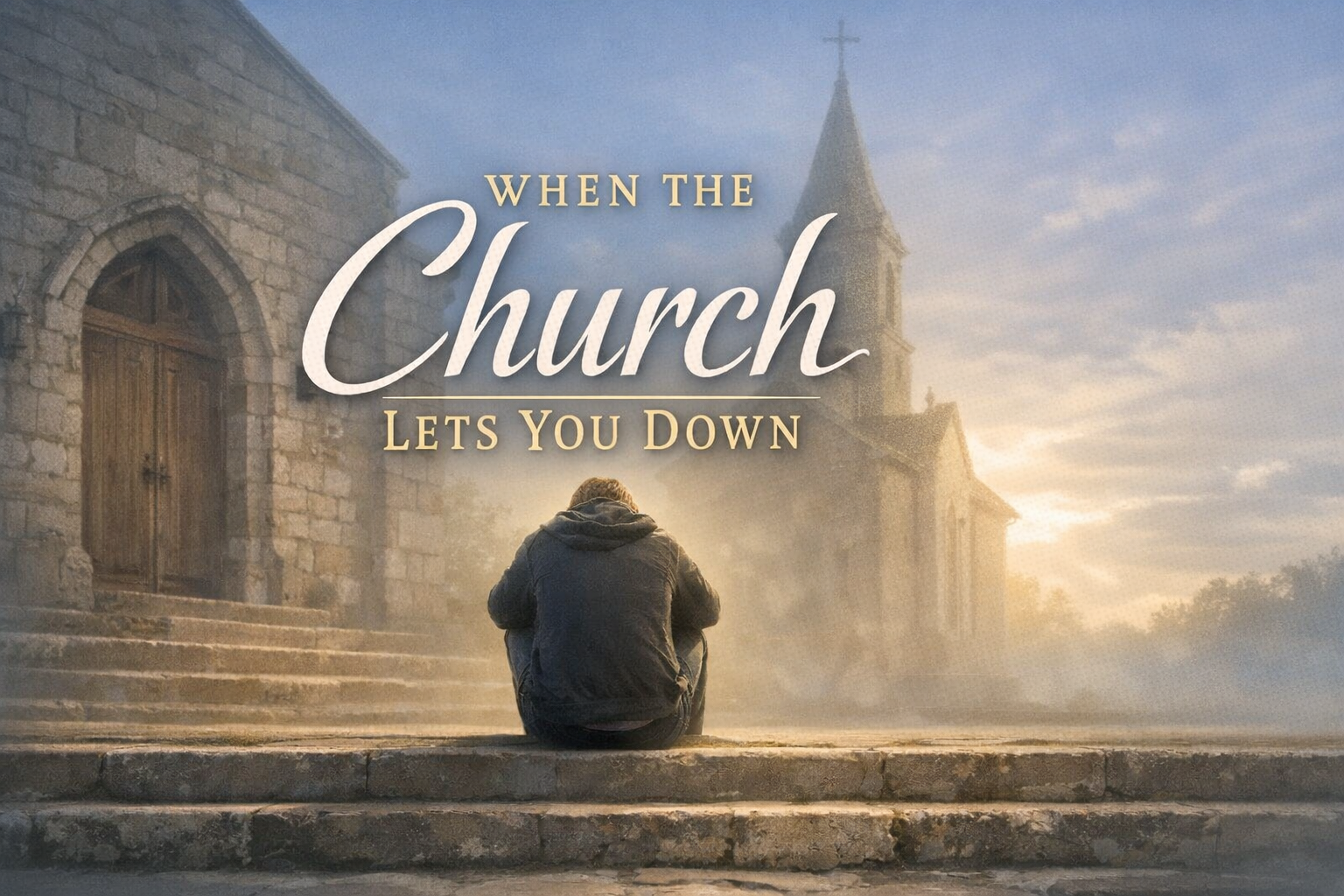
When the Church Lets You Down
Getting hurt by the church is one of the most disorienting experiences a believer can have. You came expecting grace and got something else. The wound is real. But so is the danger of letting a broken institution become your reason to walk away from the God who redeems broken institutions — and broken people.
The wound is real. So is the danger of letting it become the last word.
It happens more than most people talk about in church — which is part of the problem.
A pastor says something cutting from the pulpit that lands like a missile in the middle of your worst season. An elder handles a conflict with all the grace of a parking dispute. A congregation rallies around the wrong person. Gossip moves through a small group like a brushfire. A trusted spiritual mentor turns out to be living a double life. A church splits, and you find yourself holding pieces of relationships that will never fully reassemble.
Or maybe it’s nothing that dramatic. Maybe it’s just the slow accumulation of feeling unseen — years of showing up, serving, giving, and never quite belonging. The quiet kind of hurt that doesn’t make a good testimony but is just as real.
However it happened, if you’re reading this with a wound from the church, you’re not alone. And the wound is not nothing. We are not going to minimize it here or rush you past it to a tidy application point. The church has done real damage to real people, and pretending otherwise doesn’t serve you or the church.
But there are some things that need to be said — carefully, honestly — about what happens next. Because the decisions you make in the aftermath of being hurt by the church are among the most consequential a believer can face. And the enemy is counting on you to make the wrong ones.
First: The Wound Is Legitimate
The church is made of people. People are broken. Broken people, even redeemed broken people, hurt other people — sometimes carelessly, sometimes deliberately, sometimes in ways they don’t even know they’re doing. This is not a surprise to God. He is not embarrassed by it. He knows exactly what He’s working with.
But knowing that the church is full of sinners doesn’t make the hurt less real. When David was betrayed by his close companion — a man with whom he had walked to the house of God — he didn’t write a theological treatise about human fallenness. He wrote Psalm 55. He grieved it. He said the pain was worse because of who it came from: “It is not an enemy who taunts me — then I could bear it… But it is you, a man, my equal, my companion, my familiar friend.”
That’s a precise description of what church hurt feels like. It’s not just the wound — it’s who delivered it. You were among the people of God. You expected something better. You had a right to. And what you got instead left a mark.
Give yourself permission to call it what it is before you try to move through it. Skipping the grief doesn’t speed up the healing. It just drives it underground, where it turns into cynicism, isolation, or a bitterness that eventually poisons everything downstream.
Second: Separate the Institution From the Head
Here is the most important theological distinction to make when the church has hurt you: Jesus Christ is not the church. The church belongs to Him, was purchased by His blood, and will one day be presented holy and blameless before Him — but right now it is a community of imperfect, still-being-sanctified sinners, and its failures are not His failures.
This sounds simple. It is actually very hard to hold onto when you’re hurt, because the people who wounded you were representing Him — or claiming to. The pastor who abused his authority was supposed to be a shepherd. The elder board that mishandled the situation was supposed to embody wisdom and justice. The congregation that chose sides was supposed to be a community of grace. When they failed, it felt like He failed.
He didn’t.
Jesus was consistently harder on religious leaders than on anyone else in the Gospels. The scribes and Pharisees — the institutional custodians of faith in His day — received His sharpest rebukes. He called them whitewashed tombs, blind guides, vipers. He wasn’t protecting the institution. He was protecting the people the institution was supposed to serve.
When the church fails you, you have more in common with the wounded people Jesus was defending than you might realize right now. He sees what happened. He is not indifferent to it. And His integrity is not diminished by the failures of the people who carry His name imperfectly.
The church’s failures are real. They are also not the last word — because the Head of the church is not the broken people who populate it. He is the one making all things new, including His bride.
Third: Know the Difference Between Resting and Leaving
There are seasons when a wounded believer needs to step back from a particular congregation — and that is not only understandable, it can be wise. If you are in a situation involving genuine spiritual abuse, ongoing toxicity, or a leadership culture that is actively harmful, leaving is not a failure of faith. It is self-preservation, and God is not calling you to stay in a burning building.
But there is a significant difference between leaving a specific congregation for legitimate reasons and abandoning the church altogether. And that line is where a lot of hurt people end up crossing without quite meaning to.
It usually looks like this: you leave a church because something real happened. You tell yourself you’ll find another one when you’re ready. Weeks become months. Months become years. You discover that Sunday morning without the obligation is actually quite comfortable. You build a private faith — podcasts, devotionals, maybe a Bible app — and you call it enough. And slowly, without any single dramatic decision, you drift out of the body of Christ entirely.
Scripture doesn’t give you that option. Not as a lifestyle. Hebrews 10:24–25 is direct: “And let us consider how to stir up one another to love and good works, not neglecting to meet together, as is the habit of some, but encouraging one another, and all the more as you see the Day drawing near.” The “habit of some” who had stopped gathering was already a problem in the first century. The writer doesn’t excuse it — he calls it out and redoubles the urgency.
You were made for community. Wounded community is still community. And the private faith that feels safer than risking another church is, in the long run, a lonelier and more brittle faith than anything you’ll build inside a congregation of imperfect people.
Fourth: Understand What Forgiveness Does and Doesn’t Mean
Forgiveness is one of the most misunderstood words in the Christian vocabulary, and nowhere does the confusion do more damage than when it’s applied to church hurt.
Let’s be clear about what forgiveness is not. It is not the same as reconciliation. Reconciliation requires two parties — repentance on one side, restoration on the other. Forgiveness is a one-party act. You can forgive someone who has never apologized, will never apologize, and doesn’t believe they did anything wrong. Forgiveness doesn’t require their participation.
Forgiveness is not pretending the harm didn’t happen. It is not returning to a situation that was abusive or toxic. It is not removing all consequences from the person who caused the harm. It is not a feeling — you may forgive someone and still feel the hurt for a long time afterward, and that’s not a sign the forgiveness wasn’t real.
What forgiveness actually is: the decision to release your claim to retribution. To stop building your identity around the wound. To refuse to let what was done to you become the organizing principle of your life. It is, at its core, an act of faith — a declaration that God is the righteous judge and that you are willing to trust Him with the account rather than holding it yourself.
Romans 12:19 puts it plainly: “Beloved, never avenge yourselves, but leave it to the wrath of God, for it is written, ‘Vengeance is mine, I will repay, says the Lord.'” You are not forgiving because what happened was okay. You are forgiving because carrying the debt is destroying you, and because God is more than capable of settling the account.
This is hard. It may be the hardest thing in this entire post. And it is almost certainly not a one-time decision — forgiveness often has to be chosen again and again before it becomes settled. That’s not weakness. That’s the slow, costly work of grace in a broken world.
Fifth: Find the Faithful Remnant
One of the subtler effects of church hurt is a distorted picture of the whole. When one congregation, or one leader, or one season inside the church has been genuinely bad, it’s easy to project that experience onto every church, every pastor, every community of believers. The specific failure becomes a verdict on the institution.
That’s understandable. It’s also not accurate.
There are faithful congregations out there — not perfect ones, not ones without conflict or failure or awkward potluck dynamics — but ones where the Word is preached honestly, where leaders are accountable, where people are genuinely trying to love each other in the way of Jesus. They are harder to find than they used to be, perhaps. But they exist.
Elijah was convinced he was the last faithful man in Israel. God’s response was that He had reserved seven thousand who had not bowed the knee to Baal — 1 Kings 19:18. Elijah’s wound and exhaustion had narrowed his perception of what was actually out there. The remnant was larger than his suffering let him see.
Don’t make permanent decisions based on the visibility from your lowest point. The faithful remnant is there. You may have to look harder. You may have to risk again. That risk is real. So is what’s waiting on the other side of it.
A Word to the Church
If you’re a pastor, elder, or church leader reading this — or if you’re a church member who has watched someone get hurt and wondered what you were supposed to do — a word needs to be said directly.
The way many churches handle internal conflict, leadership failure, and wounded members is a disgrace to the gospel. Circling the wagons around a toxic pastor to protect the institution. Silencing people who raise legitimate concerns. Treating repentance as a PR problem rather than a spiritual necessity. Allowing the people who caused the harm to remain in power while the wounded quietly disappear out the back door.
Jesus had a word for leaders who drove away the people they were supposed to shepherd. It was not gentle. Ezekiel 34 — the entire chapter — is God’s sustained indictment of shepherds who exploited the flock rather than feeding it. “You have not strengthened the weak, you have not healed the sick, you have not bound up the injured, you have not brought back the strayed, you have not sought the lost.” That is a description of a church that drives people away and then wonders why they don’t come back.
If your church has hurt someone, the most important thing you can do is make it possible for them to tell the truth about what happened — and then actually listen. Not to manage the narrative. Not to protect the brand. To do justice, love kindness, and walk humbly, as Micah 6:8 commands. The integrity of the church’s witness depends on it.
The Church Is Still Worth It
This is the part that might be hardest to hear when you’re hurt. But it needs to be said, and it needs to be said honestly rather than as a sales pitch.
The church — imperfect, broken, sometimes failing badly — is still the body of Christ in the world. It is still the community through which the gospel moves, through which the Scriptures are preserved and proclaimed, through which the sacraments are administered, through which the poor are served and the lonely are found and the lost are loved into the kingdom. There is no plan B. This is the plan — these stumbling, sanctified-in-process people, called together by a grace they didn’t earn, trying to show the world what the kingdom of God looks like.
They will fail again. So will you. That’s not a reason to walk away. That’s the whole premise of grace — that broken people are being made whole, slowly, together, by a God who is more patient than we have any right to expect.
Paul, writing to a church that was sleeping with people they shouldn’t sleep with, suing each other in court, getting drunk at communion, and fighting about spiritual gifts, still called them the body of Christ. Still called them saints. Still said that the same Spirit who raised Jesus from the dead was at work in them. He didn’t minimize the failures. He confronted them directly. And then he called the church to be what it already was in Christ — holy, loved, chosen, being transformed.
That transformation is messy. It has always been messy. And you, with your wound and your wariness and your hard-won understanding of how badly the church can fail — you are part of the community that is being transformed. Your experience matters to that community. Your voice matters. Your presence matters.
Don’t give the wound the last word. The One who redeems all things — including broken institutions and the people they’ve hurt — is still at work. He has not given up on His church. And we would ask, with all the pastoral care we can muster: don’t you give up on it either.
If You’re Carrying This Right Now
At Mountain Veteran Ministries, we know that many of the men and women in our community have deep wounds from religious institutions — churches that failed them, leaders who abused their trust, communities that looked the other way. We are not here to tell you those wounds aren’t real or that you should just get over it.
We are here to tell you that God is not the institution that hurt you. And that the community of faith, for all its failures, is still the place He has called you to. If you’re trying to find your way back — or trying to figure out if you even want to — you are welcome here. Doubt, wounds, questions, and all.
“He heals the brokenhearted and binds up their wounds.” — Psalm 147:3
Key Takeaways
- The wound is real, and it deserves to be named. Skipping the grief doesn’t speed up the healing — it drives the hurt underground, where it becomes cynicism and bitterness. Give yourself permission to call what happened what it actually was.
- Jesus Christ is not the church — and the church’s failures are not His. He was consistently the fiercest defender of the people the religious institution failed. He sees what happened to you. His integrity is not diminished by those who carry His name imperfectly.
- There is a difference between resting and leaving for good. A season away from a specific congregation can be wise and necessary. Abandoning the church as a way of life is something Scripture does not permit — and it produces a lonelier, more brittle faith than the one you’re afraid to risk again.
- Forgiveness is not pretending, not reconciliation, and not a feeling. It is the decision to release your claim to retribution and trust God as the righteous judge. It has to be chosen repeatedly before it becomes settled — and that is not weakness. That is grace doing its slow, costly work.
- The faithful remnant is larger than your lowest point lets you see. Elijah thought he was the last one standing. God had seven thousand. Don’t make permanent decisions based on the visibility from the bottom of the valley.