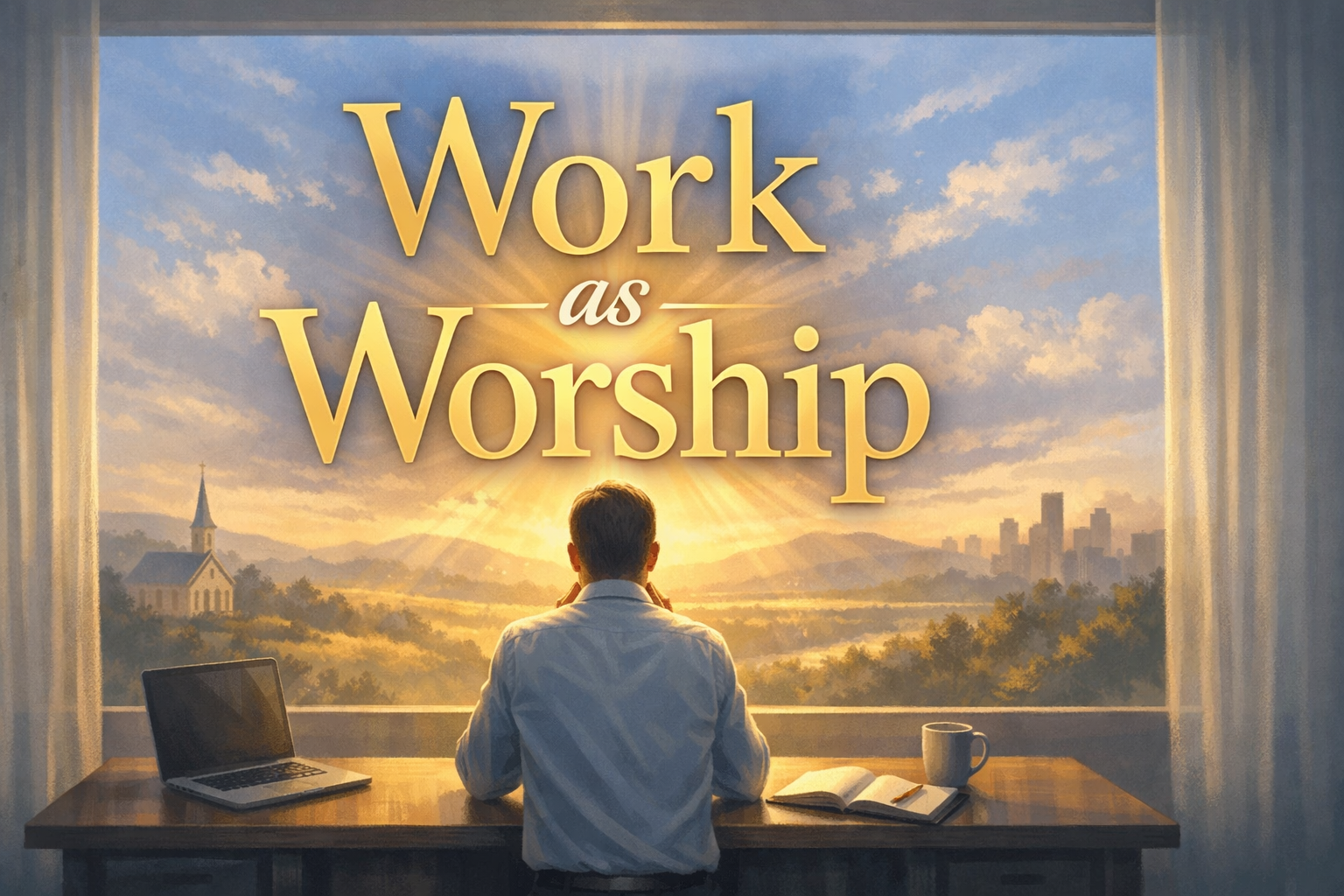
Work as Worship
You put in the hours. You carry the load. God says that matters more than you think.
You put in the hours. You carry the load. God says that matters more than you think.
Most men draw a hard line between sacred and secular. Church is one thing. Work is another. Sunday is holy. Monday is just Monday.
That line feels natural. It also happens to be completely unbiblical.
The God of Scripture is not a weekend God. He didn’t design you for a few hours of worship and then clock out until next Sunday. He designed you — all of you, including the calluses on your hands and the decisions you make under pressure — as an act of ongoing devotion to Him. The ancient theologians had a phrase for it: coram Deo. Before the face of God. Every moment. Every task. Every job.
This isn’t a motivational reframe. It’s a theological reality. And for men who’ve spent years grinding through work that felt meaningless, or carrying guilt that their faith doesn’t show up enough at the office or the shop or the field — this truth is genuinely liberating.
Work is not the obstacle to your spiritual life. Done right, it is your spiritual life.
Where Work Comes From
Before we can talk about work as worship, we need to go back to the beginning — and I mean all the way back.
Genesis 1:1 opens with God at work. He creates. He separates. He names. He builds order out of chaos. And when the work is done, He calls it good. Then He rests — not because He was tired, but to mark the completion of something excellent.
Then in Genesis 2:15, before sin enters the picture, before anything goes wrong, God places the man in the garden “to work it and keep it.” Adam was a working man in paradise. Labor isn’t a curse. Labor is part of what it means to bear the image of God in the world.
The curse in Genesis 3 didn’t invent work. It corrupted it — thorns, sweat, frustration, futility. What was once pure joy became a grind. But the thing itself — the act of working, producing, building, stewarding — that’s original design. That’s Edenic. And in Christ, it’s being restored.
“The man who works with his hands is a laborer. The man who works with his hands and his brain is a craftsman. The man who works with his hands, his brain, and his heart is an artist.” — Louis Nizer
Nizer was a lawyer, not a theologian, but he was onto something. The Bible goes further: the man who works with his hands, his brain, his heart, and his soul — who does his work before the face of God — is a worshiper.
The Theology of the Ordinary
Here’s where the Reformation cracked something open that the church still hasn’t fully absorbed.
For centuries, the medieval church operated with a two-tier system: sacred and secular, clergy and laity, those who served God and those who merely served. If you wanted your life to count for eternity, you took vows, joined a monastery, entered the priesthood. Everybody else was just managing earthly affairs.
Martin Luther blew that up. Commenting on a simple domestic task, he wrote that a Christian maidservant who did her household duties to the glory of God was engaged in a higher calling than a monk who neglected genuine service in favor of spiritual performance. That was a revolutionary statement in the 16th century. It’s still revolutionary now.
The Reformers called it the “priesthood of all believers,” rooted in 1 Peter 2:9 — “you are a chosen race, a royal priesthood, a holy nation.” That means the plumber and the pastor are both ministers. The difference is the domain, not the dignity.
Luther also gave us the concept of vocation — from the Latin vocare, to call. Your job isn’t just a job. It’s a calling. It’s the primary place where God has stationed you to love your neighbor, exercise your gifts, reflect His character, and extend His kingdom. The carpenter isn’t waiting to do something spiritual. He is doing something spiritual every time he cuts a true line and builds something that holds.
What Colossians 3 Actually Says
The clearest statement in all of Scripture on this subject might be Colossians 3:23–24:
“Whatever you do, work heartily, as for the Lord and not for men, knowing that from the Lord you will receive the inheritance as your reward. You are serving the Lord Christ.”
Read that again slowly. Whatever you do. Not “whatever ministry you do.” Not “whatever church activity you do.” Whatever. Welding. Driving. Typing. Teaching. Farming. Fixing engines. Filing paperwork at 4:45 on a Friday.
Work heartily. The Greek here is ek psyches — from the soul. This isn’t about faking enthusiasm for a job you hate. It’s about the orientation of your inner man toward the work in front of you. It means you bring your whole self to the task — your conscience, your craft, your character — not just your labor.
As for the Lord and not for men. This is the hinge. The boss changes. The paycheck varies. The recognition may never come. But the audience is fixed. You are performing for an audience of One. That single shift in perspective can transform a miserable job into meaningful service.
Paul wasn’t writing to pastors and missionaries. He was writing to slaves — people with no legal rights, no career options, no autonomy over their working conditions. And he told them: even here, even in this, you can worship. If that’s true in the worst possible work situation imaginable, it’s true in yours.
Excellence as an Act of Devotion
When a craftsman in the ancient world did his finest work — joints that fit clean, surfaces that held, structures that stood — he often marked it with his name or his guild’s seal. He was saying: this is mine. I stand behind it. It represents me.
That’s what Paul means when he says work heartily as for the Lord. Your work carries a name. Not yours — His. Ecclesiastes 9:10 puts it bluntly: “Whatever your hand finds to do, do it with all your might.” The Preacher isn’t just giving productivity advice. He’s describing a posture — full engagement, full effort, no sandbagging.
Mediocrity in your work is a theological problem, not just a professional one. When you cut corners, do the minimum, or mail it in — you’re not just underperforming for your employer. You’re offering God less than your best. That’s the definition of a blemished sacrifice.
This is not about perfectionism or workaholic hustle. Rest is also built into the design — the Sabbath is a creation ordinance, not an afterthought. The point is intentionality. The point is that when you engage your work, you bring your whole self to it because you understand who you’re actually working for.
Proverbs 22:29 captures it well: “Do you see a man skilled in his work? He will stand before kings; he will not stand before obscure men.” Skill and excellence open doors. But from a kingdom perspective, that’s secondary. The primary point is that God honors work done well. He always has.
Integrity When No One’s Watching
For veterans, this part hits different.
Military culture has a concept that civilians sometimes struggle to grasp: you do the job right because it’s the job. Not because someone’s grading you. Not because you’ll get credit. You do it because soldiers and airmen and sailors to your left and right are counting on you, and your integrity in the small things is what makes you trustworthy in the big things.
That’s exactly the ethic Paul describes. “Not for men” means you don’t ease up when the supervisor leaves the floor. You don’t fudge the numbers when no one will check. You don’t deliver garbage work with a polished presentation on top. Because the One who does see everything is the One you’re actually accountable to.
Proverbs 10:9 says, “Whoever walks in integrity walks securely, but he who makes his ways crooked will be found out.” There’s a military version of that hanging in every NCO academy — do right even when no one is watching. The biblical version is deeper: the only reason integrity holds under pressure is if it’s rooted in something that doesn’t move. For the believer, that’s the unchanging character of God and the knowledge that you live coram Deo — before His face, always.
This is also why workplace ethics aren’t a separate category from faith. How you treat subordinates. Whether your word is good. How you handle expense reports. Whether you’re honest about your hours. These aren’t minor footnotes to your Christian life. They are your Christian life, lived out in the arena where you spend most of your waking hours.
The Mission Field You Already Have
Here’s a simple fact that tends to get overlooked: for most believers, the workplace is the most consistent point of contact they have with people who don’t know Jesus.
The average man spends roughly 90,000 hours at work over the course of his career. That’s more time than he’ll spend at church, at home with his family, or in any other single context. And in that massive slice of life, he’s surrounded by colleagues, clients, supervisors, and competitors who are watching how he operates.
Matthew 5:16 doesn’t say let your words shine before men. It says let your light shine — and the word for light there is connected to deeds, to visible action, to the kind of life that can’t be ignored. The man who works with excellence and integrity, who treats people with dignity, who doesn’t panic when the market turns or lose his composure when the project falls apart — that man is a living apologetic. People notice. They ask questions. They want what he has.
You don’t have to turn every lunch break into an evangelism event. But you do have to be genuinely different in the way you work. Because if there’s no visible difference between you and the guy with no faith at all, you’ve got a consistency problem that no amount of Sunday attendance will fix.
When Work Becomes an Idol
We should say the hard thing here too, because it needs saying.
Work as worship is a biblical truth. Work as identity is a trap. And for driven men — especially men shaped by military culture, or men who built their sense of worth through performance and mission — the line between the two can get blurry fast.
The idol of work doesn’t look like laziness. It looks like staying late every night. It looks like missing your kid’s game because of a deadline that could have waited. It looks like checking your phone during dinner because you can’t stop being “on.” It looks like measuring your worth by your output, so a bad quarter hits like a personal indictment.
Ecclesiastes 2:18–20 is one of the most underpreached passages in the Bible. Solomon — the most accomplished man of his era — looks back at everything he built and says: “I hated all my toil in which I toil under the sun, seeing that I must leave it to the man who comes after me… This also is vanity.” He’s not saying work is meaningless. He’s saying work done for its own sake — for the accomplishment, the accumulation, the identity — leads nowhere worth going.
The corrective is not to work less. The corrective is to work for the right thing. Work as an offering to God, as love to neighbor, as stewardship of gifts you didn’t earn — that work has eternal weight. Work as the altar on which you sacrifice your family, your health, and your soul — that’s an idol, no matter how productive you are.
Psalm 127:2 has a word for the man who’s grinding himself to dust in pursuit of significance: “It is in vain that you rise up early and go late to rest, eating the bread of anxious toil; for he gives sleep to his beloved.” Sleep, here, is a gift — not a reward for exhaustion. It’s the mark of a man who trusts God with outcomes he can’t control.
Bringing It Home
So what does it look like practically? What changes when a man genuinely embraces the theology of work as worship?
It means you start your workday differently. Not necessarily with a formal prayer routine — though that’s not a bad idea — but with a conscious reorientation. This work is for You. This day is Yours. Whatever happens in the next eight hours, I’m representing someone bigger than myself. That’s not a magic formula. It’s a posture. And it changes the texture of everything that follows.
It means you bring honesty to hard conversations because the God you’re serving is truth. It means you deliver quality work because blemished offerings aren’t acceptable. It means you treat the guy at the bottom of the org chart with the same basic dignity as the VP because they both bear the image of God. It means you take Sabbath seriously, not as a productivity hack, but as a declaration that the world doesn’t depend on you.
And it means you stop apologizing for working. Men with families to provide for, employees who depend on them, communities that need their contribution — those men are not wasting their lives when they put in honest labor. They are participating in one of the most ancient and dignified callings God ever gave human beings.
You’re not just earning a paycheck. You’re keeping a corner of God’s world in order. That’s worth doing well.
Key Takeaways
- Work is original design, not a necessary evil. God worked before sin entered the world, and Adam was given meaningful labor in paradise. The curse corrupted work; Christ is restoring it.
- Every believer is a priest in his vocation. The Reformation recovered what Scripture always taught — there is no sacred/secular divide. Your calling is wherever God has placed you, and it matters to Him.
- Colossians 3:23 is the job description. “Whatever you do, work heartily, as for the Lord” means your audience is fixed and your motivation is permanent, regardless of what the workplace looks like around you.
- Excellence is an act of devotion. How you do your work reflects who you’re doing it for. Mediocrity in your work is not a neutral choice — it’s a theological one.
- Integrity when no one’s watching is the heart of it. The man who works coram Deo — before the face of God — doesn’t need external accountability to do the right thing. The audience is already there.
- Your workplace is your mission field. You have more hours there than anywhere else. The way you work is your most consistent witness to the people around you.
- Work can become an idol. The same drive that makes men excellent workers can enslave them. Work as offering to God is worship. Work as identity is idolatry — and the difference is visible in what you sacrifice for it.
You Don’t Have to Go It Alone
Mountain Veteran Ministries exists for men who are working through the hard questions — about faith, identity, purpose, and what it means to live well after service. If this post stirred something in you, we’d love to hear from you. Whether you’re looking for community, resources, or just someone to talk to — we’re here.
Reach out at mountainveteran.com or share this post with a man who needs to hear it.
Key Scriptures: Genesis 2:15 · Colossians 3:23–24 · 1 Peter 2:9 · Proverbs 22:29 · Ecclesiastes 9:10 · Psalm 127:2 · Matthew 5:16 · 1 Corinthians 10:31
Mountain Veteran Ministries
Find Your Next Bearing
Every journey needs a direction. If you're wondering where to go from here, choose the path that best fits where you are today.
⚒️ I Want to Live Faithfully
Discover practical wisdom for following Christ in today's world.
→ Living as a Christian Today✝️ I Want to Understand the Gospel
Learn what salvation means and why Jesus came.
→ Understanding Salvation📖 I Want to Understand the Bible
Explore why Christians trust Scripture and how to read it well.
→ Understanding the Bible❓ I Still Have Questions
Explore thoughtful answers to some of Christianity's hardest questions.
→ Hard Questions