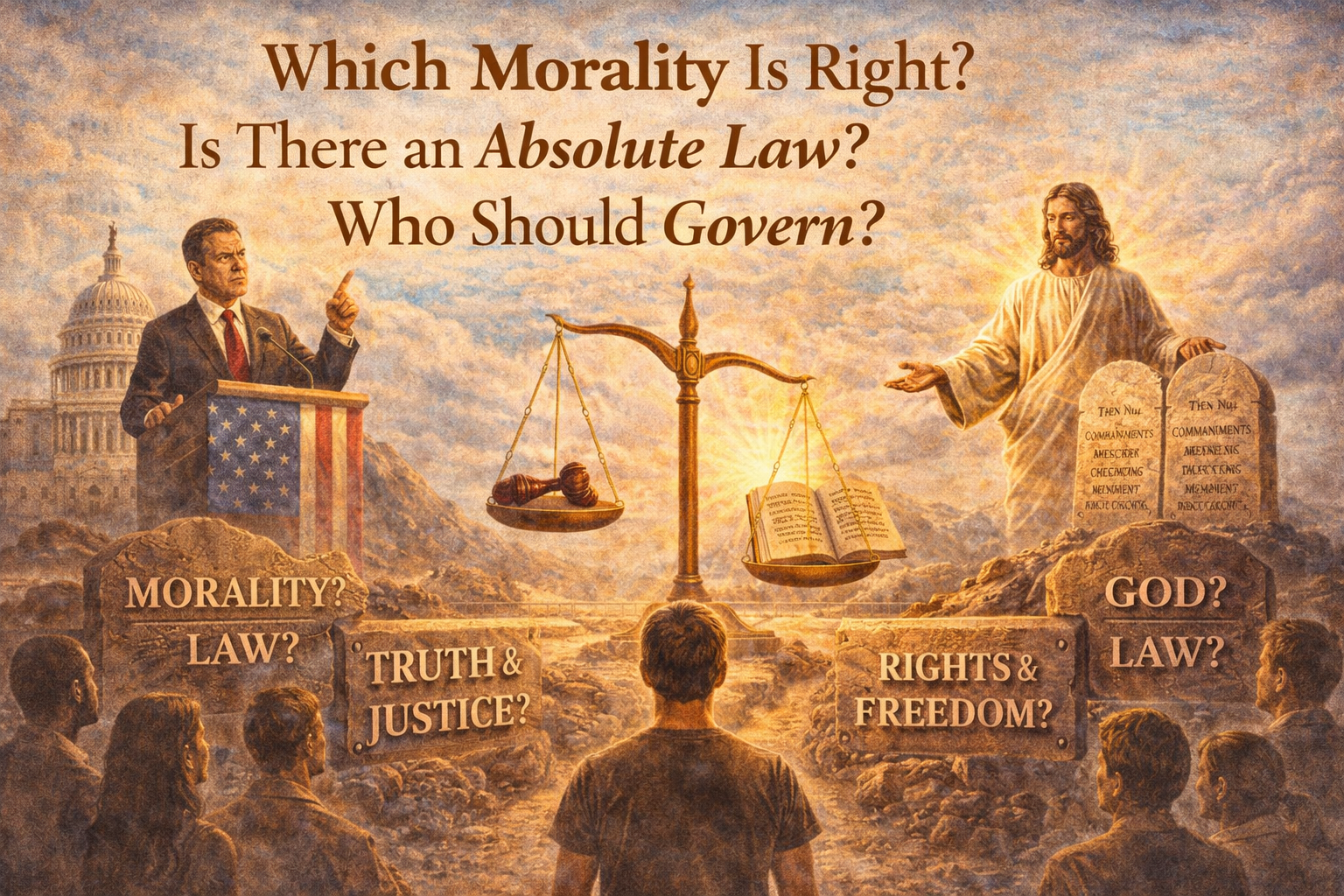
Which Morality Is Right? Is There an Absolute Law? Who Should Govern?
A Christian Response to Life’s Foundational Questions — Morality, Absolute Law, and Legitimate Governance
At the root of nearly every social debate, political argument, and personal crisis lies a handful of timeless questions: Which moral code is right? Is there such a thing as absolute truth and absolute law? Who has the right to govern, and what makes a leader legitimate?
From courtrooms to classrooms, from coffee shops to Congress, these questions stir the pot. If we don’t answer them wisely, the results are confusion, conflict, and collapse. The Christian faith doesn’t duck them. It offers clear, compelling, and time-tested answers — rooted not in emotion or trends but in the eternal character of God.
“Your Kingdom come. Your will be done, on earth as it is in heaven.” — Matthew 6:10
The Foundation
Morality Begins with God’s Character — Not Culture’s Consensus
In the Christian worldview, morality is not something we construct or vote into existence. It’s something we discover — because it flows from the character of God Himself. He is the standard, not the survey.
God is not only loving — He is just, holy, and true. Since we are made in His image (Genesis 1:27), we are designed to reflect His nature through moral living. The moral laws found in Scripture — the Ten Commandments, the Sermon on the Mount, the royal law of love — are not arbitrary rules. They are expressions of who God is.
The Alternative
When Everyone Does What Is Right in Their Own Eyes
If morality is relative — if what’s right for you isn’t necessarily right for me — then there’s no higher standard than personal preference. Might makes right. Truth becomes whatever the majority says it is today. And majorities change.
This verse describes a period of chaos in ancient Israel — when God’s law was abandoned and each person became their own moral compass. The result was moral decay, injustice, and national collapse. It’s an ancient description of what we’re watching in real time.
By contrast, the Bible calls for a revealed morality — truth that comes from outside of ourselves and doesn’t change with the weather.
Natural Law
Even Those Who Reject the Bible Know Something Is Wrong
Even people who reject Scripture often agree that murder is wrong, that justice is good, and that honesty matters. Where does that consensus come from?
Theologians call this natural law — a basic moral awareness placed in every human heart by God. Sin can distort and dull it, but it cannot erase it entirely. Even without the Bible, humans sense there is a standard beyond themselves. Christianity simply explains where that sense comes from — and gives it its full content.
The Claim
God’s Law Is Absolute, Eternal, and Just
Christianity holds that God’s law is not a fluctuating set of cultural guidelines — it is the expression of His unchanging nature. Don’t steal, don’t lie, love your neighbor, honor your parents — these are not good suggestions. They are universal truths that apply to all people in all places in all eras.
When we treat law as a human invention, we end up with legal systems that can be revised every few years to accommodate whatever the current culture prefers. God’s law provides something legal systems can’t generate on their own: stability, justice, and clarity in a morally foggy world.
C.S. Lewis on Natural Law
The Inner Witness That Points to a Lawgiver
C.S. Lewis argued in Mere Christianity that the existence of a universal moral law — observed in some form in every culture on earth — points to a divine lawgiver:
Even children instinctively know it’s wrong to cheat or steal. That inner voice — conscience — is part of God’s design. But conscience alone is not enough. It must be shaped and sharpened by Scripture, because sin can distort what we think is right. The written law corrects the dimmed inner law.
Law and Gospel Together
The Law Condemns. The Gospel Saves. Both Are Necessary.
One of Scripture’s most powerful truths: the law shows us the perfect standard — and reveals our failure to meet it. The gospel gives us the grace to pursue it, not to earn salvation, but as the fruit of God’s transforming work.
Jesus didn’t cancel the moral law. He fulfilled it, perfectly, in our place. By His Spirit, believers are then empowered to live in genuine holiness — not as a requirement for salvation, but as its natural overflow.
The Biblical View of Government
Earthly Government Is a Divine Institution — Not a Human Invention
The Bible makes this clear: human government is part of God’s design to maintain order, uphold justice, and restrain evil. It is not inherently corrupt or secular — it is a divinely authorized institution with genuine authority.
Rulers are called “God’s servants” in Romans 13:4. When functioning correctly, they reward good behavior and punish wrongdoing. That’s why Christians are called to pay taxes, obey the law, and pray for those in leadership (1 Peter 2:13–17; 1 Timothy 2:1–3). Government is not the enemy. It’s a gift that becomes dangerous when it forgets whose servant it is.
The Limits of Human Authority
When Government Demands What Only God Can Have
Earthly authorities are not ultimate. When the state demands something that contradicts God’s commands, the believer must choose: obey God or obey man. There is no question which takes priority.
Scripture praises those who chose God’s higher law:
- Daniel prayed in defiance of a royal decree — and God honored him
- The apostles preached Christ after being told to stop — and the Church grew
- The Hebrew midwives refused Pharaoh’s order to kill newborn boys — and Scripture calls them righteous
Civil disobedience in allegiance to God is not rebellion. It is the highest form of civic faithfulness — honoring the ultimate authority that all lesser authorities derive their legitimacy from.
The Ultimate King
All Human Governments Are Temporary. Christ’s Kingdom Is Not.
At the end of history, all earthly governments will give account to the one true King. Jesus Christ is not one political option among several — He is the eternal Lord to whom every knee will bow.
This doesn’t call Christians to retreat from public life — it calls them to engage it with integrity, compassion, and a Kingdom-first orientation. The goal isn’t to build a theocracy but to be ambassadors of heaven, reflecting Christ’s reign in how we live, vote, lead, and serve.
⚖️ Bonhoeffer and the Nazi Regime
Dietrich Bonhoeffer resisted Hitler’s government because Nazi law contradicted God’s law at every essential point. He was imprisoned and ultimately executed — not because he hated government, but because he loved God’s law more than man’s decree. His resistance was an act of theological obedience, not political rebellion.
✊ Martin Luther King Jr. — A Higher Law
In his Letter from Birmingham Jail, Dr. King wrote: “A just law is a man-made code that squares with the moral law or the law of God. An unjust law is a code that is out of harmony with the moral law.” His activism was not political theater — it was biblical theology applied to a specific injustice. God’s law was higher than the law of the land. That conviction cost him his life and changed a nation.
Summary — Three Questions, Three Answers
| Question | Christian Answer | Key Scripture |
|---|---|---|
| Which morality is right? | God’s morality, revealed in His character and His Word — not cultural consensus | Micah 6:8 · Matthew 22:37–40 |
| Is there an absolute law? | Yes — written in nature and conscience, fully revealed in Scripture | Romans 2:15 · Psalm 19:7 |
| Who should govern? | Earthly rulers are God’s servants with real but limited authority; Christ reigns ultimately | Romans 13:1 · Isaiah 9:6 · Acts 5:29 |
How Then Should We Live?
When it comes to morality, law, and leadership, the world is loud and confused. But the Christian has a quiet confidence — anchored not in changing times, but in the unchanging character of God.
There is a right and wrong. There is an absolute standard. And there is a sovereign King. His name is Jesus. Under His rule, we find not just truth — but freedom, peace, and eternal purpose.
“Seek first the Kingdom of God and His righteousness, and all these things will be added to you.” — Matthew 6:33
Key Scriptures: Matthew 6:10, 33; 5:13–16; 22:37–40 · Romans 13:1, 4; 2:15; 3:20; 10:4 · 1 Peter 1:16; 2:13–17 · Psalm 19:7; 145:17; 119:105 · Isaiah 9:6–7 · Acts 5:29 · Genesis 1:27 · Judges 21:25 · Micah 6:8 · 1 Timothy 2:1–3
Want to Go Deeper?
This post addresses the worldview foundations. These companion posts and resources go deeper on each question:
- The Ten Commandments in the New Covenant — God’s absolute moral law examined one commandment at a time, with 2025 application throughout
- Doctrine and Culture — five leaders on how the Church holds moral truth without losing cultural witness
- Living for Jesus in a Secular World — practical guidance on engaging every sphere of life from a Kingdom-first orientation
- Mere Christianity — C.S. Lewis; the clearest treatment of natural law and moral argument for God’s existence
- How Should We Then Live? — Francis Schaeffer; how biblical truth shaped Western civilization and what happens when it’s abandoned
- Subscribe to get new posts delivered straight to your inbox — gospel-rooted, plain-spoken truth for the week ahead.
“Your word is a lamp to my feet and a light to my path.” — Psalm 119:105