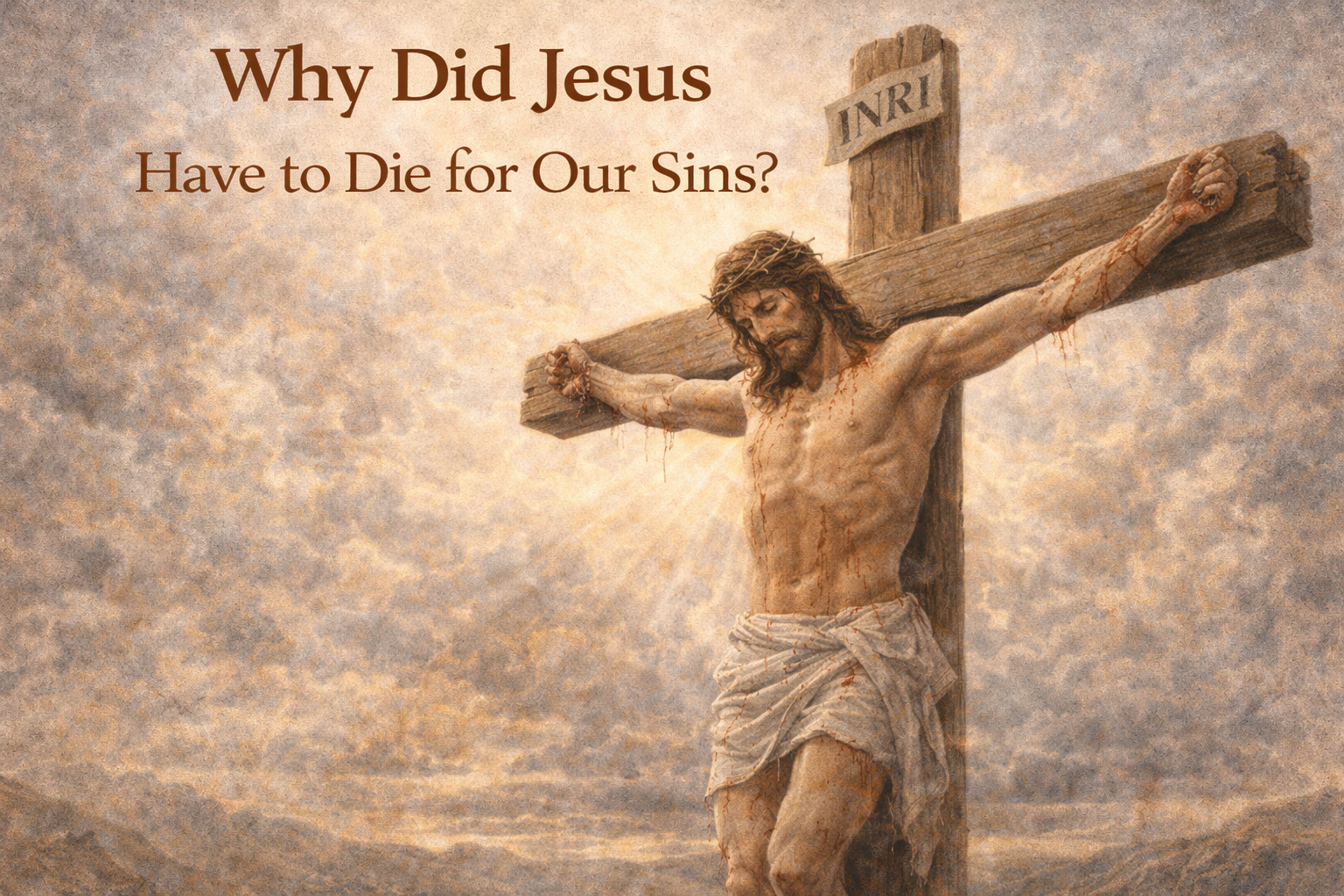
Why Did Jesus Have to Die for Our Sins?
From Genesis to Revelation — What Scripture Says, What Theologians Have Argued, and Why the Cross Is Still the Center of Everything
Why did Jesus have to die?
It’s a question that stirs hearts and stumps minds — from small-town church pews to the halls of great seminaries. And it’s not merely academic. It’s personal. If Jesus really is the Son of God, why did He have to suffer so brutally? Was it divine cruelty dressed in religious language? Or is it the deepest display of love this world has ever seen?
Let’s take a slow walk through Scripture and sit with the insights of theologians across the centuries — to understand what happened at Calvary, why it had to happen that way, and what it means for us today.
“God demonstrates his own love for us in this: While we were still sinners, Christ died for us.” — Romans 5:8
The Biblical Foundation: The Problem of Sin and the Promise of Salvation
The Bible does not leave us guessing about why death was involved. From Genesis to Revelation, a consistent pattern runs through the whole narrative: sin separates human beings from God, and restored fellowship requires the shedding of blood. The Old Testament sacrificial system was not God delighting in bloodshed — it was God demonstrating, in the starkest possible terms, both the seriousness of sin and the cost of what redemption would require.
“Without the shedding of blood there is no forgiveness of sins.” — Hebrews 9:22
Isaiah 53 painted the prophetic picture seven centuries before it happened: a Servant pierced for transgressions, crushed for iniquities, bearing the punishment that brings peace. The New Testament apostles read that passage and said: this is Jesus. Paul made it explicit — God presented Christ as “a sacrifice of atonement, through the shedding of his blood — to be received by faith” (Romans 3:25). And Jesus Himself framed His death not as something that happened to Him but as something He willingly entered: “No one takes my life from me, but I lay it down of my own accord” (John 10:18).
Historical Voices on the Cross
Over twenty centuries, the Church’s greatest theologians have asked the same questions we ask: what exactly did Jesus accomplish at the cross, and why did it have to be so costly? Their answers are not identical — but together they illuminate something that no single angle can fully capture.
4th Century
Athanasius — The Incarnate Rescuer
In On the Incarnation, Athanasius argued that humanity was sinking into corruption and death — a dissolution that could not be reversed from within. Only God Himself, entering the corruption from the inside, could reverse it. The cross wasn’t simply a payment made from a safe distance; it was a cosmic rescue mission in which God defeated death by entering it. The resurrection is the proof that the mission succeeded.
11th Century
Anselm of Canterbury — Satisfaction for Dishonored Holiness
In Cur Deus Homo (“Why the God-Man?”), Anselm argued that sin dishonors the infinite God — and the offense therefore carries infinite weight. No finite human being could offer adequate satisfaction. But a mere human HAD to make the offering, because the offense was human. The solution: a Person who is both fully God and fully man. Only Jesus could offer what was required — which is why the Incarnation was not optional but necessary.
16th Century
Martin Luther — The Great Exchange
Luther saw the cross as the great exchange: Jesus took our sin; we receive His righteousness. This is the foundation of what theologians call Penal Substitution — Jesus stood in our place, bearing the punishment that divine justice required, so that we could receive the verdict we did not deserve. For Luther, this exchange was the beating heart of the gospel. Everything else in the Christian life flows from it.
16th Century
John Calvin — Justice and Mercy Embracing
Calvin deepened Luther’s framework with the emphasis on divine sovereignty: the cross was not a backup plan improvised after the fall. It was the eternal plan of God. At Calvary, two attributes of God that seemed irreconcilable — wrath against sin and mercy toward sinners — met and were fully satisfied simultaneously. The cross did not choose between justice and love. It fulfilled both.
20th Century
Karl Barth — The Judge Judged in Our Place
Barth’s formulation guards against a common misreading of the atonement — that God the Father punished God the Son as if they were separate parties. In Barth’s framework, it is God Himself who absorbs the judgment. The cross is not divine cruelty toward an innocent third party; it is God taking the full weight of His own judgment upon Himself, in the Person of the Son, for the sake of the world He loves.
20th Century
Jürgen Moltmann — The Crucified God
Moltmann’s contribution is pastoral as much as theological: the God of the cross is not a distant deity who issues judgment from safety. He is a God who enters the depths of human suffering — abandonment, agony, death — and transforms them from the inside. The cross means that there is no human suffering so dark that God has not already been there.
Contemporary
N.T. Wright — The Victory That Launches New Creation
Wright situates the cross within the whole narrative of Scripture: Israel’s story, God’s covenant promises, and the defeat of the powers that have enslaved humanity since the fall. Jesus fulfills what Israel was always meant to accomplish — bringing God’s redemptive purposes to their appointed climax. The resurrection is not a miraculous postscript; it is the first act of the new creation that the cross made possible.
Models of the Atonement — Five Facets of One Diamond
The theologians above represent different emphases, not competing errors. Each model captures something real about what Jesus accomplished. Together they are like facets of a diamond — each one reflecting the same light from a different angle.
| Model | Core Idea | Key Thinkers |
|---|---|---|
| Penal Substitution | Jesus took our punishment in our place, satisfying divine justice | Luther, Calvin, Stott |
| Satisfaction Theory | Jesus restored the honor of God dishonored by human sin | Anselm |
| Christus Victor | Jesus defeated sin, death, and the powers of evil through the cross and resurrection | Athanasius, Aulén, Wright |
| Moral Influence | Jesus demonstrated the ultimate love that transforms those who receive it | Abelard |
| Governmental | Jesus demonstrated God’s justice while upholding the moral order of creation | Hugo Grotius |
Four Ways to Picture It
The Chain Breaker
We were chained — by guilt, by addiction, by the patterns we couldn’t escape. Jesus broke those chains at the cross. The resurrection is the proof that they are broken for good.
The Courtroom
You are guilty — the evidence is undeniable. The judge pronounces the sentence. Then he steps down from the bench, takes off the robe, and pays your fine out of his own pocket.
The Bridge
Sin created a chasm between God and humanity that no human effort could span. The cross is the bridge — the only way home across a gap we could not cross ourselves.
The Battlefield
Jesus entered the territory of death and conquered it from the inside. His resurrection is not an epilogue — it is the victory announcement. The battle is over. The King won.
Why Did He Have to Die? Three Answers
Because sin is more serious than we recognize
Not a mistake or a lapse. Sin is rebellion against a holy God — and its weight is measured not by our assessment of it but by the holiness of the One it offends. The cross tells us how serious it is.
Because only He could do it
No one else was sinless. No one else was both fully God and fully human. The price required a Person who could stand in our place without Himself owing the debt — and bear an infinite weight without being crushed by it.
Because love drove Him there
He didn’t go to the cross because He had to. He went because He wanted to rescue the people He made. “The Son of God loved me and gave himself for me” (Galatians 2:20). The cross is not primarily about wrath. It is about love that was willing to absorb wrath so that we wouldn’t have to.
Sometimes theology gets so technical that the heart of the matter gets buried underneath it. So here is the heart of it, as plainly as it can be said:
Jesus went to the cross willingly. He knew what was coming. He went anyway — for sinners who were not seeking Him, for people who were nailing Him there, for the prodigals who hadn’t started home yet.
The cross is not just a symbol. It is a story. And if you receive it, it becomes your story — the moment when someone who owed nothing took the debt you could never pay and settled it in full.
“Greater love has no one than this: that he lay down his life for his friends.” — John 15:13
Key Scriptures: Romans 5:8; 3:25 · Hebrews 9:22 · Isaiah 53:5–6 · John 10:18; 15:13; 3:16 · 1 Peter 3:18 · 1 Corinthians 15:3–4 · Galatians 2:20 · 2 Corinthians 5:21 · Colossians 2:13–15
Want to Go Deeper?
This post on the cost of forgiveness sits at the theological center of MVM’s series. These companion posts and resources explore the implications:
- What Is Christianity? — how the cross fits within the five foundational convictions of the Christian faith and why grace is defined by what the cross cost
- How Can a Loving God Send People to Hell? — the companion post on divine justice and mercy — the same tension the cross resolves
- The Call to Faith — what responding to the cross actually looks like, and what it produces in the life of the person who does
- The Resurrection — why the empty tomb is inseparable from the cross — the two together are the gospel, neither one without the other
- The Cross of Christ — John Stott; the most comprehensive and pastorally rich treatment of the atonement available at any level
- Subscribe to get new posts delivered straight to your inbox — gospel-rooted, plain-spoken truth for the week ahead.
“He himself bore our sins in his body on the cross, so that we might die to sins and live for righteousness; by his wounds you have been healed.” — 1 Peter 2:24