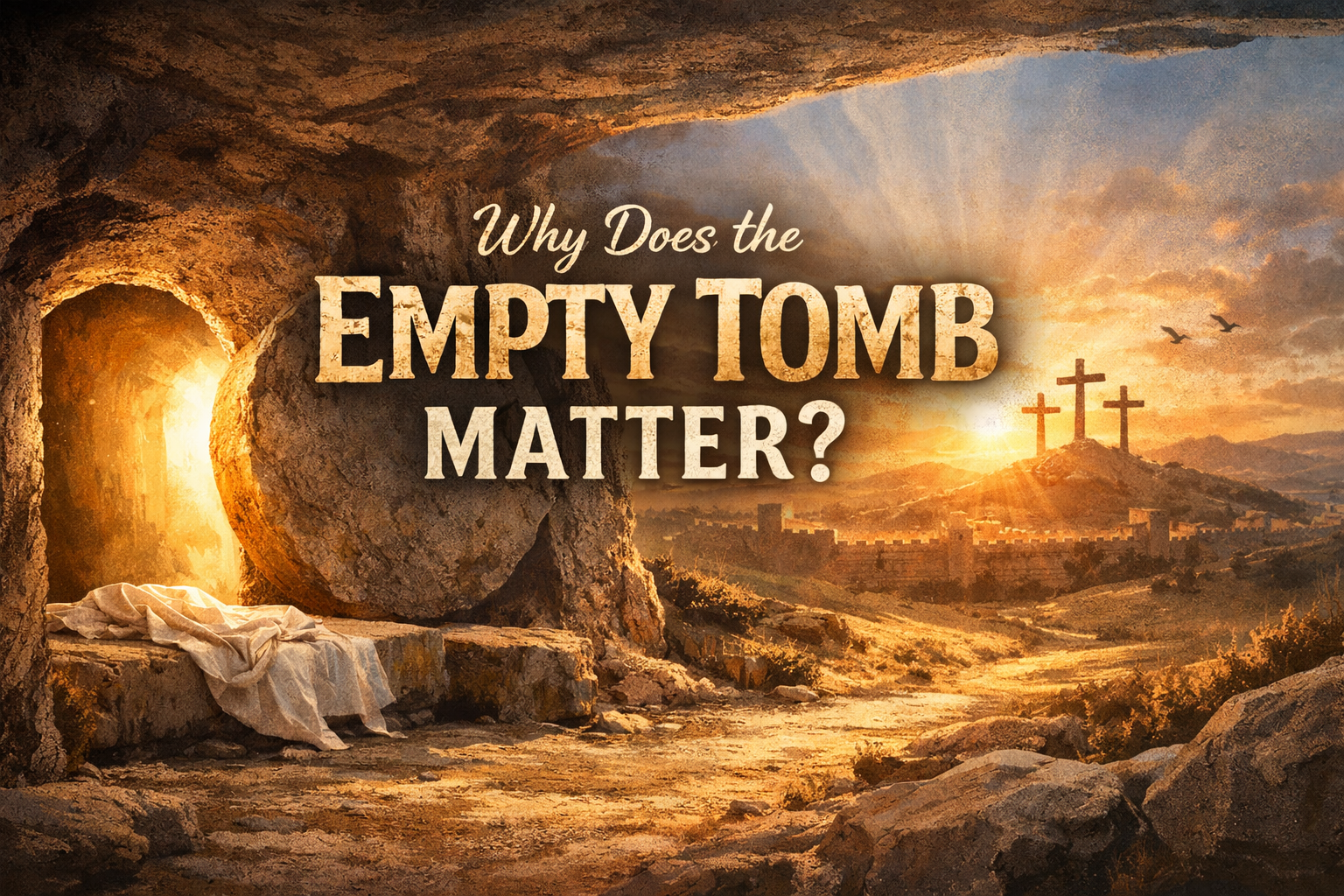
Why Does the Empty Tomb Matter?
The empty tomb is the most argued-over piece of real estate in human history. Every few years a new theory surfaces to explain it away.
Not Just a Historical Curiosity. The Hinge on Which Everything Turns.
The empty tomb is the most argued-over piece of real estate in human history. Every few years a new theory surfaces to explain it away. Every generation of skeptics takes a fresh run at it. And every time, the tomb stays empty — not because the evidence hasn’t been examined, but because it has, and it keeps pointing the same direction.
But here’s a question that gets asked less often than it should: why does it matter? Not just historically — theologically. Personally. What actually changes if a first-century tomb outside Jerusalem was empty on a Sunday morning? Why did the early Christians treat this fact as the centerpiece of everything they proclaimed? Why did Paul say that if this one thing isn’t true, the entire faith collapses?
The empty tomb matters for reasons that reach into every corner of Christian belief — and into every corner of ordinary life. Here are eight of them.
Paul’s Stakes
“If Christ has not been raised, your faith is futile and you are still in your sins… If in this life only we have hoped in Christ, we are of all people most to be pitied.” — 1 Corinthians 15:17, 19
Eight Reasons the Empty Tomb Changes Everything
Reason One
It Confirms That Jesus Is Who He Claimed to Be
During His ministry, Jesus made claims that no sane person makes. He claimed authority to forgive sins — something only God can do (Mark 2:5–7). He claimed to be the resurrection and the life (John 11:25). He predicted His own death and resurrection three times (Matthew 16:21, 17:22–23, 20:18–19). He accepted worship.
If the tomb stayed full, every one of those claims is exposed as the delusion or deception of a dead man. But if the tomb is empty — if He actually rose — then the resurrection is God’s thunderous “yes” to every claim Jesus ever made. Paul calls the resurrection the event by which Jesus “was declared to be the Son of God in power” (Romans 1:4). The empty tomb is not just evidence of a miracle. It is the divine endorsement of an identity.
Reason Two
It Means the Atonement Actually Worked
The cross was not just a tragedy or a moral example. Jesus died as the substitute for sinners — bearing the penalty of sin so that the guilty could go free. But how do we know it worked? How do we know the debt was actually paid and not just rolled forward?
The resurrection is the receipt. Paul makes the logic precise: Jesus “was delivered up for our trespasses and raised for our justification” (Romans 4:25). If the cross accomplished what it was meant to accomplish — if the penalty was truly paid, if God accepted the sacrifice — then death had no right to hold Jesus. The empty tomb is the Father’s declaration: accepted. Sufficient. Complete.
A crucified Savior who stayed dead would be a Savior whose work was unconfirmed. The empty tomb confirms it.
Reason Three
It Means Death Has Been Defeated — Not Just Postponed
Every other religious founder, every prophet, every teacher — they died and stayed dead. Their followers visited their tombs. Their legacies survived them, but they themselves did not. Jesus is categorically different not because He taught better things, but because He conquered the one enemy that defeats every other human being who has ever lived.
Paul’s language is triumphant and precise: “Death is swallowed up in victory. O death, where is your victory? O death, where is your sting?” (1 Corinthians 15:54–55). This is not metaphor. It is a declaration about something that happened in history — a body walked out of a tomb, and in doing so, broke the grip that death has held over humanity since the garden.
The empty tomb means the last enemy has been defeated. Not managed. Not negotiated with. Defeated.
Reason Four
It Gives Us a Living Savior, Not a Dead Hero
Christianity is not the preservation of Jesus’ memory or the continuation of His teachings. It is a relationship with a living person. “He is not here, for he has risen” (Matthew 28:6) — that present-tense reality changes the entire structure of what Christian faith is.
Paul does not write about a Jesus who was Lord. He writes about a Jesus who is Lord — seated at the right hand of the Father, interceding for His people (Romans 8:34), present with His church (Matthew 28:20). The risen Christ of the New Testament is not a figure from the past to be admired and imitated. He is a living person to be known, followed, and encountered.
An empty tomb means the One you pray to is actually there to receive the prayer.
Reason Five
It Validates Every Promise Jesus Made
Jesus made extraordinary promises. He promised to prepare a place for His people (John 14:2–3). He promised that whoever believes in Him would have eternal life (John 3:16). He promised that He would return (John 14:3). He promised that nothing could snatch His sheep from His hand (John 10:28–29).
Every one of those promises depends on Him being alive to keep them. A dead Jesus cannot prepare a place, cannot give eternal life, cannot return, cannot hold anyone in His hand. The resurrection validates the promissory notes. Every promise Jesus made is backed by the most extraordinary collateral in history — the fact that He conquered death itself.
Reason Six
It Is the Pattern and Guarantee of Our Own Resurrection
The empty tomb is not just Jesus’ story. Paul calls Jesus “the firstfruits of those who have fallen asleep” (1 Corinthians 15:20). In Jewish harvest theology, the firstfruits were the first portion of the same crop — the guarantee that the rest of the harvest would follow. Jesus’ bodily resurrection is not a one-off miracle. It is the down payment on the resurrection of everyone who belongs to Him.
This means that every believer who has died — every father, mother, child, friend who rested in Christ — will rise. Not just their soul floating to heaven, but their bodies raised and glorified, as His was. The Christian hope is not escape from the physical world. It is the redemption of it. And the empty tomb is the guarantee.
Reason Seven
It Establishes That This World Matters to God
The resurrection is a statement about creation. If God’s response to death was to raise a physical body — not to spirit Jesus away to a disembodied existence in heaven, but to raise Him bodily — then God has declared that matter matters. The physical world is not a prison the soul escapes. It is a creation God intends to redeem.
This has enormous practical implications. It means that the care of bodies — the sick, the poor, the vulnerable — is a resurrection-shaped activity. It means that the groaning of creation (Romans 8:22) will be answered with renewal, not deletion. The empty tomb announces a future in which heaven and earth are joined, all things are made new, and God dwells with His people in a redeemed, physical creation (Revelation 21:1–5).
Reason Eight
It Changes How You Face Your Own Death
Every person reading this will die. That is the one appointment no one misses, the one statistic that holds at exactly one hundred percent. And every human culture that has ever existed has had to reckon with it — what happens when I die? Is there anything on the other side? Does anything I do in this life matter beyond the grave?
The empty tomb answers that question not with philosophy or wishful thinking but with a historical event. A man died, was buried, and three days later walked out of his tomb and was seen by hundreds of people. That event doesn’t make death easy. But it makes death survivable — and it makes what comes after death not a fearful unknown but a confident hope.
Paul could write from a prison cell, facing execution: “For to me, to live is Christ and to die is gain” (Philippians 1:21). That is not bravado. That is a man who has staked his life on an empty tomb — and found it to be solid ground.
Paul’s Logic: If This Isn’t True, Nothing Is
Paul understood better than anyone what was at stake. In 1 Corinthians 15 he lays out the consequences with the cold clarity of a lawyer presenting a case. If the resurrection didn’t happen:
1 Corinthians 15:14–19 — The If/Then Chain
Paul is not hedging. He is not softening the stakes with comfortable language. He is saying: this is either completely true or completely worthless. There is no version of Christianity that survives a full tomb. If the body is still in the ground, go home. Go back to your life. It’s over.
And then he says: but in fact, He is risen.
A Picture from the Oregon Hills
In the Cascades, a late winter can look like the end of everything. The ground is frozen, the trees are bare, nothing moves. A man who had never seen a spring might walk through that forest in February and conclude that the world was done — dead and staying dead.
But the gardener knows something the stranger doesn’t. Under the frozen ground, the roots are alive. The bulbs are waiting. The sap has already begun to move in the maple trees, weeks before anyone can see it from the outside. The winter doesn’t get the last word — it never has.
The empty tomb is that knowledge. The world in February looks like a world where death wins. The empty tomb says: look again. Something is moving under the ground that February cannot stop.
The empty tomb matters because it is not merely a fact about the past. It is a promise about the future — your future, the future of everyone you love, the future of the creation that is groaning under the weight of its brokenness waiting to be set free.
It matters because the One who walked out of that tomb is alive right now — not as a memory, not as an influence, but as a living person who intercedes, who keeps, who holds, and who will return.
It matters because death — the thing you cannot outrun, cannot negotiate with, cannot fix — has already been defeated by someone who did it for you.
The tomb is empty. He is risen. And that is the only news that actually changes everything.
🙏 Closing Prayer
Lord Jesus, we confess that we need the resurrection to be true — not just intellectually but in the marrow of our bones. Help us live like people who actually believe the tomb is empty. Give us the courage that comes from knowing death has been defeated, the hope that comes from knowing our future is secure, and the joy that comes from knowing You are alive and present and coming again. Amen.
Key Scriptures: 1 Corinthians 15:12–22 · Romans 1:4 · Romans 4:25 · Romans 6:9 · Matthew 28:6 · Philippians 1:21 · Revelation 1:18
On the resurrection confirming Jesus’ identity — Romans 1:4 · Acts 2:36 · John 11:25–27 · Matthew 16:21
On the resurrection and atonement — Romans 4:25 · Romans 3:25–26 · Hebrews 9:26 · 1 Peter 1:3
On the resurrection and our future hope — 1 Corinthians 15:20–23 · 1 Thessalonians 4:13–18 · Philippians 3:20–21 · Revelation 21:1–5
On the resurrection and present life — Romans 6:4–5 · Colossians 3:1–4 · Philippians 1:21 · 2 Corinthians 4:14
The Full Easter Series
This post is the theological anchor of our Easter apologetics and theology series. Read the full set:
- Why the World Keeps Trying to Explain Away the Empty Tomb — the historical case and why alternative theories fail
- What the Early Enemies of Christianity Admitted About the Resurrection — hostile witnesses from Tacitus to Julian
- Didn’t the Disciples Just Make It Up? — answering the fabrication and conspiracy objections
- Easter vs. the Pagan Holiday Claims — what the evidence actually shows
- What Did Jesus’ Resurrection Body Look Like? — continuity, transformation, and what it means for us
Subscribe to Mountain Veteran Ministries for gospel-rooted, plainspoken content built for the questions real people are actually asking.
“If Christ has not been raised, your faith is futile… But in fact Christ has been raised from the dead, the firstfruits of those who have fallen asleep.” — 1 Corinthians 15:17, 20