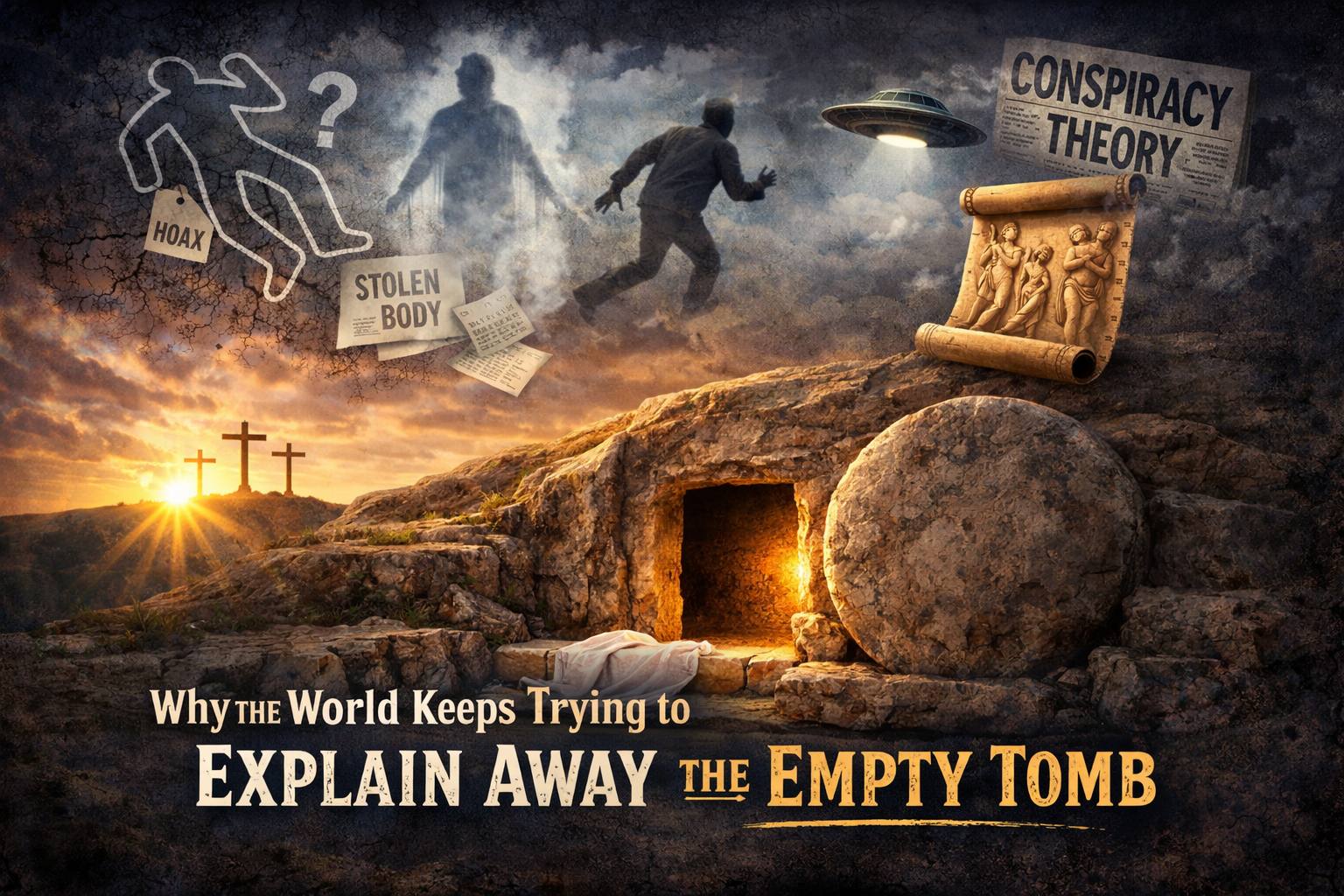
Why the World Keeps Trying to Explain Away the Empty Tomb
Every few years a new documentary drops, a new theory makes the rounds, and someone announces they’ve finally explained away the empty tomb. The disciples stole the body. Jesus survived the crucifixion. The resurrection was a legend that grew over centuries. None of these theories are new — most are as old as the resurrection itself. What’s worth asking is why the world keeps trying. Two thousand years of sustained effort to explain away one empty tomb, and the explanations keep falling apart. The tomb was empty. Everyone in first-century Jerusalem agreed on that. The only debate has ever been: why? The answer you give to that question changes everything about how you live.
The Resurrection Has Been Declared Dead Many Times. It Keeps Getting Back Up.
Every few years, a new documentary drops. A new theory makes the rounds. A journalist or scholar announces that they’ve finally cracked the case — the disciples stole the body, Jesus survived the crucifixion, the whole resurrection story was a legend that evolved over centuries. The tomb wasn’t empty. Or if it was, there’s a perfectly reasonable explanation that doesn’t require a miracle.
None of these theories are new. Most of them are as old as the resurrection itself.
What’s worth asking is why the world keeps trying. Two thousand years of sustained effort to explain away one empty tomb — and the explanations keep falling apart. That pattern deserves some attention.
The Central Question
The tomb was empty. Everyone in first-century Jerusalem agreed on that. The only debate has ever been: why? The answer you give to that question changes everything about how you live.
The Fact Nobody Disputed
Start with what the earliest sources — friend and enemy alike — actually agree on. The tomb of Jesus was empty on the third day after His crucifixion. This is not a Christian invention. The first counter-explanation comes from Matthew 28:11–15, where the Jewish religious leaders pay the Roman guards to spread the story that the disciples stole the body while they slept.
Notice what that story concedes: the tomb was empty. Nobody in Jerusalem — nobody with anything to lose — stood up and said “the body is still there.” They couldn’t. If the body had been in the tomb, the resurrection claim would have died in its cradle. The authorities had every reason and every resource to produce the body. They never did.
“He is not here, for he has risen, as he said. Come, see the place where he lay.” — Matthew 28:6
The empty tomb is not the conclusion of the Christian argument. It’s the starting point that everyone shares. The question has always been what it means.
The Theories — and Why They Don’t Hold
Over two millennia, skeptics have offered a handful of alternative explanations. Each one has been examined carefully by historians, philosophers, and scholars who had no interest in defending Christianity. Here’s what the evidence actually shows:
Theory 1
The Disciples Stole the Body
“The disciples took the body and then fabricated the resurrection story.”
This is the oldest theory — Matthew records it being circulated within days of the resurrection. It fails on multiple grounds. The tomb was sealed and guarded by Roman soldiers (Matthew 27:62–66). More critically, it requires that eleven frightened, scattered men coordinated a conspiracy — and then every single one of them willingly died rather than recant a lie they knew was a lie.
People die for things they believe are true. People do not die for things they know are fabrications. The disciples went to their deaths — by crucifixion, beheading, stoning — proclaiming what they claimed to have seen with their own eyes. Liars make poor martyrs.
Theory 2
Jesus Didn’t Actually Die — The Swoon Theory
“Jesus survived the crucifixion, revived in the tomb, and escaped.”
This theory requires us to believe that a man who had been flogged nearly to death, crucified for six hours, stabbed through the side with a spear (John 19:34), wrapped in burial linens and sealed in a tomb — somehow regained enough strength to roll away a multi-ton stone from the inside, overpower a Roman guard detail, and then convince his followers they’d seen a gloriously risen conqueror rather than a barely-alive man who desperately needed medical attention.
Roman soldiers were professional executioners. They did not make mistakes about death. The spear thrust — which produced blood and water, consistent with a punctured pericardium — was the final confirmation. Pilate himself was surprised Jesus had died so quickly and confirmed it before releasing the body (Mark 15:44–45).
Theory 3
The Disciples Went to the Wrong Tomb
“In their grief and confusion, the women simply went to the wrong tomb.”
Mary Magdalene and the other women watched the burial (Matthew 27:61, Mark 15:47). They knew exactly where the tomb was — they had been there days before. The wrong-tomb theory also fails to explain why the authorities, who knew where the correct tomb was, never corrected the record. All they had to do was walk to the right tomb and point to the body. They didn’t — because they couldn’t.
Theory 4
The Resurrection Was a Legend That Grew Over Time
“The resurrection story developed gradually, decades after Jesus died, like a myth.”
This theory collides directly with the timeline of the documents. The earliest account of the resurrection is not in the Gospels — it’s in 1 Corinthians 15:3–8, written by Paul approximately 20 years after the crucifixion. But the creedal formula Paul quotes there (“I received… what I also passed on to you”) was already established tradition when Paul received it — likely within two to five years of the crucifixion, dating to his visit with Peter and James in Jerusalem (Galatians 1:18–19).
Legends require generations to develop. The resurrection was being proclaimed — with named eyewitnesses still alive and checkable — within years of the event, in the very city where it happened, to audiences who could have walked to the tomb and interviewed the guards. That is not the soil in which legends grow.
Theory 5
The Appearances Were Hallucinations
“The disciples experienced grief-induced hallucinations and mistook them for real appearances.”
Hallucinations are individual, private experiences. They don’t happen to groups of people simultaneously seeing the same thing. Paul records that Jesus appeared to more than five hundred people at one time — and specifically notes that most of them were still alive when he was writing, inviting anyone who doubted to go check (1 Corinthians 15:6). You don’t invite skeptical cross-examination when you’re making things up.
The resurrection appearances also happened over forty days in multiple locations, to multiple groups, including people who were not expecting or hoping for a resurrection — including James, Jesus’ own brother, who had been a skeptic during the ministry (John 7:5), and Paul, who was actively hunting and killing Christians.
Four Pillars That Keep Standing
Historians and apologists Gary Habermas and Michael Licona have spent careers documenting what they call the “minimal facts” of the resurrection — historical data so well-attested that the vast majority of critical scholars, including skeptics, accept them. The facts demand an explanation. Only one explanation accounts for all of them.
Jesus Died by Crucifixion
Confirmed by Roman and Jewish sources outside the New Testament — Tacitus, Josephus. Not seriously disputed by any credible historian.
The Tomb Was Empty
Enemies and friends alike concede this. The dispute has only ever been about the explanation, never the fact itself.
Post-Resurrection Appearances
Multiple individuals and groups, in different places, over forty days. Includes skeptics — James and Paul — whose conversions require an explanation.
The Disciples’ Transformation
Frightened, scattered men became bold proclaimers willing to die. Something happened that changed them. They never wavered in their testimony about what that something was.
Why the World Keeps Trying
Here’s the thing that’s worth sitting with. Two thousand years of the best minds that skepticism has produced — and the resurrection still hasn’t been explained away. The theories come and go. Each generation produces a new one with a new veneer of scholarly confidence, and each one eventually collapses under examination.
Why does the effort continue? Because the alternative is explosive.
If Jesus rose from the dead, then He is exactly who He claimed to be. His claims about God, about sin, about judgment, about Himself — all of it stands. The resurrection isn’t just a miracle to be debated in seminaries. It’s a personal confrontation. A risen Jesus makes demands on the way you live, the way you die, and what you believe about what comes after.
That is not a comfortable position to be in if you’ve decided you don’t want it to be true. So the explaining away continues. New theories, same collapse.
1 Corinthians 15:17–19
“And if Christ has not been raised, your faith is futile and you are still in your sins… If in Christ we have hope in this life only, we are of all people most to be pitied.”
Paul understood exactly what was at stake. He didn’t soften it. Either the resurrection happened and changes everything, or Christianity is a fraud and Christians are fools. There is no comfortable middle ground.
What This Means for the Believer
You don’t have to be intimidated by the next documentary or the next skeptical professor. The case for the resurrection is not a house of cards waiting to be toppled by a clever argument. It has been examined by hostile, brilliant, motivated critics for twenty centuries. It keeps standing.
Know your ground. Read the evidence. The resurrection of Jesus Christ is the most attested event in the ancient world — not in spite of the scrutiny it has received, but because of it. Every alternative theory has been weighed, cross-examined, and found wanting. What remains is what the angel announced to the women at the empty tomb: He is not here. He has risen.
The world keeps trying to explain away the empty tomb because the empty tomb keeps confronting the world with a choice it would rather not make.
For those who have made that choice — who have staked their lives on the risen Christ — the evidence is not a threat. It is a gift. The same historical investigation that defeats every alternative theory points, again and again, to the same conclusion the disciples arrived at on that first Sunday morning.
He is risen. The tomb is empty. And that changes everything.
🙏 Closing Prayer
Lord Jesus, thank You that the evidence for Your resurrection is not hidden or fragile — it is open and strong, examined by Your enemies and vindicated by history. Give us the courage to know what we believe and why we believe it, and the boldness to proclaim it plainly to a world that still needs to hear: You are alive. Amen.
Key Scriptures: Matthew 28:1–15 · Mark 16:1–8 · Luke 24:1–12 · John 19:34; 20:1–18 · 1 Corinthians 15:1–20 · Acts 2:22–36 · Acts 4:33 · Romans 1:4 · Philippians 3:10–11
On the evidence for the resurrection — 1 Corinthians 15:3–8 · Galatians 1:18–19 · Luke 1:1–4 · Acts 1:3
On the tomb and burial — Matthew 27:57–66 · Mark 15:42–47 · John 19:38–42
On the post-resurrection appearances — Matthew 28:16–20 · Luke 24:13–53 · John 20:19–29; 21:1–14 · Acts 9:1–9
On the significance of the resurrection — Romans 4:25 · Romans 6:4–5 · 1 Peter 1:3 · Revelation 1:17–18
Want to Go Deeper?
If you want to be equipped to answer the skeptics in your life — or if you’re working through these questions yourself — these are worth your time:
- The Case for the Resurrection of Jesus — Gary Habermas & Michael Licona. The most thorough historical case available, written for a general audience.
- The Resurrection of the Son of God — N.T. Wright. Massive, rigorous, and compelling from one of the world’s leading New Testament scholars.
- Mere Christianity — C.S. Lewis. Not specifically about the resurrection, but the best single-volume case for why the Christian claims demand a response.
Subscribe to get new posts from Mountain Veteran Ministries — gospel-rooted, plainspoken, and built for the questions real people are actually asking.
“If Christ has not been raised, your faith is futile… But in fact Christ has been raised from the dead.” — 1 Corinthians 15:17, 20