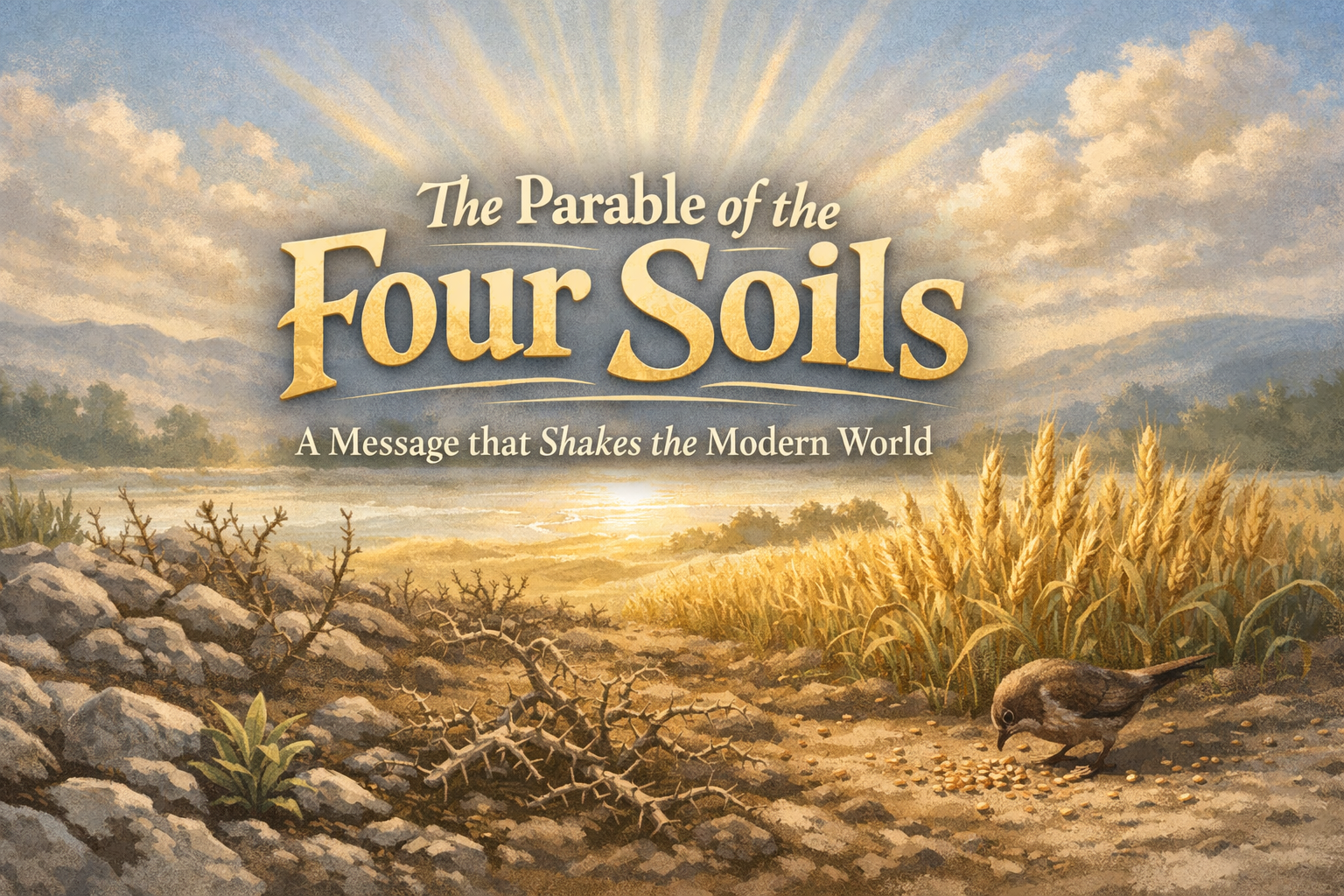
The Parable of the Four Soils: A Message that Shakes the Modern World
Matthew 13:1–23 — A Mirror Held Up to Every Human Heart
In a world drowning in information but starving for truth, one of Jesus’ simplest stories still cuts straight to the heart of human existence. The Parable of the Four Soils — sometimes called the Parable of the Sower — is not a quaint agricultural tale from ancient Israel. It’s a mirror held up to every human heart, regardless of culture, religion, or era.
The seed hasn’t changed. The Word of God is still being sown. The only question is what kind of soil it’s landing on.
“A farmer went out to sow his seed. As he was scattering the seed, some fell along the path, and the birds came and ate it up… But other seed fell on good soil, where it produced a crop — a hundred, sixty or thirty times what was sown.” — Matthew 13:3–4, 8
The Four Soils at a Glance
Jesus later explains that the seed is the Word of God, and the four soils represent the varied responses of human hearts.
The Hard Path
Seed eaten before it even has a chance. The message is heard but never enters.
Rocky Ground
Quick to sprout, quick to wither. No depth means no endurance under pressure.
Thorny Ground
Growth starts but gets choked. The worries and pleasures of life crowd out the Word.
Good Soil
Receives the Word, understands it, bears fruit — thirty, sixty, a hundredfold.
Four Soils, Four Hearts — Then and Now
Soil One
🪨 The Hard Path — The Closed Mindset
The seed that falls on the path never penetrates the surface. In Jesus’ explanation, this is the heart that hears the message of the Kingdom but doesn’t understand it — and what was sown is quickly snatched away (Matthew 13:19). The ground is packed down by traffic and too hardened to receive anything.
Soil Two
🌱 Rocky Ground — The Shallow Heart
This person receives the Word with joy — immediately, enthusiastically. But there’s no depth. When trouble or persecution comes because of the Word, they fall away at once (Matthew 13:20–21). The roots never had room to go down far enough to hold.
Soil Three
🌿 Thorny Ground — The Distracted Life
This is perhaps the most relatable soil in our time. The Word is received — genuine growth begins — but the worries of this age and the deceitfulness of wealth choke it out and it becomes unfruitful (Matthew 13:22). The thorns aren’t evil in themselves; they’re just life, grown ungoverned.
Soil Four
🌾 Good Soil — The Open, Receptive Heart
This is the person who hears the Word and understands it — who cultivates a heart that is humble, teachable, and willing to endure through seasons of growth. The result is fruit: some a hundredfold, some sixty, some thirty (Matthew 13:23). The yield isn’t identical, but the direction is clear.
What the Parable Says About Our World
🔍 Truth Is Not the Problem
The failure isn’t a shortage of seed — it’s a shortage of prepared hearts. The Gospel is being sown. The question is what it’s landing on.
📉 Depth Over Hype
Our culture chases emotional highs and instant results. But shallow enthusiasm fades. True life change requires deep roots and patient growth.
🌿 The Cost of Distraction
Thorns are not inherently evil things — they are the ordinary cares of life grown unmanaged. Busyness and materialism suffocate spiritual life silently.
🌾 Fruit Is the Proof
In a skeptical world, people are tired of hollow words. The undeniable witness is a transformed life — compassion, integrity, joy that can’t be explained away.
The Ripple Effect of Good Soil Lives
When the seed of truth lands in good soil, the impact doesn’t stop with one person. History is filled with men and women whose “good soil” lives changed the world — not through flashy charisma but through hearts that received truth and nurtured it to maturity over time.
William Wilberforce
Decades of persistent obedience eventually abolished the British slave trade.
Mother Teresa
A lifetime of small, faithful acts among the poorest became a witness heard around the world.
C.S. Lewis
A receptive mind and a disciplined pen produced fruit that is still being harvested generations later.
How to Cultivate Good Soil
- 1Practice reflection over reaction. In a reactionary culture, carve out time to be still. Turn off the noise. Let truth sink past the surface before you move on.
- 2Embrace discipline over emotion. Don’t let your spiritual life be dictated by how you feel today. Consistent, small acts of obedience bear long-term fruit when emotions have come and gone.
- 3Weed out the thorns regularly. Examine your life for the overgrowth — worry, misplaced ambitions, chronic distraction. Prune them before they choke what’s growing.
- 4Stay rooted in community. Good soil thrives best in a cultivated field. Surround yourself with people who challenge, encourage, and call you to account in love.
- 5Expect a harvest in due time. Growth takes seasons, not moments. Be patient and persistent. The farmer doesn’t dig up the seed to check on it every week.
The Parable of the Four Soils is not a Sunday School lesson about farming. It’s a profound, honest question directed at every heart in every generation: What kind of soil am I?
The seed is still being sown. The question isn’t whether it will reach you — it’s whether you’ve prepared the ground to receive it.
“But the seed falling on good soil refers to someone who hears the word and understands it. This is the one who produces a crop, yielding a hundred, sixty or thirty times what was sown.” — Matthew 13:23
Key Scriptures: Matthew 13:1–23 · Mark 4:1–20 · Luke 8:4–15 · John 15:1–8 · Psalm 1:1–3 · James 1:21–22 · Hebrews 4:12 · Romans 10:17
Want to Go Deeper?
This post is part of an ongoing series on the parables of Jesus. If it stirred something in you — or made you examine your own soil — here are a few next steps:
- Share it with someone going through a dry season, or with a small group looking for a discussion starter.
- Read Matthew 13 in one sitting — Jesus tells seven parables in this chapter, each one a different angle on the Kingdom. The Four Soils is just the first.
- Subscribe to get new posts delivered straight to your inbox — gospel-rooted, plain-spoken truth for the week ahead.
“Blessed is the one who does not walk in step with the wicked… but whose delight is in the law of the Lord… That person is like a tree planted by streams of water.” — Psalm 1:1–3
Mountain Veteran Ministries
Find Your Next Bearing
Every journey needs a direction. If you're wondering where to go from here, choose the path that best fits where you are today.
⚒️ I Want to Live Faithfully
Discover practical wisdom for following Christ in today's world.
→ Living as a Christian Today✝️ I Want to Understand the Gospel
Learn what salvation means and why Jesus came.
→ Understanding Salvation📖 I Want to Understand the Bible
Explore why Christians trust Scripture and how to read it well.
→ Understanding the Bible❓ I Still Have Questions
Explore thoughtful answers to some of Christianity's hardest questions.
→ Hard Questions