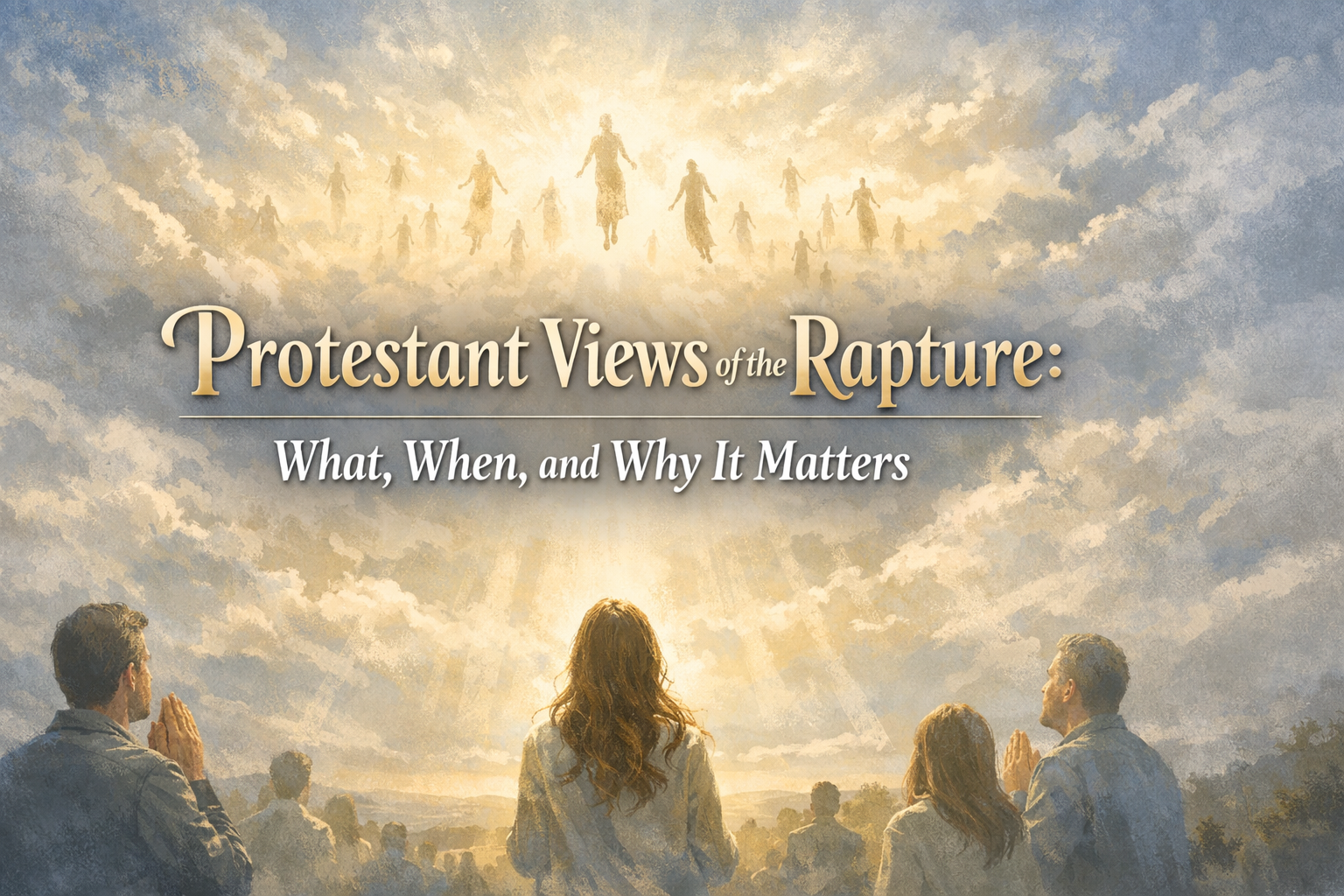
Protestant Views of the Rapture: What, When, and Why It Matters
Pre-Trib, Mid-Trib, Post-Trib, Pre-Wrath, and No Rapture — What the Bible Says and What Faithful Christians Have Believed
For centuries, believers have wrestled with one haunting and hopeful question: what will happen when Jesus returns? The idea that Christ will “rapture” His people — snatch them up to meet Him in the clouds — has stirred sermons, novels, debates, and doctrine across the entire evangelical world.
The word “rapture” doesn’t appear in English Bibles, but comes from the Latin rapturo, used in the Vulgate translation of 1 Thessalonians 4:17 to render the Greek harpazō — “caught up.” The question that divides Christians is not whether that event will happen, but when — and what it will look like.
“Then we who are alive, who are left, will be caught up together with them in the clouds to meet the Lord in the air, and so we will always be with the Lord.” — 1 Thessalonians 4:17 (ESV)
First — What Is the Tribulation?
A Quick Definition
Most rapture models are tied to a seven-year period of tribulation prophesied in Daniel 9:24–27 and elaborated in Revelation 6–19. The first half is often called “the tribulation”; the intense second half is “the Great Tribulation.”
Whether you take the seven years literally or more symbolically, how you interpret the tribulation largely determines where you place the rapture. The five views below differ primarily on that timing question — and on whether the “rapture” is a distinct event at all.
The Five Views
View One
1️⃣ Pre-Tribulation Rapture
“Jesus comes for His Church before the tribulation begins.”
The most widely held view in American evangelical Christianity, the pre-trib position teaches that Jesus raptures the Church before the seven-year tribulation begins. Believers are taken to heaven, the tribulation unfolds on earth, and Christ returns visibly with His saints seven years later. The rapture and the Second Coming are two distinct events, separated by seven years.
Theological roots: Strongly rooted in Dispensational Premillennialism. Popularized by John Nelson Darby in the 1830s and spread through the Scofield Reference Bible. Maintains a sharp distinction between God’s prophetic program for Israel and for the Church.
Key supporters: John MacArthur · Charles Ryrie · Tim LaHaye · Dallas Theological Seminary
View Two
2️⃣ Mid-Tribulation Rapture
“Believers endure the first half, then Christ comes at the midpoint.”
The mid-trib position holds that believers go through the first 3.5 years of tribulation and are raptured just before the Great Tribulation — when God’s wrath is poured out in full. The rapture is connected to the seventh trumpet of Revelation 11. The first half involves persecution, but not divine wrath; the second half is the wrath believers are spared.
Key supporters: Various Pentecostal and charismatic groups · Independent Bible teachers
View Three
3️⃣ Post-Tribulation Rapture
“The rapture happens at the Second Coming — after the full tribulation.”
Post-tribulationism holds that the Church will go through the entire tribulation period, staying faithful under persecution and sustained by God’s protection and grace. The rapture and the visible return of Christ are not two events separated by years — they are one single, climactic event. Believers are “caught up” to meet Christ as He descends, and the procession continues down to earth.
Theological roots: Tied to Historic Premillennialism. Held by most of the early Church Fathers and a large portion of Reformed and Baptist believers today.
Key supporters: George Eldon Ladd · Many Reformed Baptists · Irenaeus, Justin Martyr, and other early Church Fathers
View Four
4️⃣ Pre-Wrath Rapture
“The faithful are raptured before God’s wrath — but after tribulation begins.”
The pre-wrath view, developed in the 20th century, distinguishes between the tribulation (man’s wrath and Satanic persecution) and the “Day of the Lord” (God’s direct wrath). Believers endure the former but are raptured before the latter — sometime in the second half of the seven years but before the bowl judgments of Revelation 16. Readiness and faithfulness are central themes.
Key supporters: Marvin Rosenthal · Robert Van Kampen
View Five
5️⃣ Amillennial and Postmillennial Views
“No separate rapture event — Christ returns once, raises the dead, and judges all.”
Many Reformed, Lutheran, and mainline Protestants reject the idea of a distinct rapture event entirely. They see 1 Thessalonians 4:17 not as a secret removal, but as the Church rising to meet and escort the returning King — like citizens riding out to welcome a triumphant emperor back into the city. There is one return, one resurrection, one judgment. Revelation 20 is interpreted symbolically; the “thousand years” is the current Church age.
Theological roots: Rooted in Augustine’s amillennialism; the dominant view in confessional Reformed, Lutheran, and many Anglican traditions.
Key supporters: St. Augustine · R.C. Sproul · Most confessional Reformed churches · N.T. Wright
All Five Views — Side by Side
| View | Rapture Timing | Through Tribulation? | Relation to Second Coming | Key Supporters |
|---|---|---|---|---|
| Pre-Trib | Before tribulation | No | 7 years before visible return | MacArthur, Ryrie, LaHaye |
| Mid-Trib | At midpoint (3.5 yrs) | First half only | 3.5 years before visible return | Pentecostal and independent teachers |
| Post-Trib | After tribulation | Yes — all of it | Same event as Second Coming | Ladd, early Church Fathers |
| Pre-Wrath | Late in tribulation | Partial (before bowl wrath) | Shortly before visible return | Rosenthal, Van Kampen |
| Amillennial | No separate rapture | Spiritually endured | Single final return | Augustine, Sproul, Wright |
What Do We Do with This?
These views are not salvation issues. They’ve been held by faithful, serious, Bible-believing Christians across the centuries. The New Testament’s focus is not on timing charts but on faithfulness.
Be Ready
Jesus said, “Be on the alert” (Matthew 24:42). That doesn’t mean knowing the dates or the sequence — it means walking closely with Him every day. All five views agree on this.
Be Watchful
Whether we’re rescued from wrath or carried through it, our hope isn’t primarily in the escape plan. It’s in Christ Himself. Fix your eyes on Him, not on the prophetic chart.
Be Gracious
These views have divided churches, ended friendships, and generated more heat than light for decades. Show grace to believers who read the same texts and land in different places. The rapture is not a test of orthodoxy.
🙏 A Prayer for Readiness
Lord Jesus, whether You call us home before the storm or carry us through the fire, help us to be found faithful. Make us ready — not with fear, but with faith. Keep our eyes on You, the author and finisher of our faith. Come, Lord Jesus. Amen.
Whether you’re watching the skies or walking through hardship, remember this: Jesus is coming back, and that’s what matters most. Let’s keep our hearts anchored in His promise and our hands busy with His work.
Until He comes.
“Therefore encourage one another with these words.” — 1 Thessalonians 4:18
Key Scriptures: 1 Thessalonians 4:16–18; 5:9 · Revelation 3:10; 20:4–6 · Matthew 24:29–31, 42 · Daniel 9:24–27 · 1 Corinthians 15:52 · John 16:33 · Luke 21:36
Want to Go Deeper?
This post gives you the overview of all five rapture views. MVM’s full eschatology series goes deep into the key voices and traditions behind each position:
- What the Early Church Fathers Believed About the Rapture — What Irenaeus, Hippolytus, Augustine, and Chrysostom actually taught — before the modern rapture debate existed.
- David Jeremiah on Revelation — The pre-trib dispensational view in pastoral form.
- John MacArthur on Revelation — Literal-futurist, verse-by-verse, expository treatment of the pre-trib position.
- C.S. Lewis and the Rapture — How one of the 20th century’s most beloved Christian thinkers viewed the Second Coming and why he avoided rapture speculation.
- Five Theologians on Revelation — Walvoord, Wright, Beale, Peterson, and Sproul — five interpretive lenses on the whole book.
- Subscribe to get new posts delivered straight to your inbox — gospel-rooted, plain-spoken truth for the week ahead.
“Even so, come, Lord Jesus.” — Revelation 22:20
Mountain Veteran Ministries
Find Your Next Bearing
Every journey needs a direction. If you're wondering where to go from here, choose the path that best fits where you are today.
⚒️ I Want to Live Faithfully
Discover practical wisdom for following Christ in today's world.
→ Living as a Christian Today✝️ I Want to Understand the Gospel
Learn what salvation means and why Jesus came.
→ Understanding Salvation📖 I Want to Understand the Bible
Explore why Christians trust Scripture and how to read it well.
→ Understanding the Bible❓ I Still Have Questions
Explore thoughtful answers to some of Christianity's hardest questions.
→ Hard Questions