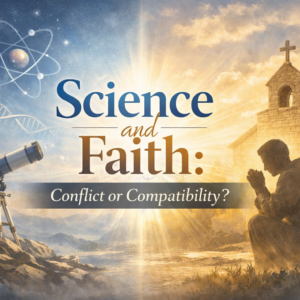

How Can You Not Believe in God With All the Wonders of the World?
Most people who say they do not believe in God have still had the moment. Maybe it was standing on a ridge watching the sun go down behind a mountain range and feeling something they could not quite name. Maybe it was the first time they held their own child and were overwhelmed by something that felt like more than biology. Maybe it was a night sky so full of stars it made them feel small in a way that was not frightening — it was almost like being welcomed into something.
The feeling does not prove anything on its own. Smart people know that feelings can mislead. But the feeling is worth taking seriously, because it keeps showing up — across cultures, across centuries, in people who were not looking for it and did not expect it. The question this post wants to sit with is simple: what if that feeling is not a glitch? What if it is a signal?
That is not a religious answer yet. It is just an honest question. And honest questions deserve a fair look.
The Universe Didn’t Have to Be Beautiful
Here is something that does not get enough attention. If the universe is purely the product of blind physical forces — no mind behind it, no purpose, no design — then it should work, but it doesn’t need to be beautiful. A universe running on nothing but physics and chemistry could produce a functional world. Gravity pulls things together. Photosynthesis feeds life. Water cycles through the atmosphere. None of that requires a sunset that stops you in your tracks.
But sunsets do stop people in their tracks. And it is not just sunsets. It is the way light filters through a forest canopy in the early morning. It is the geometry of a snowflake under a magnifying glass. It is the way a newborn’s hand wraps around your finger. It is the sound of a river running fast over rocks in a canyon. The world is not merely functional. It is extravagant. It is loaded with beauty that goes far beyond what survival requires.
The Oxford mathematician and Christian thinker John Lennox has pointed out that the deep structure of the universe — the mathematical precision underlying everything from the orbit of planets to the behavior of subatomic particles — is itself a kind of beauty that points toward a mind. He notes that scientists like Albert Einstein were openly struck by the fact that the universe is comprehensible at all. Einstein himself said that the most incomprehensible thing about the universe is that it is comprehensible. A random universe has no obligation to make sense to the creatures living in it. And yet it does — with a precision and elegance that the greatest mathematicians find breathtaking.
The Bible puts it plainly:
“The heavens declare the glory of God; the skies proclaim the work of his hands. Day after day they pour forth speech; night after night they reveal knowledge.”
— Psalm 19:1–2 (NIV)
The Psalmist is not making a naive claim. He is saying that creation itself is communicating something — that the world is not silent. It is speaking. And what it is saying is that there is a Maker.
The Sheer Scale of It
Consider the numbers for just a moment — not to overwhelm, but because the scale itself is worth sitting with.
The observable universe contains somewhere in the range of two trillion galaxies. Our own galaxy, the Milky Way, contains somewhere between 100 billion and 400 billion stars. The nearest star to our sun — Proxima Centauri — is so far away that light, traveling at 186,000 miles per second, takes over four years to get there. The light reaching your eyes from some of the stars visible on a clear night left its source before recorded human history began.
And in the middle of all of that, on a small planet orbiting an average star in one of those two trillion galaxies, conditions are calibrated with extraordinary precision for life to exist. The distance from the sun — slightly closer and the water evaporates, slightly further and it freezes. The tilt of the earth’s axis — producing seasons that allow agriculture. The presence of a large moon — stabilizing the earth’s rotation. The magnetic field — deflecting solar radiation. The ratio of oxygen in the atmosphere. The strength of gravity. Physicists call this the fine-tuning problem — the observation that the fundamental constants of the universe appear to be set within extraordinarily narrow ranges that allow for the existence of stars, planets, chemistry, and life.
C. S. Lewis addressed the underlying logic of this in a way that holds up well. He pointed out that nature itself — the whole system of physical cause and effect — cannot be its own explanation. Something outside the system had to get it started. You cannot pull yourself up by your own bootstraps. The universe’s existence, its order, its fine-tuning, and its beauty are not self-explanatory. They point beyond themselves.
Why Beauty Feels Like It Means Something
Here is the part that is hardest to explain away. When you stand at the edge of a canyon or watch a storm build over a mountain range, you do not just register the information. You feel something. And what you feel is not neutral. It has weight to it. It carries what people throughout history have called awe — a sense that you are in the presence of something that matters, something that is more than the sum of its physical parts.
Now a strict materialist — someone who believes the physical world is all there is — has to say that this feeling is simply neurons firing in a certain pattern. The beauty is not in the canyon. It is in your brain’s response to light wavelengths and spatial data. The awe is not a signal pointing toward something real. It is just what your nervous system does in certain conditions.
That explanation is tidy. But it has a problem. If that feeling is purely a product of brain chemistry with no connection to anything outside itself, then the feeling is meaningless — it is not telling you anything true about the world. But then why does it feel so specifically like recognition? Not like confusion or randomness, but like encountering something you almost remember? Like coming home to a place you have never been?
Tim Keller wrote about this in The Reason for God. He observed that every human culture in history has had a sense of the sacred — a recognition that some things are not just physically impressive but genuinely holy, genuinely other, pointing beyond themselves to something transcendent. That near-universal experience does not prove God exists, but it is significant data. It is exactly the kind of data you would expect to find if the Bible is right that God has written evidence of Himself into the creation that every human being encounters.
Paul says it this way:
“For since the creation of the world God’s invisible qualities — his eternal power and divine nature — have been clearly seen, being understood from what has been made, so that people are without excuse.”
— Romans 1:20 (NIV)
Clearly seen. Understood from what has been made. Paul is not saying God wrote His name in the clouds in letters everyone can read. He is saying that the creation — its existence, its order, its beauty, its scale — constitutes a genuine disclosure of something about the one who made it. The evidence is real. What people do with it is their choice.
The Skeptic’s Honest Problem
At this point a thoughtful skeptic might raise a fair objection: beautiful things can have natural explanations. The snowflake’s geometry follows the physics of crystallization. The sunset’s colors are explained by the scattering of light through the atmosphere. Evolution explains the complexity of living things. You do not need a God to explain any of it.
That is a fair point, and it deserves a fair answer.
The question is not whether natural explanations exist for individual phenomena. Of course they do. The question is whether natural explanations are sufficient to explain the whole — the existence of the universe in the first place, the laws of physics that make crystallization and atmospheric scattering possible, the fact that a universe capable of producing conscious creatures who can recognize beauty even arose. Natural explanations explain how things work within the system. They do not explain why there is a system, why it is ordered, why it is beautiful, or why creatures within it experience that beauty as meaningful.
John Lennox puts it this way: science explains the mechanisms. It does not explain the origin of the mechanisms, the source of the laws they follow, or the reason those laws are rational and comprehensible. Saying “the rainbow is caused by the refraction of light through water droplets” is true and worth knowing. But it does not answer the question of why there is light, water, the laws of optics, or creatures with eyes to see the result.
The wonder you feel looking at a rainbow is not explained by the physics of refraction. It is something the physics of refraction cannot account for. And that gap — between the mechanism and the meaning — is exactly where the question of God lives.
What the Natural World Is Actually Saying
Out here in rural country, people who work close to the land often have an instinct about this that more urban people have to work harder to find. A man who has watched a river run through the same canyon for thirty years, who has seen the elk come down out of the high country in the fall and the wildflowers carpet a hillside in the spring, who has sat through a lightning storm on a ridge and felt the hair on his arms stand up — that man usually does not need a philosophy lecture to know that he is in the presence of something that did not make itself.
The natural world is not quiet. It is speaking. The question is whether we are willing to hear what it is saying.
What it is saying, if you follow the evidence honestly, is that behind the order there is a mind. Behind the beauty there is an intention. Behind the fine-tuning there is a purpose. Behind the fact that conscious creatures can stand in a canyon and feel awe — there is a reason that capacity exists at all.
The Apostle Paul, writing to people in the middle of a major city who had every reason to be insulated from the natural world, still said that the invisible qualities of God have been clearly seen through what He made. He was not making a sophisticated philosophical argument. He was stating what honest observation of the world confirms: the creation points beyond itself.
But Does It Point to the God of the Bible Specifically?
This is the honest follow-up question, and it is a good one. Even if the natural world suggests a Creator — some kind of mind or power behind it all — does it specifically point to the God revealed in the Bible? Or could it just as well point to some vague cosmic force, or to many gods, or to something we have no name for?
The creation tells us some things clearly. It tells us the Creator is enormously powerful — look at the scale of the universe. It tells us the Creator is rational — look at the mathematical precision of the laws of physics. It tells us the Creator appreciates beauty far beyond what function requires — look at anything. It tells us the Creator made creatures capable of relationship, of love, of moral reasoning, and of worship.
But creation does not tell us everything. It does not tell us whether the Creator cares about individual people. It does not tell us what to do with guilt and failure and the wreckage of a badly lived life. It does not tell us whether there is hope beyond death. For those answers, you need revelation — a Creator who speaks, not just a creation that points.
That is exactly what Christians claim the Bible is. Not a human book about God, but God’s own word addressed to the people He made. And the central claim of that word is that the same God who painted every sunrise and calibrated every star also sent His Son into the world to rescue the people He made — because the creation was not enough to close the distance that sin had opened.
“For God so loved the world that he gave his one and only Son, that whoever believes in him shall not perish but have eternal life.”
— John 3:16 (NIV)
The God of the canyon and the God of the cross are the same God. The one who made the beauty also entered the suffering. That is not what you would expect from a vague cosmic force. It is what you would expect from a Person — one who made creatures capable of love because He is love, and who pursued them when they walked away.
An Honest Invitation
If you are reading this as a skeptic — someone who is not sure what to believe but is willing to think honestly — here is what we are not asking you to do. We are not asking you to ignore your doubts, suppress your questions, or pretend the hard problems do not exist. They do. Honest faith has always made room for honest questions.
What we are asking is this: the next time you feel that pull — standing at the edge of something vast, or watching something so perfectly formed it seems impossible, or holding something so alive it seems miraculous — do not be too quick to explain it away. Sit with it. Ask where it is coming from. Consider the possibility that it is not a glitch in your wiring but a signal from outside yourself, pointing you toward the One who made you capable of feeling it in the first place.
C. S. Lewis came to faith not through a dramatic conversion experience but through a long, honest process of following the evidence. He was one of the most committed atheists of his generation before he became one of the most compelling Christian voices of the twentieth century. His conclusion, after years of intellectual resistance, was that the desire for something beyond the world — the ache that beauty produces, the longing that no earthly thing fully satisfies — is itself evidence of a source outside the world. “If I find in myself a desire,” he wrote, “which no experience in this world can satisfy, the most probable explanation is that I was made for another world.”
The wonder you feel is not an accident. It is an invitation. The question is whether you will follow where it leads.
Key Takeaways
- The universe did not have to be beautiful — but it is, extravagantly so. A purely physical universe could be functional without being stunning. The beauty that goes far beyond what survival requires points toward a Creator who intended it.
- The fine-tuning of the universe for life is not easily explained by chance. The fundamental conditions for stars, planets, chemistry, and life are calibrated within extraordinarily narrow ranges. That precision points toward a Mind, not a lottery.
- The feeling of awe in the presence of natural wonders is significant data, not just brain chemistry. Every human culture in history has experienced it. The near-universal sense that some things are sacred and that beauty points beyond itself is exactly what you would expect if God has written evidence of Himself into the creation.
- Natural explanations describe the mechanisms — they do not explain the origin of the mechanisms, the laws they follow, or why conscious creatures experience them as meaningful. The gap between the physics of a rainbow and the awe of seeing one is real, and it is where the question of God lives.
- The God who made the beauty also entered the suffering. Creation points toward a Creator, but the Bible tells us who He is — the God who loved the world enough to send His Son into it, so that the distance sin opened could be closed.
Final Word
The heavens are still declaring the glory of God. The mountains are still proclaiming it. The rivers are still running with it. Every clear night and every crashing wave and every field of wildflowers in the spring is doing what creation has always done — pointing past itself toward the One who spoke it into existence.
You do not need a theology degree to hear it. You just need to stand still long enough to listen.
And if what you hear makes you want to know more about the God behind it all — that is exactly the right response. He is not hiding. He is the most present reality in the universe. And He has been speaking since the first morning of the first day, waiting for the people He made to look up from what they are doing and recognize the voice.
Key Scriptures:
Psalm 19:1–2 | Romans 1:20 | Job 38:1–7 | Isaiah 40:25–26
John 1:1–3 | Psalm 104:24 | John 3:16 | Colossians 1:16–17
Mountain Veteran Ministries
Find Your Next Bearing
Every journey needs a direction. If you're wondering where to go from here, choose the path that best fits where you are today.
⚒️ I Want to Live Faithfully
Discover practical wisdom for following Christ in today's world.
→ Living as a Christian Today✝️ I Want to Understand the Gospel
Learn what salvation means and why Jesus came.
→ Understanding Salvation📖 I Want to Understand the Bible
Explore why Christians trust Scripture and how to read it well.
→ Understanding the Bible❓ I Still Have Questions
Explore thoughtful answers to some of Christianity's hardest questions.
→ Hard Questions