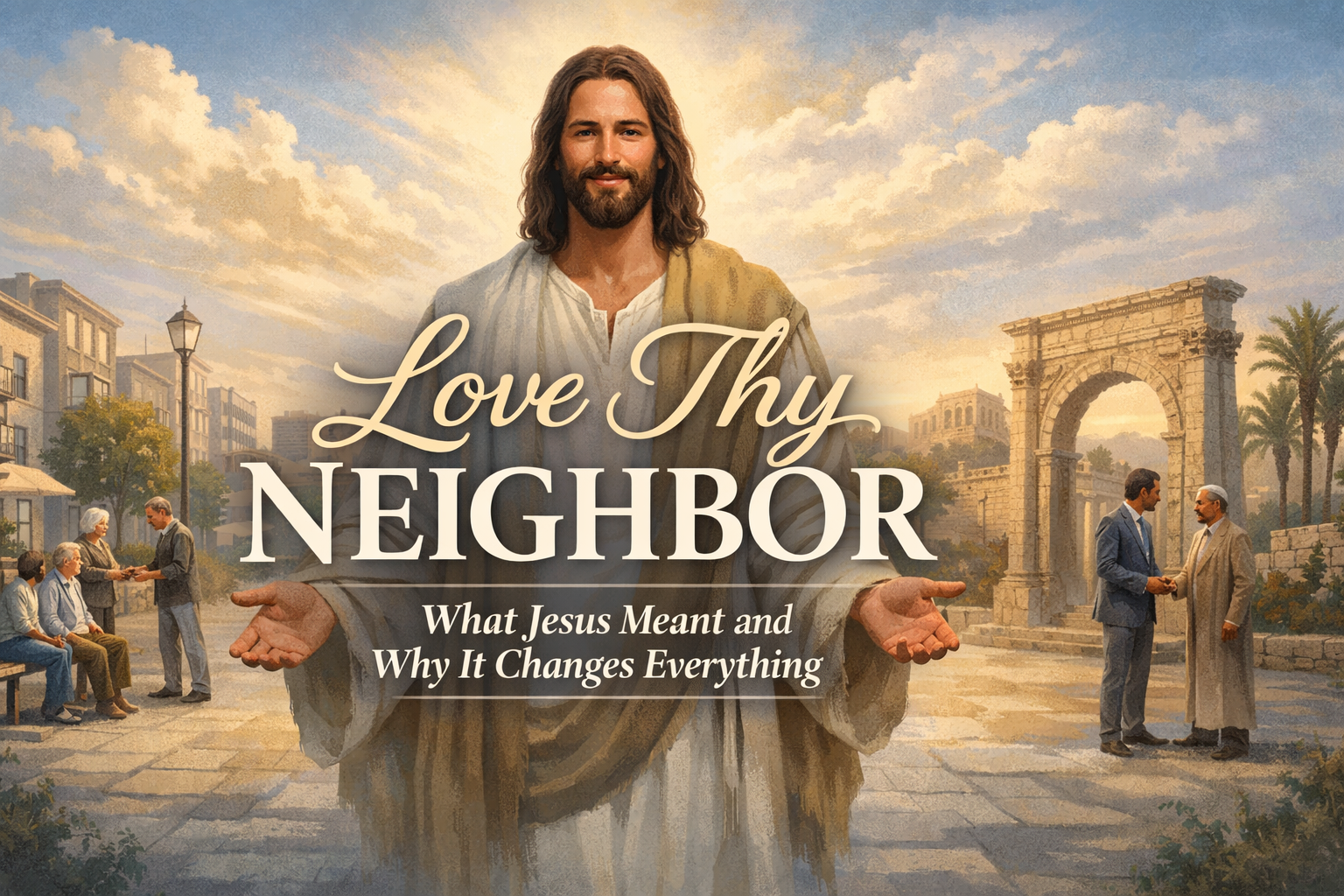
Love Thy Neighbor: What Jesus Meant and Why It Changes Everything
Jesus was asked to name the greatest commandment. He gave two — and then He told a story about a beaten man on the side of a road, a religious leader who crossed the street, and a foreigner who stopped. The parable of the Good Samaritan isn’t just a lesson about being nice. It’s a demolition of every instinct we have to draw lines around who counts as our neighbor.
This post unpacks what Jesus actually meant, who He was saying it to, and why the answer still lands like a challenge two thousand years later.alike..
The Parable of the Good Samaritan and the Command That Changes Everything
When Jesus said, "Love thy neighbor," He wasn't handing out feel-good advice or offering a polite suggestion for peaceful living. He was delivering a powerful, countercultural command that struck at the heart of human relationships — challenging assumptions, tearing down boundaries, and calling us to live with compassion and conviction.
But who exactly was He talking about? Literal next-door neighbors? People we like? Folks who believe like we do? To understand the full weight of His words, we need to dig into Scripture, examine the cultural context, and unpack what it really means to be a neighbor in the eyes of Christ.
The Great Commandment: Love God, Love People
In the Gospels of Matthew, Mark, and Luke, Jesus is asked a loaded question by religious leaders trying to test Him: "Teacher, which is the great commandment in the Law?"
"You shall love the Lord your God with all your heart and with all your soul and with all your mind. This is the great and first commandment. And a second is like it: You shall love your neighbor as yourself. On these two commandments depend all the Law and the Prophets." — Matthew 22:37–40 (ESV)
Jesus took the entire Old Testament law — hundreds of commands given to Israel — and boiled them down to two things: love God completely, and love your neighbor as yourself. These aren't two items on a checklist. Jesus said the entire law depends on them. If you get these two right, everything else falls into place.
Who Is My Neighbor? The Question Behind the Question
In Luke 10:25–29, a lawyer stands up and asks Jesus what he must do to inherit eternal life. Jesus asks what the Law says, and the man replies with the same two commands. Then comes the twist.
"But he, desiring to justify himself, said to Jesus, 'And who is my neighbor?'" — Luke 10:29 (ESV)
That question reveals the heart of the matter. The lawyer wasn't looking to learn — he was looking to limit. He wanted to know who he had to love. And more importantly, who he didn't.
The Parable of the Good Samaritan
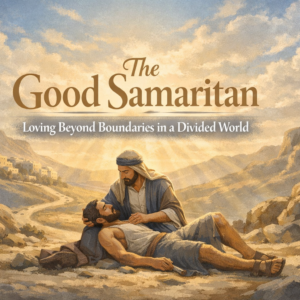
Jesus answers with a story. A man traveling from Jerusalem to Jericho is robbed, beaten, and left for dead. A priest walks by — does nothing. A Levite walks by — does nothing. But a Samaritan — a man from a group despised by the Jews — stops, bandages the man's wounds, carries him to safety, and pays for his care.
Then Jesus asks:
"Which of these three, do you think, proved to be a neighbor to the man who fell among the robbers?" The lawyer replied, "The one who showed him mercy." And Jesus said, "You go, and do likewise." — Luke 10:36–37 (ESV)
Jesus turned the question around. Instead of defining who qualifies as a neighbor, He showed what it means to be one. The burden isn't on the other person. The burden is on us.
Radical Implications: Neighbor Means Everyone
By making a Samaritan — a hated outsider — the hero of the story, Jesus obliterated every excuse we might make for not loving someone.
Social divides?
Gone. The Samaritan crossed a line no respectable Jew would cross — and Jesus called it righteous.
Racial or ethnic divisions?
Gone. The man in the ditch and the man who helped him were from groups that hated each other.
Religious differences?
Gone. The religious leaders walked past. The outsider stopped. Jesus noticed.
Political disagreement?
Gone. Your neighbor is anyone who needs your help — including the person who voted the other way.
A Story from the Gravel Road
The Stranger in the Ditch
Say you're heading home down a winding gravel road and you see an old truck broken down in a ditch. It's hot. You're tired. You don't recognize the man — might be a stranger, might be someone who doesn't talk your talk or vote your vote.
You've got a choice: keep driving and pretend you didn't see, or pull over, check on him, maybe offer a ride or call for help.
In that moment, that stranger is your neighbor.
Loving your neighbor isn't about comfort — it's about compassion.
Common Barriers to Neighborly Love
Let's be honest: this kind of love doesn't come easy. We all have reasons — or excuses — that make it hard.
Biblical Echoes: Old and New Testament
Leviticus 19:18
"You shall not take vengeance or bear a grudge against the sons of your own people, but you shall love your neighbor as yourself: I am the LORD."
This is where the command originated — but Jesus expanded it far beyond national or tribal boundaries.
Romans 13:9–10
"The commandments… are summed up in this word: 'You shall love your neighbor as yourself.' Love does no harm to a neighbor. Therefore love is the fulfillment of the law."
Paul confirms that loving others isn't just one obligation among many — it's the fulfillment of the whole law.
James 2:8
"If you really fulfill the royal law according to the Scripture, 'You shall love your neighbor as yourself,' you are doing well."
James calls it the royal law — elevating it above rituals and religious performance.
What Loving Your Neighbor Actually Looks Like
- 1 Listening with compassion. Sometimes the best thing you can do for someone is simply be present. Don't try to fix them. Don't offer a sermon. Just listen. That alone can change a person's day — or their life.
- 2 Meeting practical needs. The Good Samaritan didn't say, "I'll pray for you." He bandaged wounds, gave a ride, and paid the bill. Love looks like bringing food, mowing a yard, giving a ride, or making a call — not just a warm feeling.
- 3 Speaking truth with grace. Real love isn't soft or fake. It speaks truth — but does so with tenderness and care. Telling someone hard truth is not unkind. Telling it cruelly is.
Voices from the Church
Tim Keller
"If your understanding of the gospel doesn't move you toward the poor, the broken, the outsider, then you don't really understand the gospel."
John Piper
"Loving your neighbor means doing good things for them even if it costs you something, even if it's inconvenient, even if you get nothing in return."
Charles Spurgeon
"Love your neighbor. If he is poor, help him. If he is sick, nurse him. If he is wicked, try to win him."
Mother Teresa
"If we have no peace, it is because we have forgotten that we belong to each other."
What Happens When We Don't Love Our Neighbor?
Ignoring this command doesn't just break human relationships — it breaks God's heart. John says it plainly:
"If anyone says, 'I love God,' and hates his brother, he is a liar; for he who does not love his brother whom he has seen cannot love God whom he has not seen." — 1 John 4:20 (ESV)
That's heavy. You can't claim to love God and walk past the person in the ditch. The two are tied together like fence posts and barbed wire — you can't have one without the other.
A Church That Loves Its Neighbor
Imagine a church that welcomes everyone — not just the cleaned-up folks. That serves the community without strings attached. That prays for the hurting and actually shows up for the broken. That's the kind of church the world notices. And that's the kind of church Jesus died to build.
Every person is made in the image of God (Genesis 1:27). Every person is someone Jesus died for (John 3:16). That includes people who don't look, act, or think like you — the single mom next door, the family you disagree with politically, the guy who wronged you five years ago, the addict, the stranger, the prisoner.
Key Takeaways
| Truth | Application |
|---|---|
| Love is a command, not a suggestion | Obey Christ by loving others sacrificially — regardless of how you feel |
| Your neighbor includes everyone | No one is excluded from Christ's command — not even your enemies |
| Love fulfills the law | Loving your neighbor is walking in righteousness, not just rule-keeping |
| Jesus modeled this love | Follow His footsteps — He stopped for every broken person along the road |
🙏 A Prayer to Love Like Jesus
Lord Jesus, open my eyes to see my neighbor the way You see them. Break down my pride, my fear, and my excuses. Give me a heart that cares, hands that serve, and words that heal. Teach me to love not just the ones who love me back — but even those who don't. Let my life reflect the mercy You've shown me. Amen.
Key Scriptures: Matthew 22:36–40 · Luke 10:25–37 · Leviticus 19:18 · Romans 5:8; 13:9–10 · James 2:8 · 1 John 4:20 · Genesis 1:27 · John 3:16
Want to Go Deeper?
This post is part of an ongoing conversation about what it means to follow Jesus in the everyday. If it stirred something in you, here are a few next steps:
- Share it with someone in your church or community who's wrestling with a hard relationship.
- Read Luke 10:25–37 slowly — ask yourself honestly: who is the person I find hardest to stop for?
- Subscribe to get new posts delivered straight to your inbox — gospel-rooted, plain-spoken truth.
"You shall love your neighbor as yourself." — Matthew 22:39
Mountain Veteran Ministries
Find Your Next Bearing
Every journey needs a direction. If you're wondering where to go from here, choose the path that best fits where you are today.
⚒️ I Want to Live Faithfully
Discover practical wisdom for following Christ in today's world.
→ Living as a Christian Today✝️ I Want to Understand the Gospel
Learn what salvation means and why Jesus came.
→ Understanding Salvation📖 I Want to Understand the Bible
Explore why Christians trust Scripture and how to read it well.
→ Understanding the Bible❓ I Still Have Questions
Explore thoughtful answers to some of Christianity's hardest questions.
→ Hard Questions