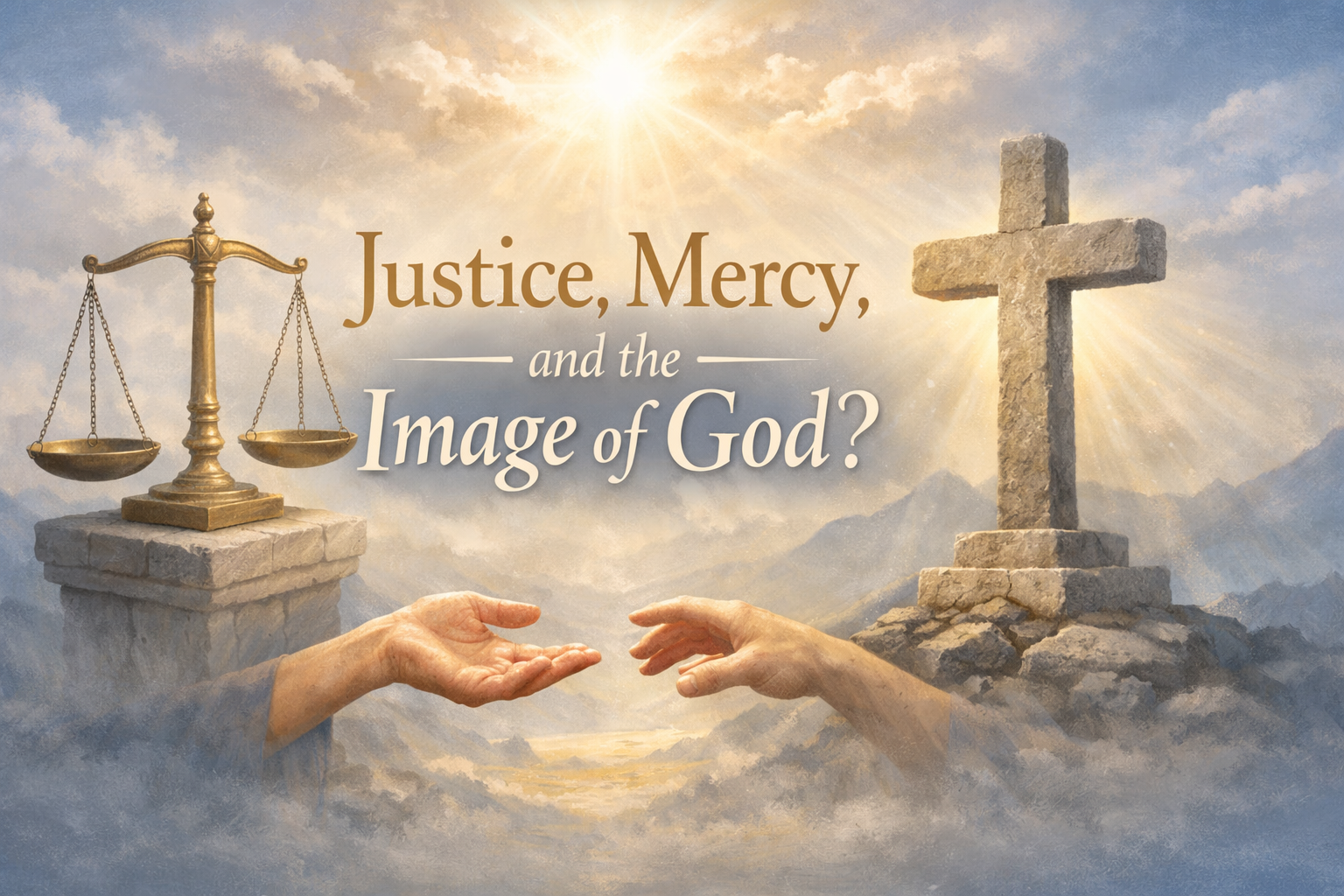
Justice, Mercy, and the Image of God
Two Hands of the Same God — and Why Every Person Carries More Weight Than You Think
Out here, we talk straight. If a fence is down, you fix it. If a neighbor’s barn burns, you show up with gloves and coffee. We know something about justice and mercy without cracking a theology book: justice keeps the cattle where they belong; mercy brings a warm casserole when life kicks hard.
But Scripture pushes deeper. It says every single person — young or old, rich or poor, friend or enemy — bears the image of God. And that changes how we see justice and mercy, not as rival teams, but as two hands of the same God.
In this post we’ll look at what the Bible says about justice, why mercy is not “soft,” and how the image of God gives weight to every human life. We’ll keep it practical, with clear steps you can take this week.
Biblical Foundation: God’s Heart in Three Words
“He has told you, O man, what is good… to do justice, and to love mercy, and to walk humbly with your God.” — Micah 6:8 (ESV)
⚖️ 1. Justice (Mishpat) — God’s Right Order
Biblically, justice means giving people their due — punishing evil, protecting the vulnerable, and restoring what’s broken (Deuteronomy 16:19–20; Isaiah 1:17). God’s justice is not mood swings; it flows from His holy character. He “shows no partiality” (Acts 10:34) and hates “unequal weights” (Proverbs 20:10). When widows and orphans are exploited, He notices (Exodus 22:22–24). When the rich crush the poor, He calls it out (Amos 5:11–12).
Justice matters because God is just. When we bend the truth or look away from wrongdoing, we misrepresent Him. John MacArthur notes that God’s justice is “the exact expression of His holiness in action” — not merely rules, but the outward display of His pure goodness. Justice is not optional for God’s people; it’s part of the family resemblance.
🤲 2. Mercy (Chesed) — God’s Loyal Love
Mercy is God’s steadfast love stooping to help the weak, forgive the guilty, and bind up the wounded (Psalm 103:8–10). In the New Testament, Christ embodies mercy — eating with sinners and healing the broken (Matthew 9:10–13). Mercy doesn’t wink at sin; it moves toward sinners with the goal of redemption. Tim Keller often said mercy is costly because it absorbs the debt instead of demanding the other person pay it all.
Jesus’ parable of the Good Samaritan shows mercy crossing social lines, paying a bill that wasn’t “his problem” (Luke 10:25–37). Mercy is active compassion — bandages, coins, time, care.
👤 3. The Image of God (Imago Dei) — Human Dignity and Responsibility
Every human being is created in the image of God (Genesis 1:26–27), stamped with dignity, designed for relationship with Him, and commissioned to steward His world. That’s why murder is so serious (Genesis 9:6): it’s an assault on God’s image. James adds that even our words should reflect this truth, because we “bless our Lord and Father, and with it we curse people who are made in the likeness of God” (James 3:9).
C.S. Lewis wrote, “There are no ordinary people. You have never talked to a mere mortal.” The image of God means every person — born or unborn, neighbor or stranger, friend or foe — carries weight. That’s the anchor tying justice and mercy together: we pursue just order because image-bearers matter; we extend mercy because image-bearers are worth the cost.
Theological Insight: Not Opposites — Twins
Some folks pit justice and mercy against each other — like a stern judge and a soft grandparent. But in God, justice and mercy meet (Psalm 85:10). The cross of Christ is where this is clearest. God does not ignore sin — that would be unjust. Instead, He bears it in Himself in the person of His Son (Romans 3:25–26). As Augustine put it, the cross is the “judgment seat” where God’s justice is satisfied and mercy is offered.
“But let justice roll down like waters, and righteousness like an ever-flowing stream.” — Amos 5:24 (ESV)
Justice without mercy becomes cold and crushing. It can produce fear but not love.
Mercy without justice becomes sentimental and spineless. It cannot heal deep wrongs; it merely covers them with a thin blanket.
In Jesus, justice and mercy dance. He confronts hypocrisy (Matthew 23) and defends the guilty who repent (John 8:1–11). He announces freedom for the oppressed (Luke 4:18) while calling all to repentance (Luke 13:3). Keller summarized the gospel this way: We are more sinful and flawed than we ever dared believe, yet more loved and accepted in Christ than we ever dared hope. That’s mercy resting on justice accomplished.
Imago Dei ties it all together. Because people bear God’s image, we must not reduce them to their worst moment — nor must we excuse the harm they’ve done. True Christian peacemaking names evil and offers a path to restoration. That’s why biblical justice includes restitution and reconciliation where possible (Exodus 22; Luke 19:8–10).
Modern Application: Boots-on-the-Ground Discipleship
🏠 In Our Homes
Justice at home looks like consistent discipline anchored in love, not anger (Ephesians 6:4). Mercy looks like forgiveness, second chances, and patient listening (Colossians 3:12–13). Remember that each family member bears God’s image — your spouse isn’t your opponent, and your teenager isn’t a problem to fix but a person to shepherd.
⛪ In Our Churches
Church discipline often makes folks nervous, but when done biblically it’s justice and mercy together — protecting the flock, calling the wandering home (Matthew 18:15–20; Galatians 6:1). The goal is not punishment but restoration. A church that never names sin forgets justice; a church that only names sin forgets mercy.
🏘️ In Our Towns
Rural communities face real injustices — addiction, exploitation, violence, and quiet despair. Christians can be the first responders of mercy: mentoring, providing rides to recovery meetings, supporting pregnancy resource centers, looking out for elders, and advocating for fair treatment where the powerless are steamrolled (Proverbs 31:8–9).
Three Practical Steps This Week
- 1 Practice “slow judgment.” Before you speak, silently say: Image of God. Let that change your tone. (James 1:19–20)
- 2 Repair something you broke. If you wounded someone with words, seek them out. Apologize specifically. Ask how you can make it right. That’s justice leading to mercy. (Matthew 5:23–24)
- 3 Pick one mercy habit. Stock a small “mercy fund” in your budget, or keep a grocery card ready for a neighbor in need. Mercy grows with practice. (Luke 10:35)
The Gate, the Calf, and the Call
A Story from the Gravel Road
A rancher I know tells the story of a busted gate after a windstorm. By morning, his neighbor’s yearling had wandered onto his pasture and trampled his young alfalfa. He could have called the sheriff, demanded compensation, and made a stink. Instead, he mended the gate, penned the calf, and called his neighbor to come fetch him. When the neighbor arrived — red-faced and apologetic — the rancher said, “Fences fail. We’ll square up the seed. Come Saturday, bring your boys and we’ll fix this post-line right.”
Justice? He didn’t pretend nothing happened; the crop mattered. Mercy? He bore the hassle, set a fair plan, and kept the relationship. And behind it all was an instinct that the man across the fence was more than a problem — he was a person, stamped with God’s image.
That Saturday turned into a long morning of mending, hot coffee, and a friendship that stuck. The rancher laughed later, “Sometimes the Lord uses a loose hinge to open a door.”
Justice puts up the fence. Mercy mends the heart. The image of God gives the why.
Common Missteps to Avoid
- Confusing vengeance with justice. Personal payback is forbidden (Romans 12:19). Biblical justice either entrusts wrongs to God or works through proper authority for redress.
- Mistaking mercy for enabling. Mercy forgives and restores; it does not feed ongoing harm (Philippians 1:9–10). Boundaries can be merciful.
- Forgetting the image of God in those we disagree with. Online or face-to-face, contempt contradicts our doctrine of humanity (James 3:9–10).
Voices from the Church
Augustine
At the cross, God is “both just and the justifier,” revealing a mercy that doesn’t cancel justice but fulfills it (cf. Romans 3:26).
C.S. Lewis
“There are no ordinary people.” Our neighbors are immortals made in God’s image. Treat them accordingly.
Tim Keller
The gospel creates a people who do justice out of grace, not guilt — because we were the poor Christ made rich (2 Corinthians 8:9).
John MacArthur
God’s justice is holiness active; mercy is His love moving toward sinners. In Christ, these do not compete — they converge.
“With it we bless our Lord and Father, and with it we curse people who are made in the likeness of God… this ought not to be so.” — James 3:9–10 (ESV)
Key Scriptures: Micah 6:8 • Genesis 1:26–27 • Amos 5:24 • James 3:9–10 • Psalm 85:10 • Romans 3:25–26 • Luke 10:25–37 • Matthew 18:15–20 • Proverbs 31:8–9 • Romans 12:19 • Exodus 22 • 1 John 1:7–9
🙏 Closing Prayer
Lord Jesus, You are perfectly just and endlessly merciful. Teach us to see every neighbor as Your image-bearer. Give us courage to name wrongs, humility to confess our own, and love to pursue restoration. Let justice roll in our town, and let mercy flow from our lives. Amen.
Want to Go Deeper?
This post is part of an ongoing conversation about faithful Christian living in the everyday. If it stirred your heart, here are a few next steps:
- Share it with someone in your church wrestling with justice, mercy, or a hard relationship.
- Read further — Tim Keller’s Generous Justice and C.S. Lewis’s The Weight of Glory are excellent starting points.
- Subscribe to get new posts delivered straight to your inbox — gospel-rooted, boots-on-the-ground truth.
“He has told you, O man, what is good… to do justice, and to love mercy, and to walk humbly with your God.” — Micah 6:8
Mountain Veteran Ministries
Find Your Next Bearing
Every journey needs a direction. If you're wondering where to go from here, choose the path that best fits where you are today.
⚒️ I Want to Live Faithfully
Discover practical wisdom for following Christ in today's world.
→ Living as a Christian Today✝️ I Want to Understand the Gospel
Learn what salvation means and why Jesus came.
→ Understanding Salvation📖 I Want to Understand the Bible
Explore why Christians trust Scripture and how to read it well.
→ Understanding the Bible❓ I Still Have Questions
Explore thoughtful answers to some of Christianity's hardest questions.
→ Hard Questions