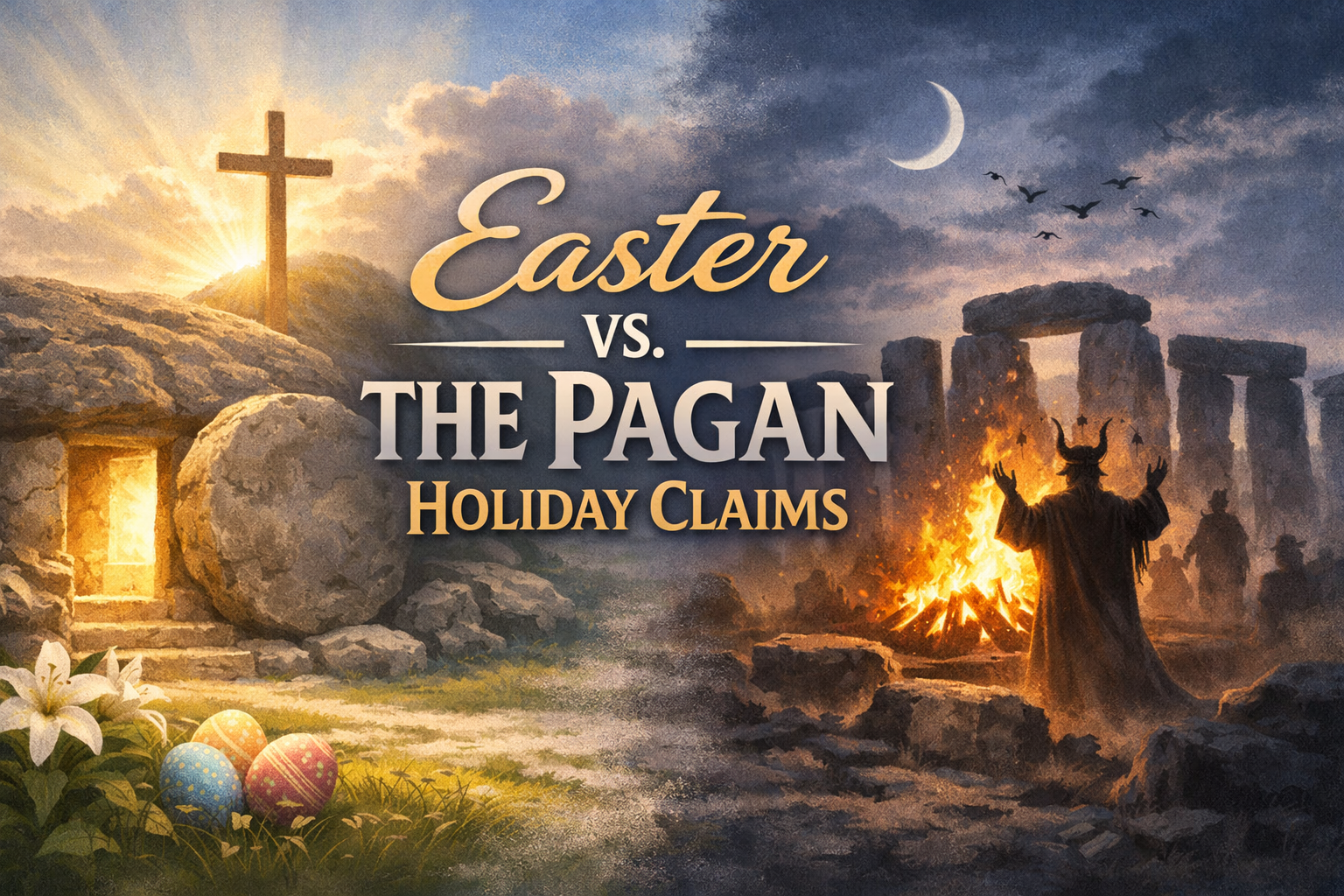
Easter vs. the Pagan Holiday Claims
Every spring the claims resurface alongside the daffodils — Easter is really a pagan holiday, the name comes from a fertility goddess, the eggs and bunnies prove it. These claims travel fast because they’re delivered with confident authority. They deserve a serious answer. Not a defensive one — a historical one. Because when you actually examine the evidence, the picture is far more complicated than the meme suggests, and the core of Easter is untouched by any of it.
Every spring the claims resurface alongside the daffodils. Here’s what the evidence actually says.
It happens every year like clockwork. Easter approaches, and somewhere on social media — or at the family dinner table, or from a skeptical coworker — comes the claim: “Easter is really a pagan holiday. Christians just stole it. The name comes from a fertility goddess. The eggs and bunnies prove it.”
These claims travel fast because they’re delivered with confident authority and they tap into a real anxiety some believers have — am I celebrating something tainted? They also get used as a rhetorical weapon: if Christianity borrowed everything from paganism, then Christianity is just dressed-up mythology.
The claims deserve a serious answer. Not a defensive one — a historical one. Because when you actually look at the evidence, the picture is much more complicated than the meme suggests, and the core of Easter is untouched by any of it.
The Claims, One at a Time
Claim 1
Easter Is Named After the Pagan Goddess “Eostre”
“The word ‘Easter’ comes from the Anglo-Saxon goddess Eostre, a spring fertility deity. Christians renamed her festival.”
Historically ThinThis claim traces to a single source: the Venerable Bede, an 8th-century English monk who mentioned in passing that the month of April was once called “Ēosturmōnaþ” after a goddess named Eostre. That’s it. One sentence, from one monk, writing three centuries after the events he was describing.
No other ancient source mentions this goddess. No inscriptions, no temples, no Roman records, no other references in any language. Some scholars believe Bede may have been mistaken or may have invented the goddess to explain the month name. Others think a minor local deity may have existed. The honest answer is: we don’t know enough to be certain either way.
More importantly — the word “Easter” is only used in English and German. Every other language in the world uses a form of the Hebrew word Pesach (Passover): French Pâques, Spanish Pascua, Italian Pasqua, Russian Paskha. The worldwide Christian tradition has always understood this holiday as rooted in Passover — the name “Easter” is a quirk of Germanic languages, not a sign of pagan origin.
Claim 2
Easter Eggs and Bunnies Are Pagan Fertility Symbols
“Eggs and rabbits are ancient symbols of the fertility goddess. Their presence in Easter celebrations proves pagan roots.”
Not Supported by EvidenceThere is no ancient pagan source — none — that connects eggs or rabbits to Eostre or any spring goddess. This is a modern claim without ancient documentation. The first written connection between Eostre and rabbits appears in the 19th century work of Jacob Grimm, who was speculating, not reporting historical fact.
Easter eggs have a well-documented Christian history. In the Eastern church, eggs were forbidden during Lent (the 40-day fast before Easter) and were given as gifts when the fast ended. Red eggs — still a major tradition in Orthodox Christianity — symbolize the blood of Christ and the resurrection. The egg as a symbol of new life emerging from what appeared dead is a natural resurrection image, not a borrowed fertility rite.
The Easter bunny as a popular cultural figure came to America primarily through German Lutheran immigrants in the 18th and 19th centuries. It’s a folk tradition — in the same category as Christmas trees — not an ancient pagan survival.
Claim 3
The Resurrection Story Was Copied from Osiris, Dionysus, or Mithras
“Dying and rising gods existed throughout the ancient world. Jesus is just another version of Osiris, Dionysus, or Mithras.”
Does Not Survive ScrutinyThis is the broadest version of the pagan-copy claim, and it’s the one most thoroughly dismantled by actual scholarship. The alleged parallels between Jesus and pagan dying-and-rising gods fall apart when you examine the primary sources rather than popular summaries of them.
Osiris was dismembered and reassembled by Isis — he did not rise to new embodied life but became the ruler of the underworld. His story bears no meaningful resemblance to the bodily resurrection of Jesus. Dionysus was a god of wine and ecstasy; the “dying and rising” version of his myth is a minor variation in a very late source. Mithras — whose supposed parallels to Jesus (born December 25, twelve disciples, died and rose, etc.) became very popular in the early 2000s — these parallels are almost entirely invented. They have no basis in actual Mithraic texts or archaeology. Scholars of Mithraism have been pointing this out for decades.
New Testament scholar N.T. Wright spent nearly 800 pages in his definitive work on the resurrection examining every dying-and-rising god in the ancient world. His conclusion: none of them are close parallels to the Christian resurrection claim, and pagans themselves would have found the idea of a bodily resurrection strange and objectionable — it was not something they were looking for or expecting.
Claim 4
The Date of Easter Was Set to Coincide with Pagan Spring Festivals
“Easter was deliberately placed on the spring equinox to absorb pagan spring celebrations.”
Historically InaccurateEaster’s date was determined by the Council of Nicaea in 325 AD and is calculated based on the Jewish calendar — specifically, its relationship to Passover, which Jesus was celebrating when He was crucified. The formula (first Sunday after the first full moon after the spring equinox) is a lunar calendar calculation rooted entirely in Jewish Passover reckoning, not in alignment with any pagan festival.
The early church debated the date extensively — not because of paganism, but because Jewish and Gentile Christian communities were calculating Passover differently. The spring timing is a consequence of when the actual crucifixion and resurrection occurred historically, not a deliberate absorption of pagan spring celebrations.
What About Things Christianity Actually Did Absorb?
A Fair and Honest Acknowledgment
Intellectual honesty requires acknowledging what is actually true here. As Christianity spread through the Roman Empire and into Europe, it did sometimes adopt local practices, repurpose existing cultural forms, and build churches on sites previously used for worship. Pope Gregory I explicitly instructed missionaries in the early 7th century to adapt local festivals rather than abolish them — to redirect existing celebrations toward Christian meaning rather than simply destroying them.
Christmas is the clearest example of this pattern. The date of December 25 was not chosen because anyone thought Jesus was born then, but partly because it fell near existing Roman and Germanic winter celebrations. Christians transformed the cultural moment rather than inventing a new one from scratch.
This is called contextualization — taking the forms of a culture and filling them with new content. It is a missionary strategy as old as the Apostle Paul, who quoted pagan poets to a pagan audience in Athens (Acts 17:28). Borrowing cultural forms to communicate truth is not the same as borrowing false religious content.
The key question is always: what is the actual content being celebrated? Easter’s content — the historical death and bodily resurrection of Jesus Christ — has no pagan parallel. The evidence for that event stands entirely on its own, as we explored in the companion post on the empty tomb.
Why These Claims Keep Spreading
The pagan-origin claims spread easily for a few reasons worth naming. First, they feel like inside information — the kind of thing “they” don’t want you to know, which gives them an automatic appeal. Second, they require no expertise to repeat but a fair amount of historical work to rebut. Third, they serve a purpose for people who want to dismiss Christianity without engaging its actual claims.
If Easter is just a recycled pagan holiday, then you never have to deal with the empty tomb. You never have to reckon with the testimony of eyewitnesses who died for what they said they saw. You never have to answer the question that Jesus Himself posed: “Who do you say that I am?” The pagan-copy argument is, at its core, a way of changing the subject.
Don’t let the subject get changed. The real question isn’t whether some Anglo-Saxon month had a spring festival. The real question is whether Jesus Christ rose bodily from the dead on the third day. That question has an answer, and the answer is yes — supported by more historical evidence than almost any other event of the ancient world.
“For I delivered to you as of first importance what I also received: that Christ died for our sins in accordance with the Scriptures, that he was buried, that he was raised on the third day in accordance with the Scriptures, and that he appeared to Cephas, then to the twelve.” — 1 Corinthians 15:3–5
What to Say When Someone Brings This Up
You don’t need to have every historical argument memorized. A few honest responses go a long way:
- “That Eostre claim traces back to one sentence from one monk in the 8th century. Every other language calls this holiday Passover.” Let them look it up.
- “The alleged parallels between Jesus and pagan dying gods don’t hold up when you read the actual ancient sources.” Recommend N.T. Wright or Gary Habermas if they want depth.
- “Even if Christians borrowed some cultural packaging, the content — the bodily resurrection — has no pagan parallel. What’s your explanation for the empty tomb?” Redirect to the actual historical question.
- “I’m happy to look at the evidence with you. The resurrection is the most examined event in the ancient world. It keeps standing up.” Confidence without contempt goes a long way.
The pagan-origin claims about Easter are largely built on thin evidence, popular mythology, and the desire to avoid a more uncomfortable question. Handle them calmly, answer them honestly, and then bring the conversation back where it belongs — to a first-century tomb outside Jerusalem that was empty on a Sunday morning, and to a risen Lord whose appearance changed the world.
He is risen. That’s the whole thing. Everything else is footnotes.
🙏 Closing Prayer
Lord Jesus, thank You that the celebration of Your resurrection doesn’t depend on settling every historical footnote. You rose. The tomb was empty. Witnesses saw You and staked their lives on it. Give us the confidence to know what we believe, the honesty to engage every question fairly, and the joy that comes from knowing that death has been defeated — not in myth, but in history, and not in the past only, but forever. Amen.
Key Scriptures: 1 Corinthians 15:1–20 · Matthew 28:1–10 · Acts 17:22–34 · Romans 1:4 · 1 Peter 3:15
On the resurrection as historical event — Luke 1:1–4 · Acts 1:3 · 1 Corinthians 15:3–8 · Galatians 1:18–19
On contextualization and culture — Acts 17:28 · 1 Corinthians 9:19–23 · Colossians 2:16–17
On defending the faith — 1 Peter 3:15 · Jude 3 · 2 Corinthians 10:5 · Colossians 4:5–6
Want to Go Deeper?
This post pairs directly with our piece on the empty tomb — Why the World Keeps Trying to Explain Away the Empty Tomb — which walks through the historical evidence for the resurrection itself. If the pagan-copy claims are the opening move, the empty tomb is the main event.
For further reading on the historical reliability of the resurrection and responses to mythicist claims, these are worth your time:
- The Resurrection of the Son of God — N.T. Wright. Exhaustive examination of resurrection in ancient context, including every alleged pagan parallel.
- The Case for the Resurrection of Jesus — Habermas & Licona. Accessible and thorough.
- Reinventing Jesus — Komoszewski, Sawyer & Wallace. Addresses mythicist claims directly with rigorous scholarship.
Subscribe to Mountain Veteran Ministries for more gospel-rooted, plainspoken content built for the questions real people are actually asking.
“Always be prepared to give an answer to everyone who asks you to give the reason for the hope that you have. But do this with gentleness and respect.” — 1 Peter 3:15
Mountain Veteran Ministries
Find Your Next Bearing
Every journey needs a direction. If you're wondering where to go from here, choose the path that best fits where you are today.
⚒️ I Want to Live Faithfully
Discover practical wisdom for following Christ in today's world.
→ Living as a Christian Today✝️ I Want to Understand the Gospel
Learn what salvation means and why Jesus came.
→ Understanding Salvation📖 I Want to Understand the Bible
Explore why Christians trust Scripture and how to read it well.
→ Understanding the Bible❓ I Still Have Questions
Explore thoughtful answers to some of Christianity's hardest questions.
→ Hard Questions