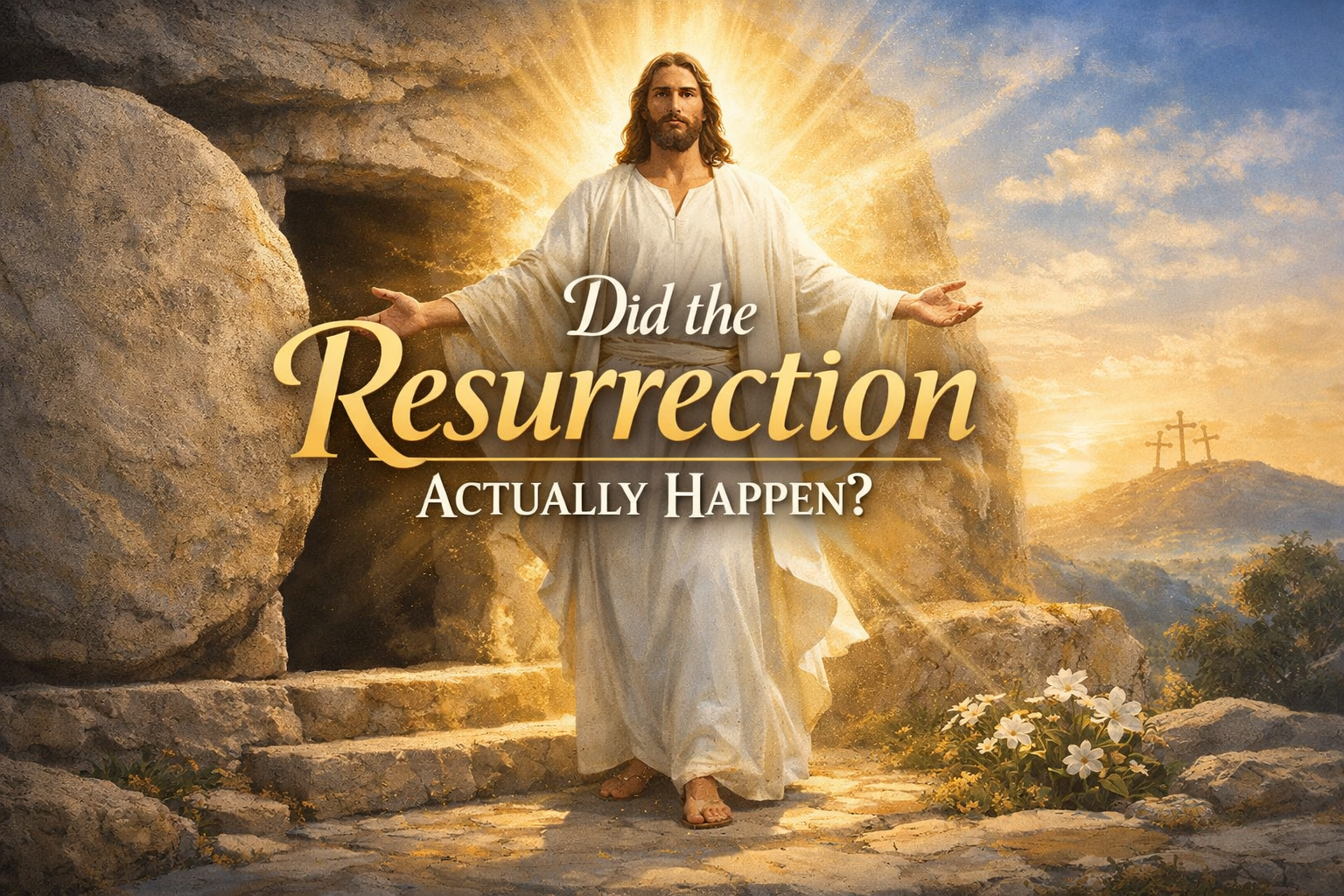
Did the Resurrection Actually Happen?
Did Jesus of Nazareth rise bodily from the dead on the third day after His crucifixion? It is the question at the center of everything. Paul didn’t soften it — if Christ has not been raised, your faith is futile and you are still in your sins. Either it happened and changes everything, or it didn’t happen and Christianity is the most elaborate waste of time in human history. So did it happen? Yes. The evidence is strong, consistent, and has withstood two thousand years of hostile examination. Here is why that conclusion is reasonable — and what it demands of us.
The Most Important Question in Human History Deserves a Direct Answer.
It is the question at the center of everything. Not whether Jesus was a good teacher — He was. Not whether the Bible contains wisdom — it does. Not whether religion is useful or community is valuable or faith makes people better. The question that determines whether Christianity is true or false, meaningful or fraudulent, worth building a life on or worth walking away from, is this one:
Did Jesus of Nazareth rise bodily from the dead on the third day after His crucifixion?
Paul knew this. He didn’t soften it or offer a comfortable middle ground. “If Christ has not been raised,” he wrote, “your faith is futile and you are still in your sins” (1 Corinthians 15:17). Either it happened and it changes everything, or it didn’t happen and Christianity is the most elaborate waste of time in human history.
So: did it happen?
The Answer
Yes. The evidence is strong, consistent, and has withstood two thousand years of hostile examination.
Here is why that conclusion is reasonable — and what it demands of us.
How Historians Approach This Question
Before laying out the evidence, it’s worth saying something about method. Historians don’t prove the past the way mathematicians prove theorems. History works differently — it weighs evidence, assesses the reliability of sources, evaluates competing explanations, and asks which account best fits all the known facts.
By those standards, the resurrection is one of the most examined events in the ancient world. It has been investigated not just by Christian believers but by skeptical scholars, hostile critics, secular historians, and philosophers who went into the investigation hoping to find a naturalistic explanation. Many of them found one. Some of them didn’t — and said so.
We are not asking you to believe on blind faith. We are asking you to look at the evidence and follow it where it goes.
Five Pillars of Evidence
Pillar One
The Death of Jesus Is One of the Most Attested Facts of Antiquity
Jesus’ execution under Pontius Pilate is confirmed by multiple independent sources — the Gospels, the letters of Paul, the Jewish historian Josephus, and the Roman historian Tacitus. No credible historian disputes that Jesus of Nazareth was crucified in Jerusalem around 30 AD. This is the foundation everything else rests on. A resurrection requires a death first, and the death is not in question.
Roman crucifixion was not a process that left room for ambiguity. The soldiers were professional executioners. When they confirmed Jesus was dead to Pilate’s satisfaction before releasing the body for burial (Mark 15:44–45), that was not a casual observation. Pilate asked specifically because he was surprised at how quickly death had come.
Pillar Two
The Tomb Was Empty — and No One Denied It
The earliest counter-argument to the resurrection was not “the tomb is full” — it was “the disciples stole the body” (Matthew 28:12–13). That argument only makes sense if the tomb was undeniably empty. The people with the most to gain from producing Jesus’ body — the Jewish religious leaders and Roman authorities who had arranged the execution — never did. They couldn’t.
The resurrection was proclaimed loudly and publicly in Jerusalem, within weeks of the crucifixion, to people who had been there and could check. If the body was anywhere findable, that was the moment to find it. It never surfaced. The tomb’s emptiness is conceded by friend and enemy alike — the debate has only ever been about the explanation.
Pillar Three
Multiple Independent Witnesses Claimed to See Jesus Alive
Paul records the appearances in 1 Corinthians 15:3–8, writing approximately twenty years after the crucifixion and quoting a creedal formula that dates to within a few years of the event. The appearances are: to Peter, to the twelve, to more than five hundred people at one time (most of whom Paul notes are still alive and checkable), to James, to all the apostles, and finally to Paul himself.
These were not private visions. They happened to individuals and to large groups, in multiple locations, over forty days. Paul’s explicit invitation to cross-examine the living witnesses — written to a skeptical audience in Corinth — is not the behavior of someone constructing a legend. It is the behavior of someone confident in verifiable facts.
Pillar Four
Two Hostile Witnesses Converted: James and Paul
James, the brother of Jesus, was a skeptic during Jesus’ ministry (John 7:5). He did not believe Jesus was the Messiah. After the crucifixion, James became one of the three pillars of the Jerusalem church (Galatians 2:9) and was eventually executed for his faith — as recorded by the hostile Jewish historian Josephus. Something happened between his skepticism and his martyrdom. Paul records it: Jesus appeared to James (1 Corinthians 15:7).
Paul himself was the church’s chief persecutor — educated, zealous, systematically hunting down Christians for imprisonment and death (Acts 8:3). His conversion on the Damascus road, his subsequent verification visit to Jerusalem where he spent fifteen days with Peter and also met James (Galatians 1:18–19), and his lifelong testimony under beatings and eventual execution all require an explanation. He claimed to have seen the risen Jesus. He never wavered. He never recanted.
Pillar Five
The Movement’s Explosive Growth Demands an Explanation
Within weeks of the crucifixion, a movement that had scattered in fear was proclaiming the resurrection publicly in Jerusalem and growing rapidly despite active, violent opposition. Within a generation, it had reached Rome. Within three centuries, it had transformed the Roman Empire — without military force, without political power, fueled entirely by the testimony of people who claimed to have seen or spoken with eyewitnesses of the risen Christ.
The historian Tacitus, writing with contempt, noted that the movement had been “checked for the moment” by the crucifixion but then “broke out again.” He could observe the phenomenon. He had no explanation for it. The resurrection explains it. Nothing else adequately does.
What About the Alternative Theories?
Every major alternative explanation has been examined carefully by scholars across two thousand years. Here is where each one breaks down:
What Scholars Who Don’t Believe Have Said
The Concession from Skeptical Scholarship
Gerd Lüdemann, one of the most prominent skeptical New Testament scholars of the 20th century, wrote: “It may be taken as historically certain that Peter and the disciples had experiences after Jesus’ death in which Jesus appeared to them as the risen Christ.” He rejected the resurrection but could not explain away the appearances.
E.P. Sanders, a highly respected critical New Testament historian who does not hold orthodox Christian beliefs, wrote in his academic work that the post-resurrection appearances “are in my judgment, historical facts.” He could not account for them naturalistically to his own satisfaction.
The philosopher Antony Flew, one of the 20th century’s most prominent atheists, said late in his life that the resurrection of Jesus was “the best attested miracle claim” he had encountered. He did not become a Christian. But he could not dismiss the evidence.
These are not friendly witnesses. Their admissions carry weight precisely because of who they are.
The Honest Objection: “But Miracles Don’t Happen”
The most common reason people reject the resurrection is not an assessment of the historical evidence. It is a prior philosophical commitment: miracles don’t happen, therefore the resurrection didn’t happen, regardless of what the evidence shows.
This is a legitimate philosophical position, but it needs to be named as what it is — a presupposition brought to the evidence, not a conclusion drawn from it. David Hume’s famous argument against miracles (that the uniform experience of natural law outweighs any testimony for the miraculous) has been debated and critiqued by philosophers for three centuries. It is not the settled consensus of philosophy that miracles are impossible.
The question is this: if God exists, are miracles possible? If the answer is yes — even in principle — then the resurrection cannot be ruled out before examining the evidence. And if you examine the evidence without that prior ruling, the resurrection is the explanation that best accounts for all the known facts.
“The historian, of course, may and must bracket out that question in the first moment of investigation. But he cannot bracket it out forever. At some point the Christian claim is that what happened to Jesus is what will happen to all of us: that God’s new creation has broken in to the old.” — N.T. Wright
A Note on What’s Really at Stake
There’s a reason the resurrection question doesn’t stay academic. A man who merely died and stayed dead — however wisely he taught — is a man whose life can be admired, whose sayings can be quoted, whose example can be followed or ignored. He makes no demands from the grave.
A man who rose from the dead is another matter entirely. A living Jesus is a Jesus who speaks, who calls, who judges, who saves. He is not safely in the past. He is present and making claims on the way you live. That is not a comfortable position to be in if you’ve decided you don’t want it to be true.
Which may be why the evidence keeps getting explained away — not because the explanations work, but because the alternative is demanding.
If It’s True, What Does That Mean for You?
The resurrection is not a fact to be noted and filed away. It is an event with a claim attached. If Jesus rose from the dead, then His words are not suggestions — they are truth. His commands are not preferences — they are imperatives. His offer of forgiveness is not wishful thinking — it is available, purchased at real cost, and valid today.
- It means sin is forgivable. Not minimized, not excused, not balanced against good works — actually forgiven, on the basis of what Jesus did and vindicated by what God confirmed in the resurrection (Romans 4:25).
- It means death is not the end. The resurrection is not just Jesus’ story. It is the pattern for everyone who belongs to Him — the firstfruits of a harvest that will include every believer who has ever died (1 Corinthians 15:20–23).
- It means you can know God personally. The risen Jesus is not a historical figure to be studied. He is a living person to be known, followed, and encountered — today, in prayer, in His word, in His church.
- It means this life is not all there is. Everything you do in this life — every act of faithfulness, every sacrifice, every moment of endurance — matters beyond the grave. “Your labor in the Lord is not in vain” (1 Corinthians 15:58).
The resurrection of Jesus Christ is the most examined, most contested, most argued-over event in the history of the world. Two thousand years of hostile, brilliant, motivated opposition — and the tomb is still empty.
It is not an article of blind faith. It is a historical claim supported by multiple independent witnesses, hostile admissions, the inexplicable conversions of enemies, the explosive growth of an impossible movement, and the consistent failure of every alternative explanation.
You don’t have to believe it because someone told you to. Look at the evidence. Follow it honestly. And then reckon with what it means if it’s true — because if it is, it demands everything.
“But in fact Christ has been raised from the dead, the firstfruits of those who have fallen asleep.” — 1 Corinthians 15:20
🙏 Closing Prayer
Lord Jesus, You rose. Not as a symbol, not as a feeling, not as a metaphor — but in a body, from a tomb, on a Sunday morning that changed everything. Give every person reading this the honesty to look at the evidence clearly and the courage to follow it where it leads. And for those who already believe — deepen our confidence, not in our ability to argue, but in the fact that You are alive. Amen.
Key Scriptures: 1 Corinthians 15:1–22 · Matthew 28:1–15 · Romans 1:4 · Romans 4:25 · Acts 2:22–36 · Mark 15:44–45 · Galatians 1:18–19 · Acts 8:1–3; 9:1–6
On the death of Jesus — Mark 15:37–45 · John 19:30–35 · Isaiah 53:8–9 · Tacitus, Annals XV.44
On the empty tomb — Matthew 27:62–66; 28:11–15 · Mark 16:1–8 · John 20:1–10
On the appearances — 1 Corinthians 15:3–8 · Luke 24:13–53 · John 20:11–29; 21:1–14
On what it means — Romans 6:4–9 · 1 Corinthians 15:20–23, 55–58 · 1 Peter 1:3 · Revelation 1:17–18
The Full Easter Series — Read It All
This post is the capstone of our Easter apologetics and theology series at Mountain Veteran Ministries. Read the complete set to build a thorough, grounded case:
- Why the World Keeps Trying to Explain Away the Empty Tomb — alternative theories and why they fail
- What the Early Enemies of Christianity Admitted About the Resurrection — hostile witnesses: Tacitus, Josephus, Pliny, Julian
- Didn’t the Disciples Just Make It Up? — the conspiracy and fabrication objections answered
- Easter vs. the Pagan Holiday Claims — what the evidence actually shows about pagan origins
- What Did Jesus’ Resurrection Body Look Like? — continuity, transformation, and our future hope
- Why Does the Empty Tomb Matter? — eight reasons this changes everything
For serious follow-up reading:
- The Case for the Resurrection of Jesus — Habermas & Licona
- The Resurrection of the Son of God — N.T. Wright
- Cold-Case Christianity — J. Warner Wallace
“Always be prepared to give an answer to everyone who asks you to give the reason for the hope that you have.” — 1 Peter 3:15
Mountain Veteran Ministries
Find Your Next Bearing
Every journey needs a direction. If you're wondering where to go from here, choose the path that best fits where you are today.
⚒️ I Want to Live Faithfully
Discover practical wisdom for following Christ in today's world.
→ Living as a Christian Today✝️ I Want to Understand the Gospel
Learn what salvation means and why Jesus came.
→ Understanding Salvation📖 I Want to Understand the Bible
Explore why Christians trust Scripture and how to read it well.
→ Understanding the Bible❓ I Still Have Questions
Explore thoughtful answers to some of Christianity's hardest questions.
→ Hard Questions