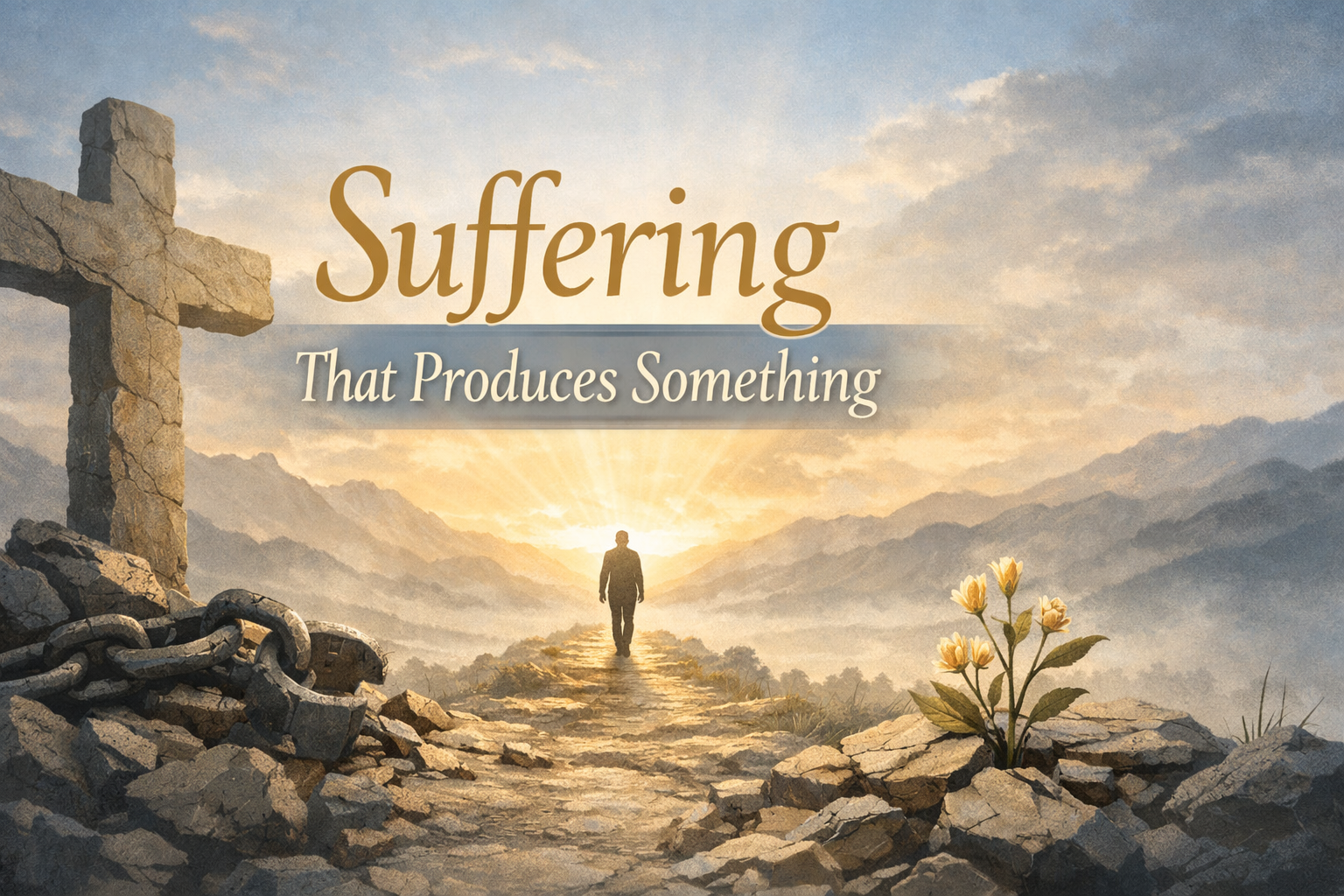
Suffering That Produces Something
Most of us want God to remove our suffering. What Scripture keeps insisting is that God intends to use it. That’s not a comfortable theology — but it’s a hopeful one. Pain without purpose is just pain. Pain with purpose is something the Bible calls formation.
Romans 5 says suffering produces something. Most of us skip to the end. Here’s why the process matters.
Nobody signs up for suffering. That’s not a character flaw — it’s basic human wiring. We are built for comfort, for safety, for the absence of pain. And when pain shows up anyway — illness, loss, betrayal, failure, grief — the first thing most of us do is pray it away.
That’s not wrong. Jesus Himself prayed in Gethsemane that the cup would pass from Him. Asking God to remove suffering is not a lack of faith. It’s honesty.
But here’s what Scripture keeps insisting on, from Genesis to Revelation: God does not waste suffering. He is not indifferent to your pain, and He is not powerless in the face of it. What He is doing — consistently, patiently, across the entire arc of redemptive history — is using it. Shaping through it. Building something in the middle of it that could not be built any other way.
The question isn’t whether your suffering will produce something. The question is whether you’ll be positioned to receive what it’s producing.
The Text That Changes the Whole Conversation
The apostle Paul wasn’t writing from a beach house when he wrote Romans 5:3–5. He was writing as a man who had been beaten, shipwrecked, imprisoned, stoned, and left for dead. When he says “we rejoice in our sufferings,” he’s not speaking theoretically. He earned those words.
Here’s what he wrote:
“Not only that, but we rejoice in our sufferings, knowing that suffering produces endurance, and endurance produces character, and character produces hope, and hope does not put us to shame, because God’s love has been poured into our hearts through the Holy Spirit who has been given to us.” — Romans 5:3–5
Read that again slowly. There’s a chain here — a progression that Paul is not presenting as possibility but as certainty. Suffering produces endurance. Endurance produces character. Character produces hope. And that hope, Paul says, will not disappoint — because it’s grounded not in circumstances but in the love of God poured out by the Holy Spirit.
That’s not a bumper sticker. That’s a theological argument about the nature of God and the purpose of pain. Let’s walk through each link in the chain.
Link One: Suffering Produces Endurance
The Greek word Paul uses here is hypomonē — sometimes translated “patience,” but more literally it means something like “remaining under.” The picture is of a man who could run from the weight but chooses to stay under it. Not passive resignation. Active, deliberate, resolute staying.
You cannot develop that by reading about it. You cannot manufacture it in a season of comfort. Endurance is the muscle you build by not quitting when quitting would be easy — and the only environment where that happens is suffering.
Think about the people in your life who have genuine, unshakable steadiness in a crisis. The ones who don’t fall apart when things go sideways. You probably already know the backstory: they’ve been through something. They’re not steady because life has been easy. They’re steady because they stayed under something hard and didn’t break. That’s hypomonē. That’s what suffering produces when you don’t run from it.
The writer of Hebrews says Jesus Himself, “for the joy that was set before him endured the cross” — Hebrews 12:2. Same word. The Son of God developed endurance by staying under the weight. If the process was good enough for Him, it is sufficient for us.
Link Two: Endurance Produces Character
The word Paul uses for character here is dokimē — it carries the sense of something tested and proven. In the ancient world, it was used of metal that had been through the fire and come out purified. Not just theoretical purity. Demonstrated purity. The kind you can stake your life on because it’s already been tested.
Character, in the biblical sense, is not personality. It’s not your natural temperament or your strengths profile. It’s the deep, tested integrity of who you actually are when the pressure is on. And you don’t get it from easy seasons.
C.S. Lewis put it plainly in The Problem of Pain: God’s goal for us is not our comfort but our perfection — using the word in its older sense of completeness, wholeness, maturity. The sculptor doesn’t make the marble more beautiful by leaving it alone. The goldsmith doesn’t produce pure metal by keeping it away from heat.
James opens his letter with the same framework Paul uses in Romans 5. “Count it all joy, my brothers, when you meet trials of various kinds, for you know that the testing of your faith produces steadfastness. And let steadfastness have its full effect, that you may be perfect and complete, lacking in nothing.” — James 1:2–4.
“Lacking in nothing.” That’s the goal. And the path to it runs straight through the valley.
The question is never whether your suffering is producing something. It always is. The question is whether you’re positioned — in faith, in community, in the Word — to receive what it’s building.
Link Three: Character Produces Hope
This is the most counterintuitive link in the chain for modern readers. We tend to think of hope as something you feel when circumstances are good — when the prognosis is positive, when the relationship is healing, when the finances are stabilizing. Hope, in that framing, is a response to favorable conditions.
But Paul is describing a completely different animal. The hope that character produces is not circumstantial. It’s not contingent on what’s happening around you. It’s the settled, confident expectation that God will do what He has promised — not because things look good, but because you have been through enough to know who God is.
That’s the hope of a veteran faith, not a rookie faith. Rookie faith hopes when things look hopeful. Veteran faith hopes when nothing looks hopeful at all — because it has learned, through the long road of endurance and tested character, that God is trustworthy at a level that transcends circumstances.
The prophet Jeremiah watched Jerusalem burn. He sat in the rubble of everything he had loved and watched the covenant people carted off in chains. And from that wreckage he wrote: “The Lord is my portion, therefore I will hope in him.” — Lamentations 3:24. That is not the hope of a man whose circumstances warrant optimism. That is the hope of a man whose character has been forged in fire and come out knowing something unshakeable about God.
The Anchor at the End: Hope That Does Not Disappoint
Paul ends the chain with a guarantee that would be audacious if it came from anyone else: this hope “does not put us to shame.” Other translations say it “does not disappoint.” And the reason he can make that claim isn’t psychological — it’s pneumatological. It’s about the Holy Spirit.
“God’s love has been poured into our hearts through the Holy Spirit who has been given to us.” — Romans 5:5.
The hope doesn’t rest on your willpower or your theological correctness or your ability to maintain a positive attitude through hard things. It rests on the active, present work of the Holy Spirit in your heart. He is the guarantor. He is the one producing the love of God in you that makes the whole chain possible.
This is why suffering doesn’t have to destroy you. Not because you’re strong enough to endure it on your own — you aren’t, and neither am I. But because the Spirit of the living God is at work inside the suffering, producing something that your best season of comfort and ease never could.
What This Looks Like on the Ground
Theology has to cash out somewhere. Let’s talk about what it actually looks like to cooperate with what suffering is producing — because the chain in Romans 5 isn’t automatic. Suffering that is resisted, resented, and isolated tends to produce bitterness rather than endurance. The fruit Paul describes requires a particular posture.
Stay in Community
Suffering in isolation is one of the most reliable paths to bitterness I know of. When you pull away from the body — from the church, from Christian community, from people who can pray with you and speak truth to you — the story you tell yourself about your suffering is the only story you hear. And that story, without correction, tends toward despair.
Hebrews 10:24–25 says to stir one another up to love and good works, not neglecting to meet together — “and all the more as you see the Day drawing near.” The “all the more” suggests that urgency increases when things get hard. Don’t pull away when suffering comes. Lean in harder.
Speak Your Suffering Honestly to God
The Psalms of lament — Psalms 10, 22, 42, 88 — are God’s own provision for the hard seasons. They give us language to bring our full experience to God without sanitizing it. The posture of lament isn’t faithlessness; it’s the refusal to pretend before God, which is itself a form of deep trust. You don’t rage at someone you don’t believe is listening.
Bring your pain to God in honest, unvarnished language. He can handle it. More importantly, the act of honest prayer — even when it feels like you’re shouting into the void — keeps the connection open and keeps you from turning your resentment inward or toward Him in a way that closes you off from what He’s doing.
Look for What’s Being Built
This doesn’t mean you have to manufacture gratitude for pain. It means periodically asking, with genuine openness: God, what are you producing here? What am I learning about you that I couldn’t have learned any other way? What is this developing in me?
You may not get an answer immediately. That’s okay. The asking itself is an act of faith — a declaration that you believe the suffering is purposeful even when you can’t see the purpose yet. And over time, looking back at seasons of suffering from the other side, the shape of what was built often becomes clear.
Don’t Short-Circuit the Process
One of the subtler temptations in suffering is to find a way out that costs you the formation. To numb the pain in ways that blunt your capacity to grow through it. To make decisions from a place of desperation that extract you from the difficulty before the work is done.
This isn’t an argument for staying in genuinely harmful situations. It’s an argument for resisting the reflex to anesthetize every uncomfortable feeling and for asking — before you run — whether God might be doing something in the staying. The butterfly that is helped out of the cocoon never develops the wing strength it needs to fly. Some processes require the struggle.
The Suffering of the One Who Suffered Most
None of this is abstract theology. It is grounded in history — specifically, in the suffering of Jesus Christ.
The writer of Hebrews says something remarkable about the Son of God: “Although he was a son, he learned obedience through what he suffered.” — Hebrews 5:8. He learned obedience through suffering. Not despite it. Not after it. Through it. The process was the point.
And what did that suffering produce? Hebrews 5:9 continues: “And being made perfect, he became the source of eternal salvation to all who obey him.” The suffering of Christ produced something for the entire cosmos — redemption itself. The greatest good in human history came through the greatest suffering in human history.
That does not minimize your pain. But it does mean that you are not navigating your suffering in a universe that is indifferent to it. You are navigating it under the care of a God who entered suffering Himself, who knows its weight from the inside, and who has already demonstrated that He can bring resurrection out of crucifixion.
Your suffering is not outside His understanding. It is not outside His purpose. And it will not be outside His redemption.
Suffering That Is Not Wasted
At Mountain Veteran Ministries, we know that many of the men and women in our community carry heavy things — combat trauma, loss, broken relationships, health crises, years of isolation. We believe God does not waste any of it.
If you’re in a season of suffering right now, we’d encourage you to sit with Romans 5:1–11 in its full context this week. Don’t skip to verse 3 — start at verse 1, with the peace that comes through justification by faith. The chain that produces hope begins there.
“And hope does not put us to shame, because God’s love has been poured into our hearts through the Holy Spirit who has been given to us.” — Romans 5:5
Key Takeaways
- Suffering is not random — it is purposeful in God’s economy. Romans 5 presents a deliberate chain: suffering → endurance → character → hope. God is not indifferent to your pain; He is producing something through it.
- Endurance (hypomonē) is built only one way. The steadiness that marks a mature believer cannot be manufactured in comfort. It is the product of staying under hard things with faith intact.
- Biblical hope is not optimism — it is proven confidence. The hope that character produces is not contingent on favorable circumstances. It is the settled expectation of a faith that has already been tested and held.
- The Holy Spirit is the guarantor of the whole chain. The reason suffering doesn’t have to destroy you is not your personal resilience — it is the active work of the Spirit pouring God’s love into your heart through the process.
- Posture matters. Suffering resented and endured in isolation tends toward bitterness. Suffering brought honestly to God, held in community, and approached with openness to formation produces the fruit Paul describes.
Mountain Veteran Ministries
Find Your Next Bearing
Every journey needs a direction. If you're wondering where to go from here, choose the path that best fits where you are today.
⚒️ I Want to Live Faithfully
Discover practical wisdom for following Christ in today's world.
→ Living as a Christian Today✝️ I Want to Understand the Gospel
Learn what salvation means and why Jesus came.
→ Understanding Salvation📖 I Want to Understand the Bible
Explore why Christians trust Scripture and how to read it well.
→ Understanding the Bible❓ I Still Have Questions
Explore thoughtful answers to some of Christianity's hardest questions.
→ Hard Questions