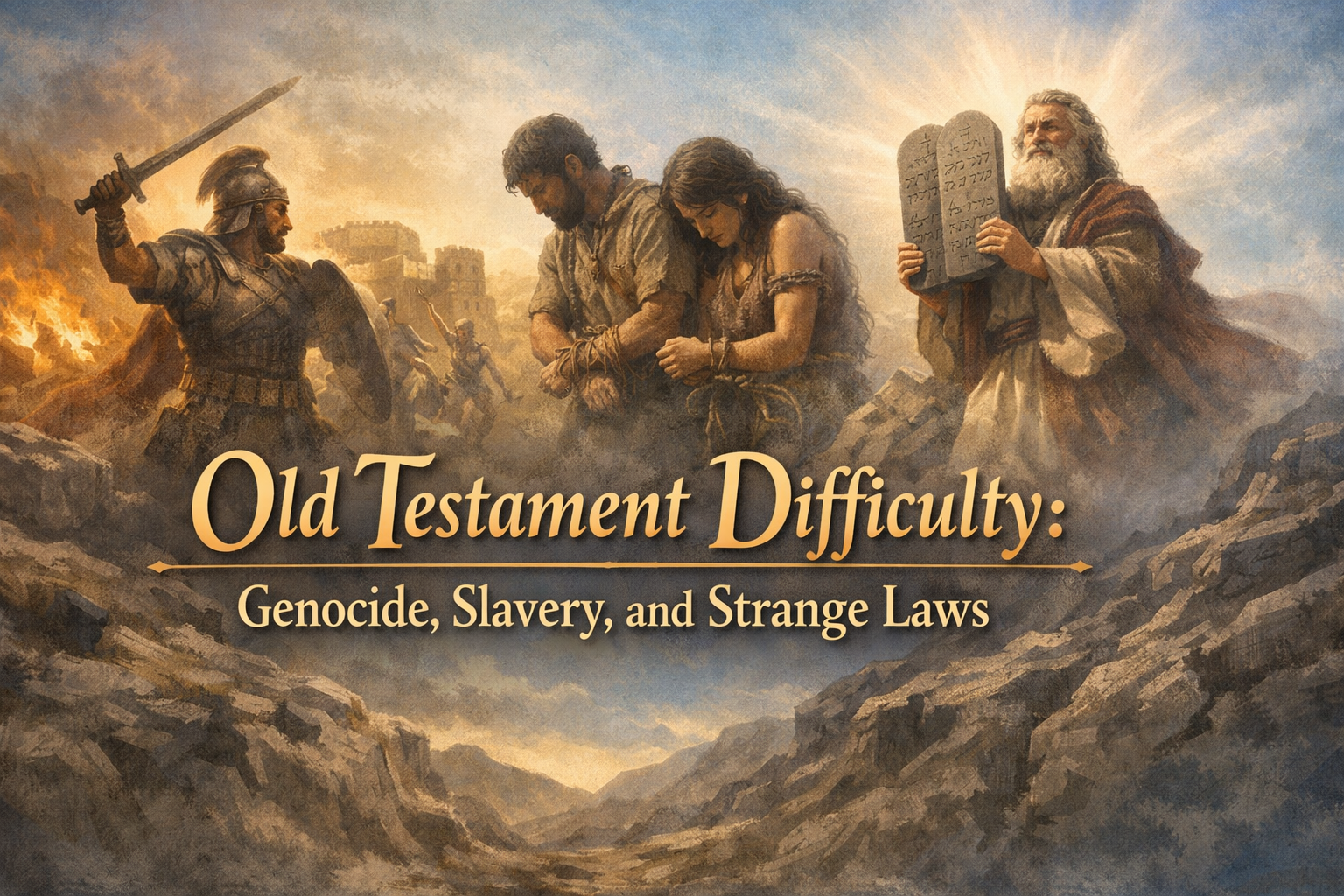
Old Testament difficulty: genocide, slavery, and strange laws
The Old Testament has passages that stop people cold. Genocide commanded by God. Slavery regulated but not condemned. Laws about fabrics and shellfish that no Christian follows. If you’ve ever read these and wondered what to do with them, you’re asking the right questions. Here’s how serious Christians have engaged them — honestly.
The Old Testament contains some of the most challenging material in all of human literature. God commanding the slaughter of entire populations. Slavery regulated rather than abolished. Laws about mixing fabrics. Instructions for selling your daughter. These passages don’t disappear when you close the cover. They require honest engagement — not dismissal, not embarrassed silence, and not pretending they say something other than what they say.
Let’s start with what we’re not going to do.
We’re not going to pretend these passages are easy. They aren’t, and any Christian who tells you they are has either not read them carefully or has not thought about them honestly. We’re not going to apply a quick theological patch and move on. And we’re not going to do what a lot of popular-level Christian apologetics does — answer the easy version of the question while ignoring the hard version.
What we are going to do is work through these texts with the tools of serious biblical interpretation, be honest about where the texts remain difficult after the best engagement we can offer, and show why these difficulties — real as they are — don’t undermine confidence in the God of the Bible or the character of Scripture.
This is one of those topics where intellectual honesty and genuine faith are not in tension. In fact, the willingness to sit with difficulty is one of the marks of a faith that takes truth seriously. Let’s get into it.
The Tools We Bring to Hard Texts
Before we look at specific passages, it helps to have a set of tools in hand — a framework for approaching texts that initially appear to portray God in ways that seem incompatible with his character as revealed in the New Testament.
1. Take the text seriously rather than spiritualizing it away. The temptation with difficult passages is to immediately reach for an allegorical or purely symbolic interpretation that makes the difficulty disappear. This usually creates more problems than it solves, and it’s intellectually dishonest. If the text says God commanded the killing of the Canaanites, engage that claim — don’t turn the Canaanites into a metaphor for sin unless the text itself invites that reading.
2. Read the text in its literary and historical context. Ancient Near Eastern cultures had frameworks for warfare, justice, and social structure that are not ours. Understanding what a text meant in its original context is a prerequisite for evaluating it — not a way of excusing it, but a way of understanding what it is actually claiming.
3. Locate the text in the whole biblical story. The Old Testament is not the final word on many of the things it addresses. It is part of a progressive revelation — God working with a specific people in a specific historical situation, moving them toward something more complete. Jesus himself says in Matthew 19 that Moses “permitted” divorce “because of the hardness of your hearts” — acknowledging that some Old Testament provisions were accommodations to human limitation, not the final expression of God’s will.
4. Let Jesus be the interpretive lens. The New Testament consistently presents Jesus as the fulfillment of the Old Testament — the one who brings to completion and clarity what the Old Testament was moving toward. When Jesus says “You have heard it was said… but I say to you,” he is not contradicting the Old Testament. He is authoritatively interpreting and in some cases escalating it. Reading the Old Testament through the lens of Jesus is not abandoning it — it’s reading it as it was designed to be read.
5. Distinguish between what God commanded, what God permitted, and what God merely recorded. Not everything in the Old Testament narrative is endorsed by the narrator. Much of it is simply described. Asking who is commanding what, and whether the text presents it as God’s will or as a human action God records and sometimes judges, prevents a lot of misreadings.
The Hardest One: Genocide in the Old Testament
The Canaanite conquest is the most serious challenge the Old Testament poses to Christian faith. God commands Israel to destroy entire populations — men, women, children, and livestock. In Deuteronomy 20 and Joshua 6–11, the word used is herem — total destruction, complete devotion to destruction. This is not ambiguous. The text means what it says.
Here is the most honest engagement the tradition has offered:
The Hebrew word herem — translated “devoted to destruction” or “put under the ban” — is the central term. It means setting something apart as wholly belonging to God, typically by destruction. It appears in the context of the Canaanite conquest specifically and was not a general military policy. Israel was not commanded to wage herem war against all their enemies — only against specific Canaanite populations in the land God was giving them.
Recent Old Testament scholarship has argued that the conquest narratives use ancient Near Eastern hyperbolic war rhetoric — a literary convention common throughout the ancient world in which total destruction is claimed even when the enemy survives and continues to appear in the narrative. The same books that claim total destruction of the Canaanites (Joshua) also describe ongoing Canaanite presence in the land and ongoing conflicts with them (Judges). This does not resolve the moral question entirely, but it does raise the question of whether the texts are claiming what we initially read them as claiming.
The biblical narrative does not present the Canaanite conquest as arbitrary ethnic cleansing. It presents it as divine judgment on a specific population whose moral and religious practices had reached an extreme that the text describes as vomiting the land out (Leviticus 18:24–28). Archaeological and textual evidence confirms that Canaanite religion included child sacrifice, ritual prostitution, and other practices that even the standards of the ancient world regarded as extreme.
The text also explicitly states that Israel’s occupation of the land was not on the basis of Israel’s righteousness (Deuteronomy 9:4–6) — it was the completion of judgment on the Canaanites that had been building for generations. Abraham is told in Genesis 15:16 that the iniquity of the Amorites “is not yet complete” — suggesting a centuries-long patience before judgment falls. This context does not make the command comfortable, but it changes its character from arbitrary ethnic violence to the execution of judgment that had been withheld for generations.
The conquest narratives exist within a story that moves dramatically away from this kind of violence as the revelation unfolds. The prophets move toward a vision of universal peace — swords into plowshares, nations streaming to Jerusalem, the nations blessed through Israel. Jesus explicitly rejects the “eye for an eye” retaliatory ethic, commands love of enemies, and tells Peter to put his sword away. The New Testament contains no commission to wage herem warfare against anyone.
The theological move here is not to say God was wrong in the Old Testament. It is to recognize that God was working with a specific people in a specific historical situation — forming a nation, establishing boundaries, creating a distinct community within the nations — and that some of the provisions of that era were tied to that specific situation in ways that the New Testament explicitly supersedes.
The pattern is consistent: God meets people where they are and moves them toward where he is taking them. The Old Testament represents an earlier stage of that journey, not the destination.
Slavery in the Old Testament
The second great challenge: the Old Testament does not abolish slavery. It regulates it. Exodus 21, Leviticus 25, and Deuteronomy 15 contain laws about the treatment of slaves — laws that have been used both by defenders of the institution and by critics of biblical morality. Both uses require careful examination.
The antebellum American chattel slavery — based on race, involving kidnapping and forced transport, treating human beings as property with no legal personhood — has essentially no basis in the Old Testament laws and is explicitly condemned in them. Exodus 21:16 makes kidnapping for enslavement a capital offense. The runaway slave law of Deuteronomy 23:15–16 commands sheltering escaped slaves and not returning them — the opposite of the Fugitive Slave Act.
A complex set of arrangements including debt-bondage (voluntary entry into service to pay off debt, with a mandatory release at seven years), war captivity, and economic servitude. These arrangements varied by whether the servant was Hebrew or foreign, had specific legal protections for servants, and functioned more as an ancient economic welfare system than as chattel ownership. This does not make it comfortable by modern standards — but it is a different thing from what “slavery” conjures in American cultural memory.
The most important hermeneutical point about slavery in the Old Testament is the distinction between regulation and endorsement. God regulated an institution that existed throughout the ancient world — an institution Israel’s neighbors practiced in far harsher forms — while building in protections that significantly limited its harshest abuses. A Hebrew servant served a maximum of six years before mandatory release (Deuteronomy 15:12–15). Servants beaten severely enough to lose teeth or an eye were to be freed (Exodus 21:26–27). The Sabbath applied to servants as well as owners (Exodus 20:10).
These laws are not abolition. But in context they represent a significant restriction of what the ancient world permitted — and they embed within the Mosaic law a set of values (human dignity, limitation of power over others, periodic liberation) that point beyond themselves toward the fuller expression of human dignity the New Testament makes explicit.
Paul’s letter to Philemon — a personal plea for the freedom of a runaway slave — and the statement that in Christ “there is neither slave nor free” (Galatians 3:28) represent the trajectory of biblical revelation arriving at its destination. The abolition movement in both Britain and America was driven largely by Christians citing these New Testament principles against the institution of slavery — a trajectory that was embedded in the Old Testament itself, even if it required centuries of revelation to reach its explicit expression.
The Strange Laws: Shellfish, Mixed Fabrics, and Stoning Your Children
Some Old Testament laws confuse people because Christians don’t follow them and have no obvious reason why not. Others confuse people because they seem impossibly harsh. Both categories deserve attention.
Why Christians Don’t Follow the Dietary and Fabric Laws
This is actually one of the easier questions once you have the right framework. The Old Testament law was given to Israel as the terms of the Mosaic covenant — the specific relationship between God and this specific nation. The law served multiple purposes, including marking Israel off from the surrounding nations as a distinct people. The dietary laws, the fabric laws, and many of the ritual laws functioned as boundary markers — they maintained a visible distinction between Israel and the nations around them.
The New Testament explicitly addresses the ceremonial laws. Acts 10 records God telling Peter that the dietary distinctions have been abolished — what God has made clean, Peter is not to call unclean. The letter to the Galatians argues that circumcision is no longer required for Gentile believers. Hebrews explains at length that the entire sacrificial system was a shadow pointing toward the substance of Christ’s once-for-all sacrifice. Colossians 2:16–17 says explicitly that food laws, drink laws, and holy days “are a shadow of the things that were to come; the reality, however, is found in Christ.”
So Christians don’t follow the dietary and fabric laws for the same reason they don’t offer animal sacrifices: the New Testament explains that these laws were pointing toward Christ, and the arrival of what they pointed toward means the shadow gives way to the substance. This is not arbitrary selective Bible reading. It is reading the Old Testament the way the New Testament teaches you to read it.
The Harsh Penalties: Stoning for Sabbath-Breaking and Dishonoring Parents
Leviticus and Deuteronomy contain laws mandating death for a range of offenses that modern readers find wildly disproportionate: gathering firewood on the Sabbath (Numbers 15:32–36), cursing your parents (Leviticus 20:9), adultery (Leviticus 20:10), and others.
Several factors help locate these laws properly. First, they governed Israel as a theocratic nation-state — a community in which the political and the religious were unified in a way that has not existed in any Christian society and does not apply to the church. These were civil penalties for civil offenses in a context where religious identity and national identity were inseparable.
Second, the evidentiary requirements for capital punishment in Mosaic law were extraordinarily stringent. Two or three witnesses were required for any capital conviction (Deuteronomy 17:6). False witnesses received the penalty the accused would have received (Deuteronomy 19:16–21). The rabbinic tradition later added so many procedural safeguards to capital cases that some rabbis argued a Sanhedrin that executed anyone once in seventy years was considered bloodthirsty. These laws were not designed for quick or easy execution.
Third, the trajectory of biblical revelation moves decisively away from these civil penalties in the New Testament. When the religious leaders bring to Jesus a woman caught in adultery — a capital offense under Mosaic law — Jesus does not endorse the execution. He disperses the crowd and tells her to go and sin no more. He is not abolishing the moral law (adultery remains wrong). He is demonstrating that the civil-penalty apparatus of the Mosaic covenant does not carry forward into the new covenant era.
Selling Your Daughter and Other Passages That Stop People Cold
Exodus 21:7: “If a man sells his daughter as a servant…” The verse is real. It is in the Bible. Here is what is required to engage it honestly.
The law in Exodus 21:7–11 does not give a father unrestricted authority to sell his daughter into any situation. It governs a specific arrangement — the placement of a daughter into a household that would lead to marriage, common in the ancient Near East as an economic arrangement that provided for daughters in a world where women had almost no independent economic means. The law then enumerates her rights within that arrangement: if the man she is placed with does not marry her, she cannot simply be sold to foreigners; if she is given to his son, she must be treated as a daughter; her food, clothing, and marital rights cannot be diminished; if they are, she is to go free without payment.
This is not a charter for the trafficking of women. It is a law that takes an existing practice — prevalent throughout the ancient world in far more brutal forms — and wraps it in protections for the woman that the surrounding cultures did not offer. It is regulation of a practice the surrounding world normalized, with significant built-in protections.
Is it the New Testament vision of the dignity and equality of women? No. Is it the worst possible reading that the verse initially invites? Also no. It is a law doing what ancient law did — governing a world it did not have the power to instantly remake, from the inside, while embedding values that would eventually produce a more complete vision.
The Deeper Question: Is the God of the Old Testament Different From the God of the New?
This is really the question underneath all the others. The second-century heretic Marcion answered it by saying yes — the Old Testament God is a different, inferior deity, and Christians should reject the Old Testament entirely. The church rejected Marcion’s answer then. It is still the wrong answer.
The Old Testament and the New Testament do present God differently in some respects. The wrath of God is more explicit and more frequently enacted in the Old Testament. Direct divine commands to kill appear in the Old Testament and not in the New. The picture of God does develop — not because God changes, but because the revelation of God’s character unfolds progressively across the canon.
Several things need to be said simultaneously. The God of the Old Testament is also the God of Exodus 34:6–7 — “The LORD, the LORD, the compassionate and gracious God, slow to anger, abounding in love and faithfulness” — which is the most frequently repeated divine self-description in the entire Old Testament. The God of the New Testament is also the God of Hebrews 12:29 — “a consuming fire” — and of Revelation’s judgment scenes that are as intense as anything in the Old Testament.
The difference is not a different God. It is a different stage of the story. The Old Testament is the era of preparation, formation, and national covenant with Israel — an era in which God works through specific historical acts of judgment and deliverance with a specific people. The New Testament is the era of fulfillment, in which God himself enters the story in human form, absorbs the judgment into himself at the cross, and extends the covenant to all nations. The cross does not make God softer. It reveals how seriously he took the problem that required it.
The charge that the God of the Old Testament is a moral monster requires one to either ignore the New Testament’s wrath and judgment, or to ignore the Old Testament’s mercy and patience. Neither portrait is complete without the other.
What to Do With the Passages That Still Bother You
After all of the above, some passages will still bother you. That’s the right response to them, actually — they should bother you. A God who commanded the killing of children should produce moral discomfort in you, and that discomfort is not evidence against the faith. It is evidence that you have a functioning moral conscience, which the Christian tradition holds comes from being made in the image of a God who cares about those children.
The question is what to do with the discomfort.
The worst option is to suppress it — to adopt the posture that any question about the Old Testament is a failure of faith. It isn’t. Job argued with God. The Psalmists argued with God. Habakkuk’s entire short book is an argument with God about why he appears to be doing something morally wrong. God engages those arguments rather than dismissing them. He can handle yours.
The second-worst option is to let the discomfort settle into a conclusion before you’ve done the work. “This passage troubles me, therefore the Bible is unreliable, therefore Christianity is false” is a very long chain of inferences, and several of the links need examining before you commit to the conclusion.
The most honest option is to hold the difficulty in tension with the cumulative weight of everything else you know about the God of the Bible — his patient dealings with Abraham, his mercy to Israel in Egypt, his grief over the exile, his entry into human suffering in the person of his Son, his promise to make all things new. A God capable of all of that is at minimum not obviously the moral monster the most superficial reading of a few passages suggests. He is a God whose ways are higher than ours — and who has given us enough of his character that trusting him with the parts we don’t yet fully understand is not a category of intellectual cowardice. It’s the most reasonable response to the available evidence.
“The Scripture is full of difficulties, but where I cannot understand, I will trust.”
— Martin Luther
Key Takeaways
- The hard passages require honest engagement, not dismissal or embarrassed silence. Pretending they aren’t difficult or quickly patching them with superficial answers is worse than sitting with the difficulty. The Bible can take serious scrutiny — and a faith that can’t engage hard questions honestly isn’t much to stand on.
- The Canaanite conquest is the most serious challenge, and it has multiple serious responses. Ancient Near Eastern hyperbolic rhetoric, the context of centuries-patient judgment on extreme wickedness, and the trajectory of the whole story away from this kind of violence all matter. The question of children remains genuinely unresolved at a fully satisfying level.
- Old Testament slavery was not antebellum chattel slavery. It was a complex set of debt-servitude and war-captivity arrangements, regulated with protections far beyond what surrounding cultures required. The trajectory of biblical revelation — “there is neither slave nor free” — was embedded in the Old Testament’s values and arrived at its explicit expression in the New.
- The three categories of Old Testament law explain why Christians follow some laws and not others. Moral law (reflecting God’s unchanging character) is reaffirmed in the New Testament. Civil law (governing Israel as a theocratic nation) provides principles but not directly applicable codes. Ceremonial law (maintaining Israel’s distinctness) is fulfilled and superseded in Christ — which is why Christians eat shellfish but don’t offer animal sacrifices.
- The harsh penalties were tied to a specific theocratic context with stringent evidentiary requirements. They governed a community in which religious and national identity were inseparable, with procedural safeguards the text itself establishes. Jesus’s handling of the adultery case demonstrates that these civil penalties do not carry forward into the new covenant.
- The God of the Old Testament and the God of the New Testament are the same God at different stages of the same story. The difference is not a different deity — it is a progressive revelation of the same character across different eras of redemptive history. The Old Testament’s wrath and the New Testament’s mercy are both expressions of a God who takes sin and righteousness seriously.
- The passages that still bother you after all of this are not enemies of faith — they are invitations to deeper engagement. Holding difficulty in tension with the cumulative weight of what you know about God’s character is the most intellectually honest thing you can do. Trust where you cannot yet understand — not as intellectual surrender, but as the reasonable response of someone who has examined the evidence seriously.
Honest Questions Deserve Honest Engagement
If the hard passages of the Old Testament are what’s holding you back from taking the Bible — or the faith — seriously, you’re not alone. These are questions serious people have wrestled with for centuries, and the wrestling is worth doing rather than avoiding.
The answers here are not all the way satisfying. Some of these texts remain genuinely difficult after the best engagement we can offer. But the cumulative weight of who the Bible reveals God to be — patient, merciful, just, and willing to enter human suffering himself rather than exempt himself from it — is strong enough to trust him with the parts we don’t yet fully understand.
If you want to keep working through this — in a community of people who take both the text and the questions seriously — Mountain Veteran Ministries is here for that conversation. Reach out.
Key Scriptures: Genesis 15:16 · Deuteronomy 9:4–6 · Deuteronomy 15:12–15 · Exodus 34:6–7 · Leviticus 18:24–28 · Matthew 19:8 · John 8:1–11 · Galatians 3:28 · Colossians 2:16–17 · Hebrews 12:29 · Acts 10:15 · Isaiah 2:4
Mountain Veteran Ministries
Find Your Next Bearing
Every journey needs a direction. If you're wondering where to go from here, choose the path that best fits where you are today.
⚒️ I Want to Live Faithfully
Discover practical wisdom for following Christ in today's world.
→ Living as a Christian Today✝️ I Want to Understand the Gospel
Learn what salvation means and why Jesus came.
→ Understanding Salvation📖 I Want to Understand the Bible
Explore why Christians trust Scripture and how to read it well.
→ Understanding the Bible❓ I Still Have Questions
Explore thoughtful answers to some of Christianity's hardest questions.
→ Hard Questions