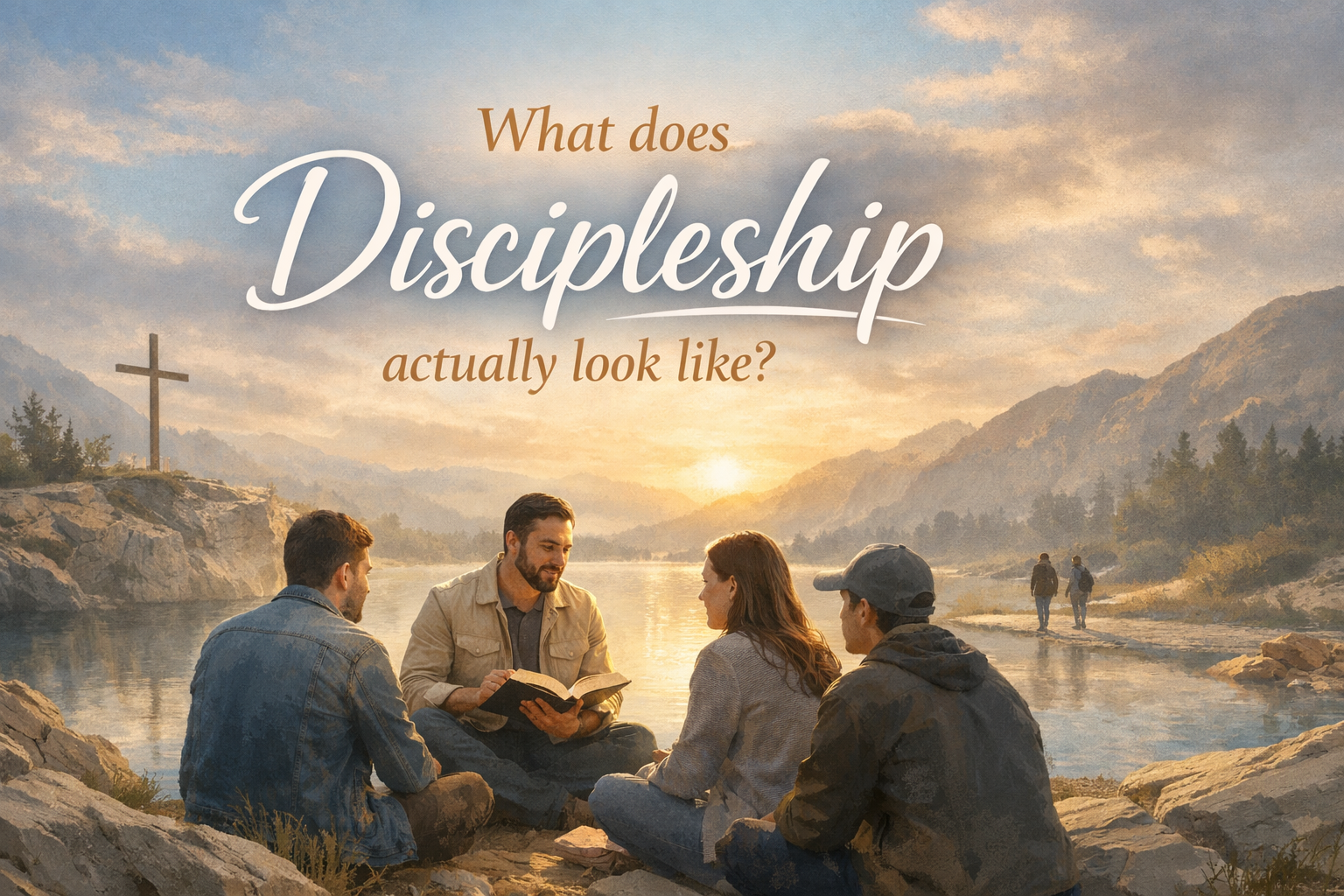
What does discipleship actually look like?
Discipleship is one of the most talked-about words in the church and one of the least understood in practice. We say we want to make disciples, but when you press people to describe what that actually looks like on a Tuesday afternoon, things get vague fast. The New Testament is less vague. It shows us something concrete, demanding, and worth the cost.
Jesus gave us a clear command. The church has made it complicated. Let’s get back to what it actually means to make and be a disciple.
The Great Commission is three sentences long. Go. Make disciples. Baptize and teach them to obey everything I commanded you. That’s the whole assignment.
And yet walk into most churches today and ask someone to define discipleship in concrete terms — what it looks like, where it happens, what you’re actually doing — and you’ll get a range of answers that don’t add up to the same picture. Programs. Small groups. Curriculum. Podcasts. Sunday services. All of these get labeled “discipleship.” Some of them are. Some of them are discipleship-adjacent at best.
This isn’t a criticism of any particular church. It’s an observation that the word has gotten stretched thin. When everything is discipleship, nothing is. And when nothing is, we end up with a lot of people who have attended a lot of church activities and still don’t look much like Jesus.
So what does discipleship actually look like? The New Testament gives us a clearer picture than we sometimes admit.
Start with What Jesus Did
Jesus spent three years with twelve men. He taught them publicly and privately. He brought them into situations they weren’t ready for and then debriefed afterward. He answered their questions, corrected their assumptions, modeled prayer, and gradually gave them more responsibility. When they failed — and they failed often — He didn’t fire them. He kept working with them.
That’s a discipleship model. It has some identifiable characteristics: proximity, intentionality, time, shared life, instruction, correction, and increasing responsibility. Notice what’s not on that list: a curriculum, a meeting room, or a twelve-week program with a completion certificate.
The word “disciple” — mathētēs in Greek — simply means learner. But in the first-century Jewish context, a disciple wasn’t just someone who learned a rabbi’s content. He was someone who followed the rabbi’s way of life. The goal wasn’t information transfer. It was formation — becoming someone who thought, prayed, related to others, and obeyed God the way your teacher did.
That distinction — information versus formation — is probably the most important lens for evaluating any discipleship effort. Are people accumulating knowledge, or are they actually changing?
The Four Elements You Can’t Skip
When you look at how discipleship actually worked in the New Testament — in Jesus’ ministry, in Paul’s letters, in the early church described in Acts — a few non-negotiable elements keep showing up.
1. The Word, taught and applied. Discipleship is always grounded in Scripture. Paul tells Timothy to devote himself to the public reading of Scripture, to exhortation, and to teaching (1 Timothy 4:13). He reminds him that all Scripture is breathed out by God and profitable for teaching, reproof, correction, and training in righteousness — so that the man of God may be complete (2 Timothy 3:16–17). The goal of Bible teaching in discipleship isn’t knowing more Bible. It’s being equipped to live differently. That means good teaching always connects the text to life — to the actual decisions, temptations, relationships, and callings your disciple is navigating right now.
2. Accountability and honest relationship. Discipleship happens in relationships where the truth can be told. Not performance relationships, where people show their best self. Real ones. Paul tells the Ephesian elders he taught them “publicly and from house to house” (Acts 20:20), and he wasn’t shy about naming sin and calling people to repentance. Hebrews tells us to exhort one another daily, “that none of you may be hardened by the deceitfulness of sin” (Hebrews 3:13). Sin deceives. Isolation gives it room to operate. Honest relationship is part of how we fight it.
3. Shared life and witness. The early church didn’t just meet for services. They broke bread together, held things in common, met in each other’s homes, and bore witness to the resurrection in the ordinary spaces of their lives (Acts 2:42–47). Discipleship that happens only in scheduled meetings is missing something. When you share life with someone — when they see how you handle conflict, how you talk to your kids, how you respond when things go wrong — that’s a discipleship context that a classroom can’t replicate. The world gets discipled watching how you actually live.
4. Reproduction. Paul’s instruction to Timothy in 2 Timothy 2:2 is one of the most compact discipleship blueprints in the New Testament: “What you have heard from me in the presence of many witnesses entrust to faithful men, who will be able to teach others also.” That’s four generations in one verse — Paul to Timothy, Timothy to faithful men, faithful men to others. The goal of discipleship is never just the person in front of you. It’s the people they will eventually disciple. A disciple who never makes disciples hasn’t finished becoming one.
Where It Actually Happens
Discipleship happens in at least three overlapping spaces, and a healthy church cultivates all three.
The gathered community — the corporate worship service — is where disciples hear the Word preached, receive the sacraments, sing truth together, and are shaped by the rhythms of the church calendar. It’s formative. But it’s not sufficient on its own. You can attend a church faithfully for a decade and never be truly known.
The small group or household is where the relational accountability, shared prayer, and deeper Bible discussion happen. This is closer to the “from house to house” model of Acts. It’s where people can say what’s actually going on in their lives and get a real response. Many churches treat this as optional or supplementary. The New Testament treats it as essential.
The one-on-one or one-on-two relationship is the most targeted and often most neglected. This is where a more mature believer walks intentionally alongside a younger one — asking hard questions, opening their life to observation, giving specific feedback. It’s the model Jesus used with the Twelve, and the model Paul used with Timothy and Titus. It doesn’t scale easily, which is probably why institutions prefer other options. But the fruit it produces tends to be deeper and more durable.
Healthy discipleship doesn’t require choosing between these. It uses all three, understanding that each one does something the others can’t.
What It Costs
Here’s why discipleship gets watered down: it’s expensive. Not financially. It costs time, vulnerability, and the willingness to let someone else see you up close.
Programs are easier to scale than relationships. Curriculum is easier to distribute than life. A podcast reaches thousands; intentional mentorship reaches one or two. The return on investment looks terrible by most metrics — until you zoom out and see what that one or two become, and what the people they disciple become after that.
Jesus didn’t build a movement by reaching the masses first. He built it by going deep with twelve. The masses came later, through the men He had formed.
That pattern still holds. The most durable growth the church has ever seen has come through disciple-making relationships, not primarily through programs or platforms. This doesn’t mean programs are worthless — it means they work best when they’re feeding and supporting those relationships, not replacing them.
A Word on the Veteran Community
The military runs on something that looks a lot like discipleship, even if nobody calls it that. Senior enlisted leaders pass down institutional knowledge, tactical skills, and professional standards to junior personnel through close, ongoing relationship. The good ones don’t just teach what to do — they model who to be. That’s formation, not just information.
Veterans understand this intuitively. They know the difference between someone who briefed them from a slide deck and someone who walked beside them through something hard and showed them how to carry it. The second kind of leadership changes you.
That’s exactly what Christian discipleship is supposed to be. Not a class you take, but a relationship you enter. If you’ve been in the military, you already understand the concept. The question is whether you’re willing to be that kind of presence for someone in the church — and whether you’re open to finding someone who can be that for you.
Key Takeaways
- Discipleship is formation, not just information. The goal is people who are becoming like Christ, not people who have accumulated more biblical content without corresponding change in how they live.
- Jesus modeled the core method: proximity, time, shared life, instruction, and increasing responsibility. No program or curriculum replicates this — it requires actual relationship.
- Four elements are non-negotiable: the Word applied, honest accountability, shared life, and reproduction. A discipleship effort missing any of these is incomplete.
- Discipleship happens in three overlapping spaces: gathered worship, small groups, and one-on-one relationships. Healthy churches cultivate all three rather than substituting one for the others.
- The cost is real — time, vulnerability, and intentionality. Programs scale more easily than relationships, but relationships produce more durable fruit.
- The goal is always multiplication. Paul’s instruction in 2 Timothy 2:2 builds four generations into a single sentence. A disciple who never makes disciples hasn’t finished becoming one.
Key Scriptures: Matthew 28:18–20 · Mark 3:13–19 · Acts 2:42–47 · 2 Timothy 2:2 · 2 Timothy 3:16–17 · Hebrews 3:12–13 · Colossians 1:28–29 · Luke 6:40
Mountain Veteran Ministries
Find Your Next Bearing
Every journey needs a direction. If you're wondering where to go from here, choose the path that best fits where you are today.
⚒️ I Want to Live Faithfully
Discover practical wisdom for following Christ in today's world.
→ Living as a Christian Today✝️ I Want to Understand the Gospel
Learn what salvation means and why Jesus came.
→ Understanding Salvation📖 I Want to Understand the Bible
Explore why Christians trust Scripture and how to read it well.
→ Understanding the Bible❓ I Still Have Questions
Explore thoughtful answers to some of Christianity's hardest questions.
→ Hard Questions