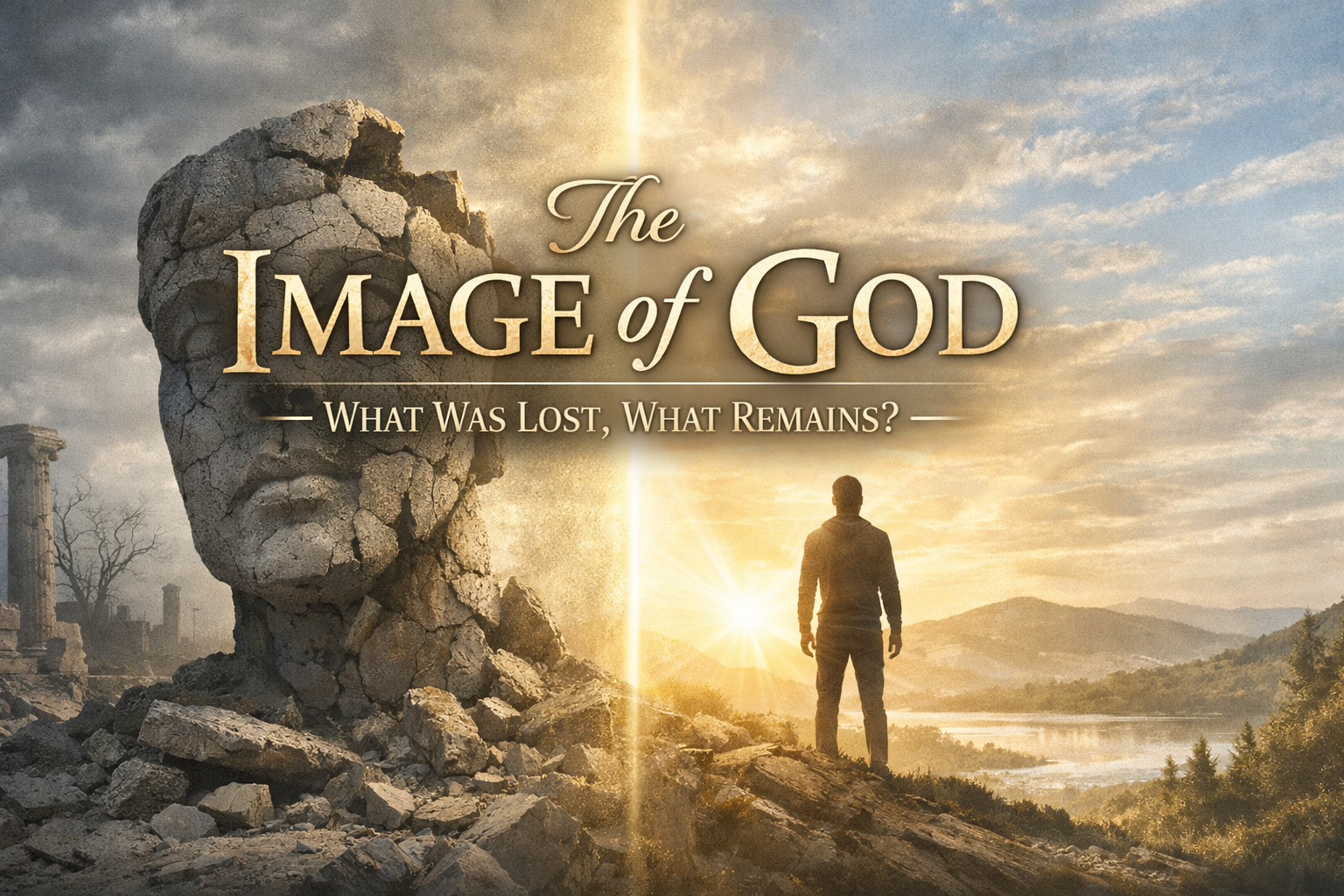
The Image of God — What Was Lost, What Remains?
The doctrine of the image of God is one of those Bible truths simple enough for a child to hear and deep enough for a theologian to study all his life. It reaches from the first page of Genesis all the way forward to the hope of redemption in Christ. When man fell into sin, what happened to that image? Was it lost entirely? Damaged? What remains? The answer shapes how we think about human dignity, sin, morality, and what salvation actually accomplishes.
The best biblical answer is this: the image of God in man was not destroyed by the fall, but it was deeply marred, morally corrupted, and spiritually disordered. Something real remains in every human being. Something precious was lost in terms of original righteousness, holiness, and proper fellowship with God. The image was not erased, but it was damaged. Man is still man, still bearing God’s image in an important sense. But he is no longer what he was meant to be — not apart from redeeming grace.
This doctrine lets Christianity say two things at once without apology: Human beings are deeply broken and Human beings are still profoundly valuable. Both truths belong together, and you need both to think rightly about sin, dignity, and salvation.
The Image of God at Creation
Genesis 1:26–27 — “And God said, Let us make man in our image, after our likeness… So God created man in his own image, in the image of God created he him; male and female created he them.”
That is one of the most important statements in all of Scripture. Human beings are unlike the animals, unlike the plants, unlike every other earthly creature — made in special relation to God. Christians have long discussed exactly what the image includes, and the Bible does not reduce it to any single trait. It seems right to understand the image broadly: man reflects God in a creaturely way through his rationality, moral awareness, relational capacity, spiritual nature, and royal calling to exercise dominion under God.
In plain terms, man was made to know God, represent God, and live under God’s rule in holy fellowship. Adam was not merely alive — he was upright. Not merely intelligent — he was morally ordered. Not merely biological — he was a covenant creature made for communion with God. That matters because it helps us see precisely what was damaged in the fall.
What Was Lost in the Fall
Original righteousness was lost. Ecclesiastes 7:29 says, “God hath made man upright; but they have sought out many inventions.” That uprightness did not remain after the fall. The heart turned from God. The will bent toward sin. The affections became disordered. The mind became darkened. While the image in a broad structural sense remained, the moral beauty of that image was badly damaged.
Fellowship with God was broken. Before sin, Adam and Eve enjoyed open communion with God. After sin, they hid. The image-bearing creature no longer functions as he should — still made for God, but now alienated from God. Still accountable, but estranged. Still personal, but spiritually dead apart from grace. That is one of the saddest turns in all of Scripture: the creatures made to walk with God now shrink back in fear and shame.
Moral and spiritual clarity was darkened. The fall did not eliminate the human mind, but it darkened it spiritually — “Having the understanding darkened, being alienated from the life of God” (Ephesians 4:18). Unbelievers can still think intelligently about many things. But as to God, truth, holiness, and spiritual beauty, the fallen mind is darkened and distorted.
The affections were disordered. Man still loves — but he loves wrongly. He loves gifts more than the Giver. He loves self-rule more than obedience. He loves darkness rather than light. The image was made to reflect God in holy love and glad submission. Sin did not erase the capacity to love, but it twisted its direction.
Dominion was frustrated by the curse. Part of man’s image-bearing role was to rule creation under God. That dominion was not removed, but it became painful, contested, and frustrated — thorns, sweat, decay, and death. Man still builds, plants, governs, invents, and shapes culture. But now all of it happens east of Eden, under the shadow of futility.
What Remains After the Fall
The image of God was not annihilated. Something real remains in every human being — and Scripture is explicit about this even after the fall.
After the flood — long after Eden — God says:
Genesis 9:6 — “Whoso sheddeth man’s blood, by man shall his blood be shed: for in the image of God made he man.”
That is crucial. Humanity after Eden, after sin, after judgment, is still spoken of as bearing God’s image. The prohibition against murder is grounded in that continuing reality. James confirms it: “therewith curse we men, which are made after the similitude of God” (James 3:9) — again describing post-fall humanity. The image remains in a meaningful sense.
Fallen people still reason, communicate, create, form relationships, make moral judgments, and act as moral agents. They still have conscience. Even Gentiles without the written law “shew the work of the law written in their hearts, their conscience also bearing witness” (Romans 2:14–15). That is not saving righteousness, but it is evidence that man remains a morally accountable creature before God.
Even in a fallen state, humanity still tills fields, designs tools, writes books, governs towns, raises children, and shapes culture. Fallen man can produce art, music, architecture, poetry, systems of law, acts of courage, and forms of compassion. None of that means he is spiritually whole. It means the ruin is the ruin of an image-bearer — not the ruin of a non-human creature. A wrecked barn is still a barn. A broken mirror is still a mirror. It does not reflect as it should, but it still tells you what it was made for.
The Broader and Narrower Image
The simplest way to hold this together is a distinction the old theologians found helpful:
The image in the broader sense includes those human capacities and callings that remain after the fall — reason, personhood, moral awareness, dominion, relational life, accountability. These persist in every human being because God made man this way, and the fall did not unmake his humanity.
The image in the narrower sense includes man’s original righteousness, holiness, and true knowledge of God — the moral and spiritual beauty of the image as it was at creation. That narrower sense has been lost and must be restored by grace.
So: the structure remains; the holiness is lost. The dignity remains; the righteousness is ruined. The image abides; the likeness must be renewed. That is why every person deserves dignity — and every person needs redemption.
The New Testament: Renewal of the Image
The New Testament speaks of salvation partly in terms of restoring what the fall destroyed. Paul says believers have “put on the new man, which is renewed in knowledge after the image of him that created him” (Colossians 3:10). And in Ephesians:
Ephesians 4:24 — “Put on the new man, which after God is created in righteousness and true holiness.”
Knowledge, righteousness, and holiness — exactly what was lost in the fall — are being renewed in the people of God. The image remains in all human beings, but in believers it begins to be renewed in a saving and transformative way.
And if you want to understand the image of God most fully, you must look to Christ. The New Testament calls Him the image of God in the highest and fullest sense — “the image of the invisible God” (Colossians 1:15), “the express image of his person” (Hebrews 1:3). Where Adam failed, Christ did not. Where man’s image-bearing became distorted, Christ reveals perfect human obedience and perfect divine glory. He is not merely a repaired Adam. He is the true and flawless man, the last Adam, the perfect image-bearer.
And when sinners are saved, they are not only forgiven — they are conformed to Him.
Romans 8:29 — “For whom he did foreknow, he also did predestinate to be conformed to the image of his Son.”
Redemption is not only rescue from wrath. It is restoration into the likeness of Christ. Not yet complete — the image is being renewed, and full conformity awaits the resurrection. But it is begun. Christians are not what they once were, and by grace they will not remain as they are.
What This Means in Practice
For human dignity: Because the image remains, Christians should be the first to defend the dignity of every human life — opposing murder, abuse, cruelty, exploitation, racism, and every casual treatment of people as disposable. Human value is not earned by intelligence, strength, or usefulness. It is grounded in God’s creating act. You cannot treat people as trash if you believe they bear the mark of their Maker — including the weak, the elderly, the disabled, the inconvenient, the stranger, and the enemy.
For understanding sin: Because the image is marred, we should not be sentimental about human nature. A polished sinner is still a sinner. A cultured rebel is still a rebel. Man can invent life-saving tools and wage monstrous wars with the same hands, compose beautiful music and still hate his brother, show tenderness one day and cruelty the next. The dignity is real. The corruption is real too. Education, culture, politics, and prosperity cannot fix the deepest problem.
For understanding salvation: The gospel is not God tossing humanity aside and starting over. It is God redeeming ruined image-bearers through His Son — forgiving guilt, breaking sin’s dominion, renewing the heart, and beginning to restore what was morally and spiritually lost. Salvation is not merely legal pardon. It is re-creation. “If any man be in Christ, he is a new creature” (2 Corinthians 5:17).
A Plain Summary
- Original righteousness and uprightness
- True holiness before God
- Open fellowship and communion with God
- Right moral order in heart, will, and affection
- Spiritual clarity toward God and His truth
- Freedom from corruption and death
- Human personhood and enduring dignity
- Rationality, creativity, and language
- Moral awareness and conscience
- Relational capacity and capacity to love
- Accountability before God
- A continuing (though broken) dominion calling
Think of an old hand mirror that has fallen off a shelf and cracked. It still reflects, but not cleanly. The image is there, but it is warped and fractured by the damage. That gets close to man after the fall — still reflecting something of God’s creaturely design, but the mirror is cracked. The reflection is distorted. Now imagine a master craftsman who does not throw the mirror away but repairs and restores it. That is closer to redemption. In Christ, God is restoring ruined image-bearers so that they may reflect His glory rightly again.
The image of God in man was not erased by sin, but it was deeply marred. What remains gives every human being enduring dignity. What was lost shows why every human being needs grace. And what is renewed in Christ gives believers their great hope: God is not finished with His image-bearers. He is restoring them, through the gospel, into the likeness of His Son.
Key Takeaways
- The image of God was marred in the fall, not erased. Scripture is explicit that post-fall humanity still bears God’s image (Genesis 9:6; James 3:9). The structural capacities of personhood, reason, conscience, and moral accountability remain — but original righteousness, holiness, and true fellowship with God were lost.
- The “broader” and “narrower” image is a helpful distinction. The broader image (human capacities and calling) remains in all people. The narrower image (original righteousness, holiness, and true knowledge of God) was lost in the fall and must be restored by grace in Christ.
- The remaining image grounds human dignity. Every person — regardless of usefulness, ability, age, or belief — bears the mark of their Maker. Christian ethics begins here. This is why Christians should be the first to oppose dehumanization in any form.
- The marred image grounds the urgency of the gospel. Because the image is corrupted — not merely scratched — sin is serious, man is genuinely fallen, and education, culture, or prosperity cannot solve the deepest problem. New birth, not self-improvement, is what is needed.
- Christ is the perfect image-bearer, and conformity to Him is redemption’s goal. He is “the image of the invisible God” (Colossians 1:15) — where Adam failed, Christ did not. Salvation is not only forgiveness; it is being conformed to His image (Romans 8:29). That renewal has begun in believers and will be complete at resurrection.
- The doctrine keeps us from two equal-and-opposite errors. Sentimentality about human nature (ignoring the depth of the fall) and despair about human worth (ignoring the remaining image) both go wrong. The Bible holds dignity and depravity together — and so should we.
Key Scriptures: Genesis 1:26–27 · Genesis 9:6 · Ecclesiastes 7:29 · Psalm 8 · Romans 2:14–15 · Romans 8:29 · 2 Corinthians 5:17 · Ephesians 4:18, 24 · Colossians 1:15 · Colossians 3:10 · James 3:9 · Hebrews 1:3
Mountain Veteran Ministries
Find Your Next Bearing
Every journey needs a direction. If you're wondering where to go from here, choose the path that best fits where you are today.
⚒️ I Want to Live Faithfully
Discover practical wisdom for following Christ in today's world.
→ Living as a Christian Today✝️ I Want to Understand the Gospel
Learn what salvation means and why Jesus came.
→ Understanding Salvation📖 I Want to Understand the Bible
Explore why Christians trust Scripture and how to read it well.
→ Understanding the Bible❓ I Still Have Questions
Explore thoughtful answers to some of Christianity's hardest questions.
→ Hard Questions