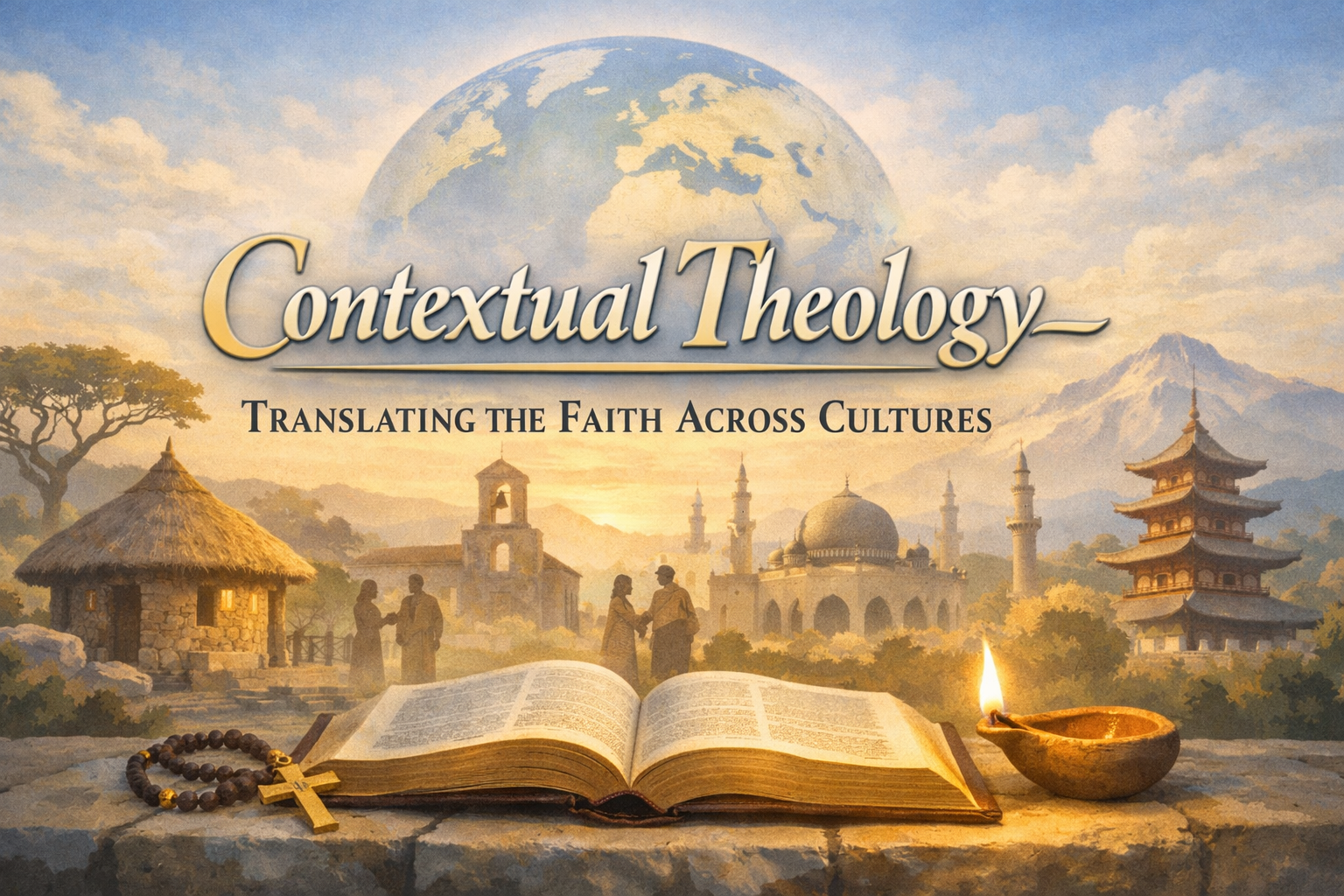
Contextual Theology — Translating the Faith Across Cultures
There is a difference between changing the message and translating the message. That difference matters a great deal in Christian ministry. How do we communicate the unchanging gospel in different cultures, languages, habits, and settings without watering it down or twisting it into something else? That is the heart of what people often call contextual theology — and done rightly, it is not compromise. It is translation.
This is not just a missionary question for people crossing oceans. It is a question for every preacher, parent, Bible teacher, and Christian who tries to explain the faith to another human being. A pastor in rural Oregon does not speak exactly like a church planter in downtown Seattle. A believer explaining Christ to a farmer, a mechanic, a soldier, a professor, or a new immigrant will not always use the same illustrations or start from the same assumptions. That does not mean the truth changes. It means people hear through particular ears shaped by particular worlds.
The church is always pulled in two directions. Understanding them helps us find the biblical middle.
Treating one cultural form of Christianity as though it were the gospel itself — defending habits, language, styles, and local customs as though God handed them down from Sinai. The result is a Christianity that appears foreign in needless ways and communicates: “To follow Christ, you must also adopt our cultural wrappers.”
Letting culture become the boss — adjusting the message itself so that repentance disappears, the exclusivity of Christ softens, or doctrine bends toward whatever a surrounding culture already wants affirmed. That is not translation. That is surrender to the age.
The biblical path is different from both. Contextual theology is the faithful expression of the old gospel in real human settings — not changing it, translating it.
The Gospel Is Supracultural
The Christian faith is not owned by any one culture. The gospel did not begin as a Western religion, even though Western history has been deeply shaped by it. It belongs to no tribe, nation, or people-group — it comes from God and speaks to all peoples.
That means Christianity is both at home in every culture (because Christ is Lord of all) and at odds with every culture (because every culture is fallen). No culture is so good that it needs no correction from Scripture. No culture is so foreign that it cannot receive Christ.
The gospel affirms what is good, exposes what is sinful, and transforms what is broken in every human setting. So contextual theology is not about taking a perfect culture and sprinkling a little Jesus on top. It is about bringing God’s Word to bear on every culture as both grace and judgment.
We See This in Scripture Itself
This is not a modern invention. The Bible itself shows us faithful contextualization in action.
Paul among Jews and Gentiles. Paul says: “Unto the Jews I became as a Jew, that I might gain the Jews… to them that are without law, as without law… I am made all things to all men, that I might by all means save some” (1 Corinthians 9:20–22). He did not change the gospel for different audiences. He adjusted his approach, language, starting points, and manner so that people could hear the same Christ clearly in their own setting. When speaking to Jews he often began with Scripture, promise, covenant, and fulfillment. When speaking to Gentiles unfamiliar with the Old Testament he often started with creation, providence, idolatry, and the nature of the true God. Same gospel. Different doorway.
Paul in Athens. Acts 17 is one of the clearest examples. In the synagogue Paul reasons from the Scriptures. But when speaking to pagan philosophers in Athens, he begins differently — their altar to the unknown god, God as Creator, a challenge to idolatry, even quoting lines familiar to his audience. He does not affirm their pagan worldview. He confronts it. But he does so in a way that engages their actual thought world. He started where they were in order to bring them where they needed to go.
Jesus Himself. Jesus taught through images people knew: seeds, fields, vineyards, fishing nets, weddings, shepherds, coin losses, family conflicts, debt, storms, lamps, bread. He spoke heavenly truth in earthly language without reducing the truth to the earthly thing. That is a model worth noticing.
The Crucial Distinction — Form and Content
A great deal of wisdom in this area comes down to keeping straight what changes and what cannot change.
- Who God is
- Who Christ is — His person and work
- What sin is and why it matters
- What the cross accomplished
- The necessity of repentance and faith
- The authority of Scripture
- The call to holiness
- The reality of judgment
- The hope of resurrection
- Language and vocabulary
- Illustrations and examples
- Order of explanation
- Tone and style
- Music forms and worship style
- Local customs that do not violate Scripture
- Practical packaging of truth for the audience
- Starting points and cultural bridges
A missionary may preach the same gospel under a tree, in a storefront, in a cathedral, or through a radio microphone. A rural preacher may explain providence through crop failure, weather, and land. A city pastor may use traffic, deadlines, and apartment life. The truth is the same. The form differs. If we confuse form with content we may end up defending our own habits as though they were the gospel. If we loosen content in the name of form, we lose the faith altogether.
Every Culture Has Doors and Walls
A faithful contextual theologian learns that no culture is all door or all wall. The gospel comes to every culture prepared to do three things: affirm, expose, and transform.
Every culture has traces of common grace — a sense of justice, family duty, spiritual reality, moral order, or longing for redemption. These can serve as contact points and bridges. A culture with strong honor-and-shame categories may open into a deep understanding of the cross. A culture that prizes individual conscience may open into a grasp of personal faith and accountability.
Every culture also carries idols, blind spots, sins, and distortions that the gospel must knock down. A culture that prizes family duty may resist the claim that Christ demands ultimate loyalty. A culture that prizes individual freedom may resist divine authority, community accountability, and the call to holiness. The gospel judges and renews every culture without exception.
What Must Never Be Compromised
- The authority of Scripture. Culture never gets veto power over God’s Word.
- The centrality of Christ. Contextual theology must not become merely social analysis with Bible language on top.
- The offense of the gospel. Some parts of Christianity will always offend fallen humanity. We must not confuse avoidable offense with necessary offense.
- The call to repentance and faith. No culture gets a version of Christianity that removes the need for conversion.
- The holiness of the church. The church is not meant to be absorbed into the surrounding world.
- Love for real people. Faithful contextualization is not marketing. It is pastoral, missionary, truth-telling love.
Common Dangers
Over-contextualization happens when the desire to connect becomes so strong that the message itself starts shifting — a gospel without repentance, a Christ without lordship, a kingdom without holiness, grace without truth, theology reduced to whatever a culture already wants affirmed. That is not contextual theology. That is surrender to the age. A church that stops talking about sin because its culture dislikes guilt is not being contextual. It is being cowardly.
Under-contextualization happens when Christians speak true things in such culturally tone-deaf ways that people cannot really grasp what is being said. The message may stay orthodox on paper but get wrapped in one cultural form so tightly that outsiders mistake the wrapper for the faith itself — accidentally communicating that following Christ requires adopting a particular social style, political instinct, and unwritten customs.
Confusing cultural preference with biblical command is where many church conflicts actually live. People may defend a music style, dress expectation, preaching tone, or tradition as though God handed it down from Sinai, when it may simply be a local custom. Wisdom is needed to tell the difference.
Romanticizing other cultures happens when Christians critique their own culture so heavily that they start treating other cultures as naturally purer or closer to biblical faith. That is naïve. Every culture carries idols, blind spots, and distortions. The gospel does not need one culture to rescue it from another. It judges and renews them all.
A Rural Illustration
Think about seed and soil. The seed is the gospel — it must stay what it is. If you change the seed, you will not get the right crop no matter how carefully you plant it. But soil conditions differ. One field is rocky. Another is heavy clay. Another is sandy. One needs more water. One needs the weeds cleared first. A wise farmer does not change the seed, but he pays close attention to the ground he is working.
That is something like contextual theology. The preacher or missionary does not invent a new gospel for each field. He brings the same seed. But he must understand the soil if he is going to plant wisely.
The church must hold two things together with steady hands: the gospel must never change, and the gospel must always be translated. Not transformed into another message — translated into the language of real people. Courageous enough to confront every culture where it rebels against God, and compassionate enough to speak so people can truly understand what God has said. Faithful contextual theology does both.
Key Takeaways
- Contextual theology is translation, not transformation. It is the faithful expression of the unchanging gospel within a particular cultural setting — not changing Christianity to fit a culture, but expressing Christianity clearly in that culture while letting it judge and transform the culture.
- The church faces two constant temptations: freezing the faith in one cultural form, or melting it into whatever culture prefers. The biblical path refuses both — it insists on holding form and content distinct, adapting the former while protecting the latter.
- The form of theology may legitimately vary; the content never may. Language, illustrations, examples, music, and packaging can shift with culture. God’s character, Christ’s person and work, the necessity of repentance and faith, and biblical authority cannot.
- The gospel is supracultural — at home in every culture, and at odds with every culture. No culture is all door or all wall. The gospel affirms traces of common grace, confronts idols, and transforms what sin has broken in every human setting without exception.
- Scripture models this throughout. Paul adjusted his starting point for Jews and Gentiles. On Mars Hill he engaged Athenian philosophy without affirming it. Jesus taught heavenly truth through earthly images. Faithful contextual theology is apostolic, not modern.
- The dangers run in two directions: over-contextualization dilutes the message; under-contextualization makes it needlessly inaccessible. Wisdom, prayer, and close attention to both Scripture and the people being addressed are needed to navigate between them.
Key Scriptures: Matthew 28:18–20 · Mark 4:1–20 · Acts 14:8–18 · Acts 17:16–34 · 1 Corinthians 1:18–25 · 1 Corinthians 9:19–23 · Colossians 1:28 · Colossians 4:2–6 · Revelation 5:9 · Revelation 7:9
Mountain Veteran Ministries
Find Your Next Bearing
Every journey needs a direction. If you're wondering where to go from here, choose the path that best fits where you are today.
⚒️ I Want to Live Faithfully
Discover practical wisdom for following Christ in today's world.
→ Living as a Christian Today✝️ I Want to Understand the Gospel
Learn what salvation means and why Jesus came.
→ Understanding Salvation📖 I Want to Understand the Bible
Explore why Christians trust Scripture and how to read it well.
→ Understanding the Bible❓ I Still Have Questions
Explore thoughtful answers to some of Christianity's hardest questions.
→ Hard Questions