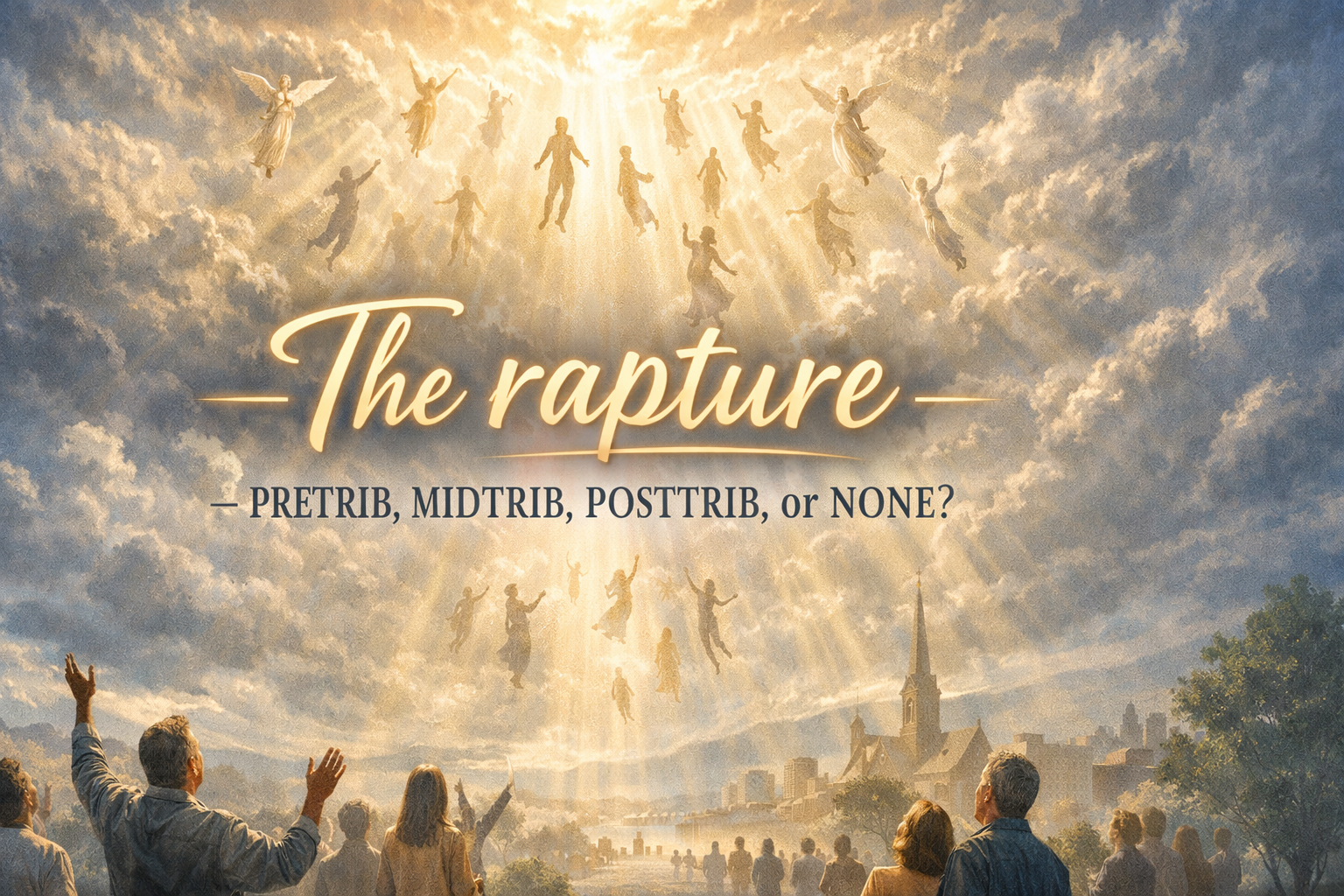
The rapture — pretrib, midtrib, posttrib, or none?
Few end-times subjects stir up more debate among Bible-believing Christians than the rapture. Will the church be caught up before the tribulation, in the middle of it, at the end, or is the whole modern rapture debate built on a distinction Scripture does not clearly make? The answer shapes how we read prophecy, how we understand tribulation, and how we prepare our hearts for whatever lies ahead.
The word rapture does not appear in most English Bibles, but the idea comes directly from the apostle Paul:
1 Thessalonians 4:16–17 — “For the Lord himself shall descend from heaven with a shout, with the voice of the archangel, and with the trump of God: and the dead in Christ shall rise first: then we which are alive and remain shall be caught up together with them in the clouds, to meet the Lord in the air: and so shall we ever be with the Lord.”
Nearly every end-times view agrees on this much: Christ will return, the dead in Christ will be raised, and living believers will be caught up to meet Him. The real disagreement is over when that catching up happens and whether it is a separate event from Christ’s final public coming — or simply one aspect of the same grand event.
That is where the debate begins.
The Four Main Views at a Glance
The rapture and the second coming are two distinct stages, separated by the tribulation period. Christ comes for His church first; later He comes with His church in glory.
The church endures the first half of the tribulation but is removed before the more intense outpouring of divine wrath in the latter half. A middle position between pretrib and posttrib.
The rapture and second coming are one grand event. The church endures the tribulation and is caught up to meet the returning Christ — accompanying Him in His royal arrival, not escaping before it.
Believers are indeed caught up at Christ’s return — but there is no separate “rapture event” as a distinct prophetic category. The catching up is simply part of the one second coming of Christ.
Each view is held by serious, Scripture-honoring Christians. Each is trying to make sense of real biblical themes. Let us walk through them one by one.
Pretribulationism
The Church Is Taken Before the Storm
Pretribulationism says the church will be caught up to meet Christ before the tribulation begins. Christ first comes for His church in what is often described as a distinct, separate event — and then, at the end of the tribulation, returns with His church in public, visible glory. This view has been especially common in dispensational circles and widely taught across much of American evangelicalism.
Why many are drawn to it: Several passages seem to promise believers a certain kind of rescue. 1 Thessalonians 1:10 says Jesus “delivered us from the wrath to come.” 1 Thessalonians 5:9 says, “God hath not appointed us to wrath.” Revelation 3:10 promises to keep believers “from the hour of temptation, which shall come upon all the world.” Pretribulationists read these as pointing to removal before the tribulation outpours. Another strong appeal is imminence — the idea that Christ could come for His church at any moment, with no prophetic prerequisite needing to happen first.
Genuine strengths: A warm pastoral note — the Lord may come for His people at any time. Serious weight given to promises about deliverance from divine wrath. A strong emphasis on watchfulness and expectant hope. At its best, it keeps the church’s gaze fixed forward.
Genuine concerns: The most significant challenge is that Scripture nowhere plainly describes two future comings of Christ separated by years. Critics also point out that 1 Thessalonians 4 sounds anything but quiet — there is a shout, the voice of an archangel, and the trumpet of God. And there is a real question whether “tribulation” and “wrath” are the same thing: the Bible clearly promises believers are spared from God’s condemning wrath, but it also clearly promises suffering, persecution, and tribulation in this present age (John 16:33). That distinction matters enormously.
Midtribulationism
Endurance First, Rescue Before the Worst
Midtribulationism says the church is raptured around the midpoint of a seven-year tribulation period — experiencing the first half of the trouble but removed before the more intense outpouring of God’s climactic wrath in the latter half. This view is less common than pretrib or posttrib, but it has serious defenders and a coherent logic.
The core distinction it draws is between two different kinds of tribulation: the suffering caused by human evil and satanic persecution (which the church endures), and the later climactic judgments of God’s own wrath (from which the church is spared). Some connect the rapture to the “last trump” language of 1 Corinthians 15:52 and try to align it with Revelation’s trumpet sequence at the midpoint.
Genuine strengths: It takes the church’s call to endure suffering more seriously than some forms of pretribulationism. It preserves the promise about divine wrath. And it has a pastoral realism to it — God’s people often endure much, but God also knows how to rescue His own at the right time.
Genuine concerns: Critics often find it the least textually anchored of the four positions — there is no single passage that clearly designates the tribulation midpoint as the moment of the catching up. It also depends heavily on a specific tribulation chronology and timeline framework that not all Christians share. It can feel like a mediating position more than an independently grounded one.
Posttribulationism
Endurance Through, Then Gathered to the King
Posttribulationism says the church will go through the tribulation and be caught up to meet Christ at His visible, public return — after the tribulation. In this view, the rapture and the second coming are not two separate events divided by years. They are one grand event: Christ comes, believers are caught up to meet Him in the air, and they accompany Him as He arrives in glory.
The image of meeting the Lord “in the air” is understood not as departure to heaven for years, but as the church going out to greet the returning King — the way citizens of a city would go out to meet a conquering ruler and escort him in. The direction of travel, in that ancient custom, was ultimately back into the city.
Why many are drawn to it: Matthew 24:29–31 seems to place the gathering of believers explicitly “after the tribulation of those days,” with the angels gathering the elect accompanied by a great trumpet. That is difficult to work around. The three main gathering passages — Matthew 24, 1 Thessalonians 4, and 1 Corinthians 15 — all describe Christ’s coming, trumpet language, and the gathering of believers. Posttribulationists argue these are best read as different angles on the same climactic event. The Bible also repeatedly promises the church will face suffering rather than escape from it (John 16:33; 2 Timothy 3:12; Acts 14:22).
Genuine strengths: Simplicity — it avoids multiplying future comings of Christ beyond what the clearest texts require. A sturdy spiritual realism that prepares the church for endurance rather than exemption. And it fits naturally with the long pattern of Scripture in which God preserves His people through affliction rather than always removing them from it.
Genuine concerns: How does this view handle passages about being kept from wrath and from the hour of trial? Posttribulationists answer that God can shield His people amid judgment — as He protected Israel in Goshen during Egypt’s plagues — without removing them entirely. Critics find that less satisfying than a pretrib rescue. Questions about imminence also remain: if major prophetic events must precede Christ’s coming, in what sense is He coming “soon” or “at any moment”?
No Separate Rapture
One Coming, One Catching Up, No Separate Event
Some Christians resist the entire “pretrib / midtrib / posttrib” framing because they think it already assumes more than Scripture warrants. Their position: yes, believers will be caught up to meet the Lord — that is right there in 1 Thessalonians 4. But that catching up is simply part of the one public second coming of Christ. There is no separate “rapture event” as a distinct prophetic category.
This view overlaps significantly with posttribulationism but is worth naming separately because it is not necessarily tied to a detailed tribulation timetable at all. It often fits within amillennial or non-dispensational frameworks where the emphasis falls on one climactic return of Christ, one resurrection, one judgment, and the beginning of the eternal state — without multiple intervening stages.
Genuine strengths: Clarity and interpretive restraint. It refuses to build elaborate prophetic frameworks where the texts themselves may be less explicit than popular teaching sometimes claims. It keeps the church’s focus on the blessed hope itself: Christ is coming. And it avoids the spectulative excess that has sometimes surrounded rapture teaching in popular culture.
Genuine concerns: Critics may feel it does not give sufficient weight to passages about being kept from the hour of trial, or to the New Testament’s emphasis on imminent expectation. Some may also feel it collapses prophetic distinctions that the texts actually make, though proponents would argue those distinctions have been overread from the start.
The Deeper Questions Under the Debate
The labels often get argued without anyone facing the actual interpretive questions driving the disagreement. Here are the ones that really matter:
Is Christ’s coming one event or two-stage? Does Scripture describe one future appearing of Christ with different aspects — or two distinct future stages separated by years? That is the largest structural question, and it drives everything else.
What exactly is “the tribulation”? Is it a distinct future seven-year period? A broader description of the church’s suffering throughout this age with an intensified final outbreak? How one answers this changes the whole framework.
What does being “spared from wrath” actually mean? Does it require removal from the earth before divine judgment falls? Or can God protect His people while they are present — as He has done throughout Scripture — without extracting them first?
How do Matthew 24 and 1 Thessalonians 4 relate? Are these two passages describing the same event from different angles, or two entirely different events? That question carries enormous weight and is where much of the real exegetical work happens.
What All Faithful Views Share
- Jesus Christ will return bodily, visibly, and in glory
- Believers who have died will be raised from the dead
- Living believers will be transformed and caught up to meet the Lord
- The people of God will be gathered to Christ forever
- Final judgment will come upon the unrepentant
- Christ will triumph utterly over every enemy, including death itself
- The church’s hope is eternally secure in Him
In plain rural terms, folks may disagree over when the wagon turns into the home stretch — but all of them are headed toward the same blessed country. And the destination is far more certain than any particular map of the route.
Common Errors to Avoid
Chart fever. When someone gets more excited about end-times timelines than about Christ Himself, something has gone crooked. The purpose of prophecy is to produce hope, holiness, and faithful endurance — not to reward those who can solve the sequence fastest.
Escape-centered Christianity. If a believer becomes so fixated on getting out of trouble that he forgets Christ calls His people to endure faithfully — and to love, serve, and witness in the meantime — the emphasis has reversed itself from what Scripture actually calls for.
Fear-driven teaching. End-times doctrine should steady the church in uncertain times, not whip it into panic every time the headlines get strange. The point of passages like 1 Thessalonians 4 is comfort, not alarm.
Pride. This subject has humbled a great many careful and godly people over the centuries. That track record alone should make all of us slower to swagger about our particular view.
Whatever position one holds, the posture Scripture plainly calls for is the same: be watchful, be sober, be ready, endure suffering faithfully, do not fear man, do not love this world too much, and keep your eyes on Christ. Whether the Lord comes before, during, or after a final tribulation season, the church’s assignment does not change.
The Comfort That Does Not Depend on Getting It All Right
Paul ends his great rapture passage not with a chart but with a command: “Comfort one another with these words” (1 Thessalonians 4:18). The comfort of the passage is not that Christians will win an argument about timing. The comfort is this: And so shall we ever be with the Lord.
Whatever one believes about the sequence of end-time events, that sentence is the anchor. Christ is coming. His people will be gathered to Him. The separation will end. Every tear will be wiped away. Every enemy will be beneath His feet. Every promise will be kept.
Study the question. Think carefully. Hold your convictions from Scripture. But do not let the debate swallow the comfort — and do not let the label become more important than the Lord it is supposed to point toward.
Key Takeaways
- All four views agree that believers will be caught up to meet the Lord. The disagreement is over when that happens and whether it is a separate event from Christ’s final public coming or simply one aspect of the same grand event.
- Pretribulationism emphasizes deliverance from wrath and imminent expectation. Its challenge is the absence of any text that plainly describes two future comings of Christ separated by years, and the question of whether tribulation and divine wrath are the same thing.
- Midtribulationism tries to balance endurance and rescue. Its challenge is finding a single passage that clearly marks the tribulation midpoint as the rapture moment, rather than deriving it from a particular chronological framework.
- Posttribulationism emphasizes simplicity and the church’s call to endure. Its challenge is explaining passages about being kept from the hour of trial and from wrath — though its proponents argue God can protect His people through judgment without removing them from the earth.
- The “no separate rapture” view emphasizes one climactic return with no distinct prior event. Its strength is restraint; its challenge is accounting for the New Testament’s emphasis on imminence and certain deliverance-language passages.
- The deepest questions are hermeneutical, not just chronological. How one reads Revelation, how one defines “tribulation,” what “deliverance from wrath” requires, and how Matthew 24 relates to 1 Thessalonians 4 — these are the real load-bearing issues under the labels.
Key Scriptures: John 14:1–3 · Matthew 24:29–31 · 1 Corinthians 15:51–52 · 1 Thessalonians 1:10 · 1 Thessalonians 4:13–18 · 1 Thessalonians 5:1–11 · 2 Thessalonians 1:6–10 · 2 Thessalonians 2:1–8 · Revelation 3:10 · Revelation 19–20