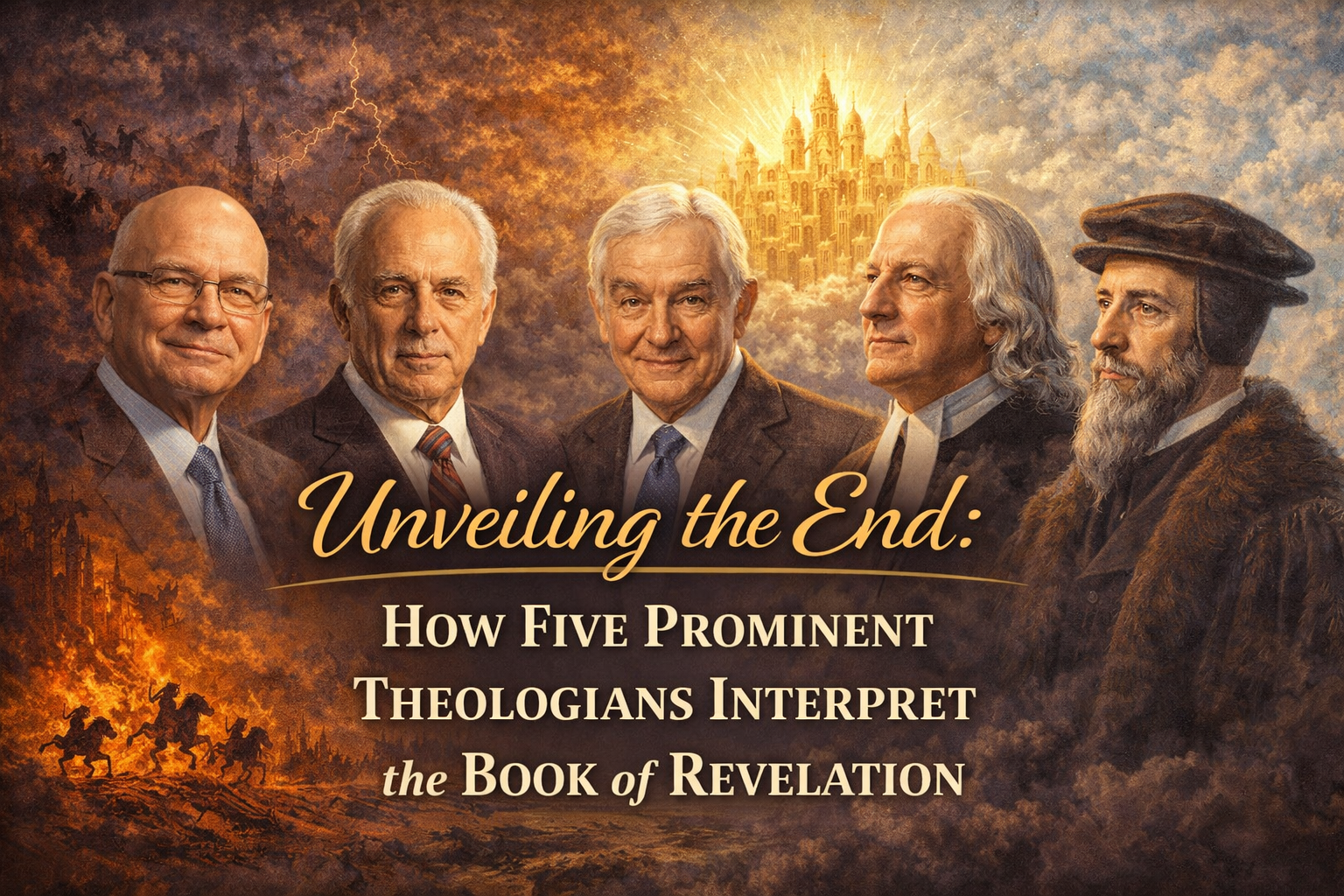
Unveiling the End: How Five Prominent Theologians Interpret the Book of Revelation
Walvoord, Wright, Beale, Peterson, and Sproul — Five Interpretive Lenses on the Most Mysterious Book of the Bible
The Book of Revelation has fascinated, confused, and inspired believers for centuries. Beasts and bowls, trumpets and dragons, a great harlot and a triumphant Lamb — what does it all mean? Are we reading prophecy about the end of the world, or a symbolic pastoral message for today? Is it a timeline, a poem, a political tract, or a letter of hope?
The honest answer is: faithful, serious, Bible-loving scholars have answered those questions very differently. This post introduces five of the most significant modern interpreters of Revelation and the distinctive lens each one brings to the book.
“Blessed is the one who reads aloud the words of this prophecy, and blessed are those who hear and keep what is written in it, because the time is near.” — Revelation 1:3 (CSB)
Five Voices, Five Lenses
Voice One
🗺️ John Walvoord — The Prophetic Roadmap
Dispensational Premillennialism · Dallas Theological Seminary · 1910–2002
“The Revelation becomes understandable when interpreted as it is written, plainly and literally.” — John Walvoord, The Revelation of Jesus Christ, 1966
Walvoord, longtime president of Dallas Theological Seminary, is the defining voice of the literal-futurist approach. For Walvoord, Revelation is a divinely inspired roadmap of events still to come — a sequential account of how God’s plan for history will culminate in judgment, the return of Christ, and eternal glory.
Key interpretive commitments:
- Literal method — Revelation outlines real, future events; symbols should be interpreted as literally as context allows
- Pretribulation Rapture — the Church is removed before the seven-year Great Tribulation begins
- Israel and the Church — two separate peoples with separate prophetic programs; God’s promises to Israel are literal and unfulfilled
- Millennium — a literal 1,000-year reign of Christ on earth (Revelation 20:1–6), fulfilling Old Testament covenant promises
Voice Two
🌍 N.T. Wright — Revelation as Political Theology
Inaugurated Eschatology · Anglican Bishop & New Testament Scholar
“Revelation is not a riddlebook. It is a picture-book. And the pictures are symbols, rich with meaning for first-century Christians and for us today.” — N.T. Wright, Revelation for Everyone, 2011
Wright reads Revelation as a symbolic and pastoral document deeply rooted in first-century Roman context. The great beast isn’t a future world leader — it’s the empire of Caesar. Babylon isn’t a future city — it’s Rome, the corrupt power oppressing the early Church. The book is written for people who know what it’s like to choose between Caesar and Christ.
Key interpretive commitments:
- Symbolic cosmic battle — the conflict between Christ and empire, not a future geopolitical sequence
- Babylon = Rome — and every corrupt power structure in every age
- Victory of the Lamb is present and ongoing — not just a future event
- New Creation is breaking in now — every act of justice and beauty is a preview of Revelation 21
Voice Three
📚 G.K. Beale — Symbolism and Cycles
Amillennialism · Reformed Biblical Theology · Princeton Theological Seminary
“Revelation portrays the same events multiple times from different angles, using symbol-laden visions to reveal the spiritual battle behind the scenes.” — G.K. Beale, The Book of Revelation, 1999
Beale’s massive commentary on Revelation is among the most respected academic works on the subject. His approach is amillennial and idealist — Revelation is not a chronological sequence of future events but a symbolic, cyclical depiction of the same spiritual realities viewed from multiple angles. Nearly every verse in Revelation alludes to an Old Testament text, and that intertextual web is the key to reading it well.
Key interpretive commitments:
- Cyclical structure — the seals, trumpets, and bowls are not sequential stages; they depict the same period of history from different perspectives
- OT saturation — almost every verse in Revelation echoes the Hebrew Scriptures; you cannot read it without them
- Millennium = Church Age — the thousand years is the current era between Christ’s ascension and His return
- Eternal hope — the final judgment and new creation are real future events that anchor everything
Voice Four
🎶 Eugene Peterson — A Call to Worship
Devotional / Poetic · Translator of The Message · 1932–2018
“Revelation is not about what’s coming at the end, but what is always here and always now.” — Eugene Peterson, Reversed Thunder, 1988
Peterson approached Revelation not as a code to be cracked or a sequence to be mapped, but as a call to worship. In Reversed Thunder, he reads the book as doxology in the face of chaos — a sustained act of praise that reorients the believer away from fear and toward the enthroned Lamb. For Peterson, the book is less about prediction and more about formation.
Key interpretive commitments:
- Jesus at the center — not the beasts, not the numbers, but the Lamb is the gravitational force of the book
- Poetry, not prediction — Revelation uses the language of imagination and symbol, not prophetic chronology
- Worship is warfare — overcoming evil in Revelation happens through praise, witness, and faithful endurance
- Speaks to all generations — every church in every age can hear this book directly
Voice Five
⚔️ R.C. Sproul — Judgment in History
Partial Preterism · Reformed Theology · Ligonier Ministries · 1939–2017
“We must remember that Revelation was first a letter to real churches, facing real suffering, under a real empire.” — R.C. Sproul, The Last Days According to Jesus, 1998
Sproul favored partial preterism — the position that many (not all) of Revelation’s events were fulfilled in the first century, particularly around the Roman destruction of Jerusalem in A.D. 70. The “Great Tribulation” Jesus warned about was not a future event; it was the catastrophic judgment that fell on Israel within a generation of His death. Revelation was written to interpret that approaching storm and call the church to perseverance.
Key interpretive commitments:
- Beast = Nero / Roman Empire — the mark of the beast reflects the forced emperor worship of the first century
- Babylon = Jerusalem or Rome — depending on the specific passage and context
- Tribulation = first-century persecution — the “great distress” is primarily the Jewish-Roman War of A.D. 66–70
- Millennium = present reign of Christ — He is reigning now; the final resurrection and judgment are still future
Five Voices — Side by Side
| Theologian | Interpretive Style | The Millennium | Primary Emphasis |
|---|---|---|---|
| Walvoord | Literal / Futurist | Literal 1,000 years (future) | Prophetic sequence; Israel’s future restoration |
| N.T. Wright | Symbolic / Historical | Present spiritual reign | Political theology; the Church under empire |
| G.K. Beale | Symbolic / Cyclical | Church Age (amillennial) | OT fulfillment; spiritual warfare behind history |
| Eugene Peterson | Poetic / Devotional | Not specified | Worship, perseverance, formation |
| R.C. Sproul | Historical / Partial Preterist | Present spiritual reign | First-century fulfillment; judgment in history |
What All Five Agree On
For all their differences, these five interpreters share the same foundation. Revelation isn’t primarily about beasts, bowls, and battles. It’s about Jesus Christ — revealed, victorious, and coming again.
- Revelation calls us to perseverance. Whether facing first-century Rome or 21st-century pressure, the message is the same: hold fast to Christ.
- It reveals Jesus, not just future events. The Lamb is the hero of the story from beginning to end (Revelation 5:6). Every other figure is peripheral to Him.
- It calls the Church to worship. The heavenly throne room (Revelation 4–5) is the book’s center of gravity — everything else flows from there.
- It warns every church. The seven letters (chapters 2–3) speak to every congregation in every age — including ours. The question is which church we most resemble.
- It assures us of the end. Evil will not win. God will dwell with His people forever (Revelation 21:3–4). That promise is not symbolic. It is certain.
Revelation is less about decoding the news and more about keeping your eyes on Jesus Christ. Whether you find yourself drawn to Walvoord’s prophetic precision, Wright’s political courage, Beale’s theological depth, Peterson’s doxological wonder, or Sproul’s historical anchoring — every one of these men is pointing you toward the same Lamb on the same throne.
So read Revelation not to fear, but to hope. Not to chart the future, but to be faithful in the present. The King is coming. That changes everything.
“Even so, come, Lord Jesus.” — Revelation 22:20
Key Scriptures: Revelation 1:3; 5:6; 20:1–6; 21:1–5; 22:20 · Daniel 9:24–27 · Matthew 24:34 · Romans 11:25–27 · 1 Thessalonians 4:16–17
Want to Go Deeper?
This post gives you the overview. MVM’s full eschatology series goes deep into each major interpretive tradition. Explore the companion posts:
- David Jeremiah on Revelation — The Walvoord tradition in pastoral form, with strong application for today.
- John MacArthur on Revelation — Literal-futurist, verse-by-verse, expository treatment.
- Tim Keller on Revelation — Reformed/symbolic; the Lamb at the center, heaven coming down.
- John Wesley on Revelation — Historicist; Revelation as a call to holiness across church history.
- John Calvin on Revelation — The great Reformer’s illuminating silence, and what it teaches us.
- What the Early Church Fathers Believed — Irenaeus, Augustine, Chrysostom before the modern debate existed.
- C.S. Lewis and the Rapture — What the most beloved Christian thinker of the 20th century actually believed about the end.
- Subscribe to get new posts delivered straight to your inbox — gospel-rooted, plain-spoken truth for the week ahead.
“The Lamb who was slain is worthy to receive power and wealth and wisdom and strength and honor and glory and praise.” — Revelation 5:12