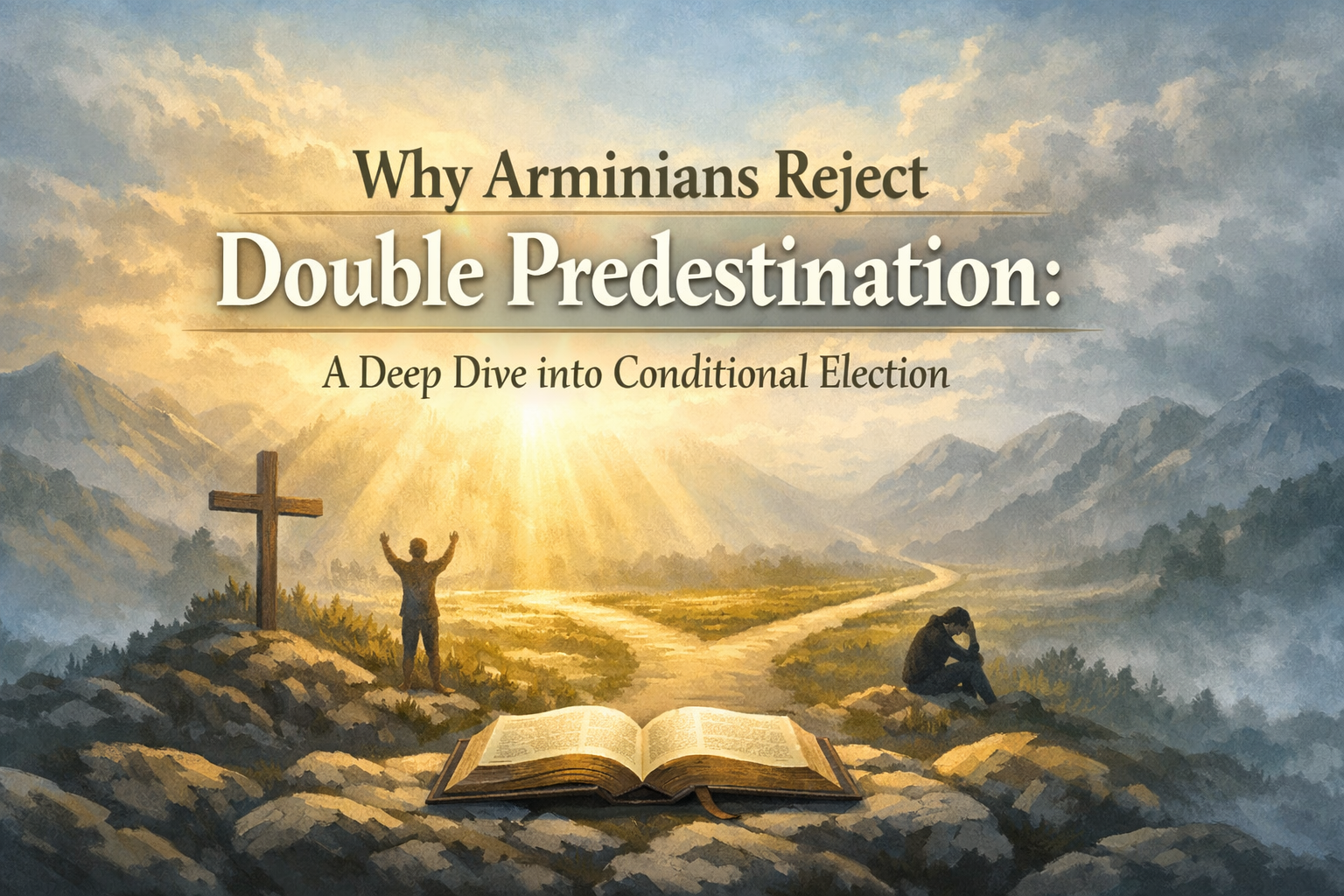
Why Arminians Reject Double Predestination: A Deep Dive into Conditional Election
What Arminius Believed About God’s Grace, Human Freedom, and Who Can Be Saved
Few doctrines in Christian theology spark as much debate as predestination. For centuries, Christians have wrestled with the questions: Who does God save? Who is lost? And why? One of the most controversial answers — double predestination — teaches that God actively chose some for salvation and others for damnation before the world began.
Arminians reject that teaching firmly and clearly. This post explains what they believe instead, why they believe it, and how it shapes the way they preach, pastor, and pray.
“Everyone who calls on the name of the Lord will be saved.” — Romans 10:13
What Is Double Predestination?
Definition
Double predestination holds that God, in His eternal decree, chose some people to be saved (election) and chose others to be condemned (reprobation) — both choices made unconditionally, apart from any foreseen faith, works, or decisions.
In its strictest form (supralapsarianism), God’s decree to elect and reprobate even precedes His decree to allow the fall — meaning before Adam ever sinned, the eternal destiny of every person was already fixed.
This doctrine was codified at the Synod of Dort (1618–1619), which responded to Arminius’s followers — the Remonstrants — and sided firmly with unconditional election and reprobation. It remains the position of confessional Calvinist theology today.
Jacob Arminius’s Perspective
Jacobus Arminius (1560–1609) was a Dutch theologian and former student of Theodore Beza — Calvin’s own successor in Geneva. He came to believe that double predestination could not be reconciled with the God he encountered in Scripture.
“The scriptures know no election by which God… has determined to save anyone without having first considered him as a believer.” — Jacob Arminius
Arminius and his followers emphasized that God’s election was conditional — based on His foreknowledge of who would respond to His grace. God does not arbitrarily choose some and reject others. He desires all to be saved and has made salvation genuinely possible for everyone.
What Arminians Affirm Instead
Affirmation One
Conditional Election
God’s choice of individuals for salvation is conditional — He elects those whom He foreknows will freely respond to His grace. This foreknowledge is not passive; it is active and relational. But it honors the reality of genuine human response rather than bypassing it.
Affirmation Two
Universal Atonement and Prevenient Grace
Arminians reject the idea that Christ died only for the elect. They believe Jesus died for all people — though only believers receive the benefit of His sacrifice. To make this genuine offer possible, God gives prevenient grace — a grace that “goes before,” enabling every person to hear and respond to the gospel. This grace is real, but it is not irresistible. People can reject it.
Affirmation Three
Human Responsiveness and Genuine Freedom
Those who are condemned are not condemned because God decreed it before they were born. They are condemned because they persistently and freely reject the grace God genuinely offered them (John 5:40). This maintains the real weight of the biblical calls to repent, believe, and turn — because those calls assume a genuine choice is being made.
Two Illustrations
The Coach
A coach invites every student at school to join the team. He provides uniforms, equipment, and training — everything needed to participate. Some accept and come; others refuse. Those who don’t make the team can’t blame the coach for not wanting them.
This, Arminians argue, is how God works: He invites everyone, equips everyone with prevenient grace, and genuinely desires everyone to come — but the response belongs to each person.
The Teacher’s Extra Credit
A teacher offers an optional extra-credit project that can raise every student’s grade. Some take advantage; others don’t. The students who fail do so because they chose not to participate — not because the teacher wanted them to fail or withheld the opportunity from them.
God’s prevenient grace makes salvation available to all. Those who are lost chose to reject what was freely and genuinely offered.
Why Arminians Reject Double Predestination
❓ God’s Character and Justice
Arminians believe double predestination paints God as unjust and unloving — creating certain people with no intention of ever saving them, then condemning them for not responding to a grace they were never given. This contradicts the many biblical passages showing God’s love for all humanity (John 3:16) and His impartiality (Acts 10:34–35).
❓ Human Responsibility Becomes Hollow
If God decreed from eternity who is saved and who is damned — unconditionally, apart from any human response — the biblical calls to repent, believe, and live faithfully become theatrics. Why call people to choose if the choice was already made for them? Arminians see this as undermining the genuine moral weight Scripture places on human decision.
❓ Sovereignty Reimagined
Arminians fully affirm God’s sovereignty — but define it differently. God is sovereign enough to accomplish His purposes through creatures who freely respond, rather than through creatures whose every response He has decreed. This sovereignty-in-love better reflects the God who “woos” and “grieves” (Matthew 23:37; Ezekiel 18:23) rather than merely overrides.
Arminian vs. Calvinist — Side by Side
| Doctrine | 🌿 Arminian | 🧱 Calvinist |
|---|---|---|
| Election Basis | Based on God’s foreknowledge of foreseen faith (Romans 8:29) | God’s sovereign choice, unconditional and unrelated to foreseen faith |
| Atonement | Unlimited — Christ died for all people | Limited (Particular) — Christ died effectively for the elect only |
| Grace | Prevenient and resistible — can be rejected | Irresistible — God’s elect will always respond |
| Reprobation | Result of the individual’s persistent unbelief | Active decree by God — made unconditionally |
| Human Role | Genuine free cooperation with God’s grace | Passive recipient of God’s sovereign decree |
Strengths and Honest Criticisms
✅ Strengths of the Arminian View
- Preserves God’s universal love and impartial justice
- Maintains the genuine weight of human responsibility
- Makes the gospel a real offer to every person without qualification
- Grounds pastoral care in a God who grieves over the lost
⚠️ Calvinist Criticisms
- Makes God’s plan contingent on human decisions — potentially limiting His sovereignty
- May underemphasize the depth of total depravity
- Reads Romans 9–11 in a way many Calvinist exegetes dispute
How This Shapes Pastoral Care
Arminian theology doesn’t just affect how theologians argue. It shapes what a pastor can say at a bedside, a graveside, and in a counseling room.
A Pastoral Moment
“I stood with a grieving mother who had just lost her child. In that moment, I was grateful I could say with confidence: God did not ordain this tragedy to teach you a lesson. He loves you and He grieves with you.”
This is one pastor’s account of how theology shapes what words are actually available in the hardest moments of ministry.
The pastoral implications run through every corner of the faith:
- Evangelism — Every person can be invited without hesitation or fine print, because Christ died for all and the grace being offered is genuine.
- Assurance and hope — People wrestling with doubt can be reminded plainly: God desires your salvation. He is not indifferent to whether you come.
- Suffering and justice — God does not ordain evil. He works to redeem it — and He suffers with those who suffer.
Arminians reject double predestination because they believe it contradicts God’s love, undermines human responsibility, and conflicts with the full weight of Scripture’s testimony about who God is and how He saves.
In its place, they affirm a single decree — to save those who believe — a universal invitation through Christ’s atonement, and a prevenient grace that genuinely enables every person to respond. Those who are lost are lost by their own persistent unbelief, not by divine design.
God’s offer is open. His arms are wide. And everyone who calls on His name will be saved.
“Everyone who calls on the name of the Lord will be saved.” — Romans 10:13
Key Scriptures: Romans 10:13 · Romans 8:29–30 · John 3:16 · 2 Peter 3:9 · 1 Timothy 2:4 · Matthew 23:37 · John 5:40 · Acts 10:34–35 · 1 Peter 1:1–2 · Ezekiel 18:23 · Romans 9:16
Want to Go Deeper?
This post is part of an ongoing series on the theological traditions that have shaped the church. To get the full picture of this debate, read these companion posts:
- What Is Arminianism? — MVM’s plain-spoken overview of Arminian theology’s five points and pastoral implications.
- What Is Calvinism? — MVM’s survey of TULIP and the Reformed perspective on grace and election.
- The Protestant Reformation — The historical background from Wycliffe to the Synod of Dort.
- Subscribe to get new posts delivered straight to your inbox — gospel-rooted, plain-spoken truth for the week ahead.
“For God so loved the world that he gave his one and only Son, that whoever believes in him shall not perish but have eternal life.” — John 3:16
Mountain Veteran Ministries
Find Your Next Bearing
Every journey needs a direction. If you're wondering where to go from here, choose the path that best fits where you are today.
⚒️ I Want to Live Faithfully
Discover practical wisdom for following Christ in today's world.
→ Living as a Christian Today✝️ I Want to Understand the Gospel
Learn what salvation means and why Jesus came.
→ Understanding Salvation📖 I Want to Understand the Bible
Explore why Christians trust Scripture and how to read it well.
→ Understanding the Bible❓ I Still Have Questions
Explore thoughtful answers to some of Christianity's hardest questions.
→ Hard Questions