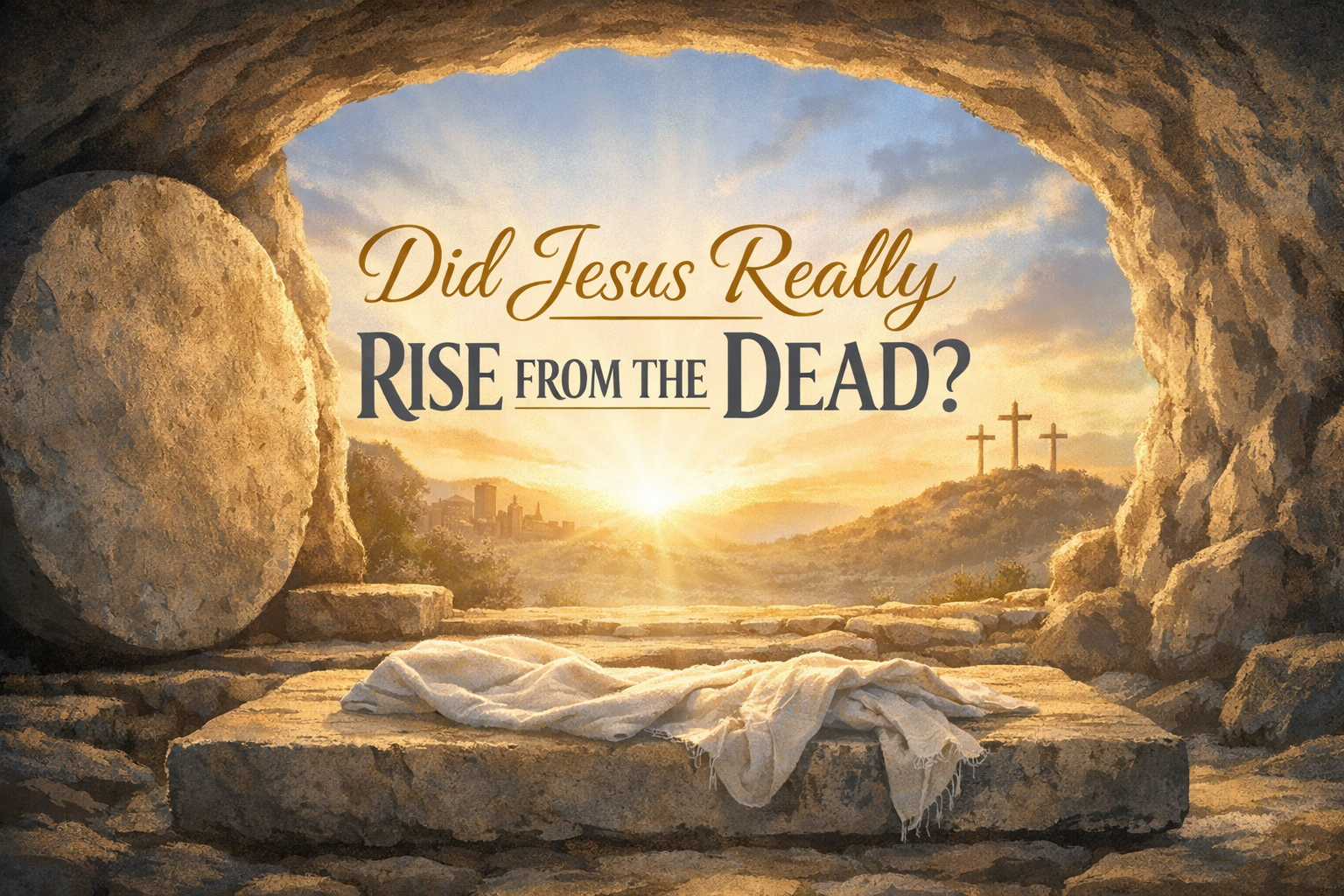
Did Jesus Really Rise from the Dead?
The Arguments of Habermas and Licona — Historical Evidence for the Most Important Event in Human History
The resurrection of Jesus Christ stands at the very heart of Christianity. If it happened, Christianity is true. If it didn’t, our faith is in vain.
Few scholars have done more to investigate this pivotal question than Dr. Gary Habermas and Dr. Mike Licona. With a blend of historical rigor, theological insight, and apologetic clarity, they’ve built a powerful case for the resurrection that speaks to both the heart and the mind. This post walks through their arguments — step by step.
“And if Christ has not been raised, your faith is futile and you are still in your sins.” — 1 Corinthians 15:17
Habermas’s Minimal Facts Approach
Dr. Gary Habermas has studied the resurrection for over four decades. His “Minimal Facts” approach is perhaps the most influential framework in modern resurrection studies. Rather than assuming Christian doctrine or requiring belief in biblical inerrancy, Habermas builds his case on a narrow set of facts that meet two criteria: they are strongly supported by historical evidence, and they are accepted by the vast majority of scholars — including skeptics and non-Christians.
The Five Minimal Facts
- 1Jesus died by Roman crucifixion. No serious historian disputes this. The crucifixion is one of the most historically certain events of the ancient world.
- 2The disciples believed Jesus rose and appeared to them. These were not later legends. They claimed to have seen Jesus alive immediately after His death — and held to that claim even when dying for it.
- 3Paul was converted after experiencing what he believed was a resurrection appearance. From Saul the persecutor to Paul the apostle — something radical happened to the most hostile opponent the early church had.
- 4James, the skeptical brother of Jesus, converted after believing he saw the risen Christ. James had not followed Jesus during His ministry (John 7:5), but later became a key church leader in Jerusalem (Galatians 1:19).
- 5The tomb was found empty. This fact is affirmed by a majority of scholars across traditions and is supported by multiple early, independent sources.
Why these facts matter: Habermas argues they create a historical puzzle that the resurrection alone resolves. The alternatives collapse under scrutiny:
“The resurrection of Jesus is the best explanation for the facts that virtually all scholars, regardless of belief, accept.” — Gary Habermas
Licona’s Historiographical Method
Dr. Mike Licona brings a historian’s toolkit to the question. In The Resurrection of Jesus: A New Historiographical Approach, he evaluates competing explanations using five standard criteria applied in historical inquiry. The question isn’t “do you believe in miracles?” — it’s “which hypothesis best explains the available data?”
Explanatory Scope
Does the hypothesis account for all the known facts — or only some of them?
Explanatory Power
Does the explanation make the facts more likely than rival explanations do?
Plausibility
Is it consistent with other accepted knowledge and background information?
Less Ad Hoc
Does it require the fewest additional assumptions — the simplest explanation?
Illumination
Does it help explain other things we know, or does it create new puzzles?
The Verdict
Licona finds that only the bodily resurrection of Jesus passes all five tests better than any rival hypothesis.
“The hypothesis that Jesus rose from the dead passes all five tests better than any rival hypothesis.” — Mike Licona
Three People the Resurrection Changed
Beyond the historical arguments, the personal transformations surrounding the resurrection are some of the most compelling evidence. These are not people predisposed to believe — they are people whose lives were overturned by what they encountered.
Peter — Denier to Proclaimer
Peter denied Jesus three times hours before the crucifixion. Weeks later he was publicly preaching the resurrection in Jerusalem — at the risk of his life. Something happened between those two moments.
Paul — Persecutor to Apostle
Paul had everything to lose by converting. He was educated, respected, and actively destroying the church. He asks: “Have I not seen the Lord?” (1 Cor. 9:1). He suffered imprisonment and execution for that claim.
James — Skeptic to Leader
James did not believe in Jesus during His earthly ministry (John 7:5). After a resurrection appearance, he became the head of the Jerusalem church — and died for that conviction.
You don’t die for a lie. And all three of these men died for their unshakable belief that Jesus was risen and reigning.
Handling the Hard Questions
❓ Don’t miracles violate natural law? Isn’t that impossible by definition?
If God exists, miracles are not only possible — they are expected. The question is not whether a supernatural event can occur, but whether a supernatural explanation best accounts for the natural data we have. Habermas and Licona argue the resurrection is the only hypothesis that does.
❓ Couldn’t these stories have developed over time — like any legend?
Legends need time to grow. Paul’s creed in 1 Corinthians 15:3–8 — “Christ died, was buried, and rose on the third day” — dates to within 3–5 years of the crucifixion. And the early preaching happened in Jerusalem, the worst possible place for a hoax, where anyone could check the tomb and interview the witnesses.
Why the Resurrection Matters Theologically
It Confirms Jesus’ Divinity
Jesus didn’t rise spiritually or symbolically. He rose bodily — affirming that He was who He claimed to be: the Son of God (Romans 1:4). The resurrection is God’s declaration that Jesus’s claims were true.
It Validates the Cross
Without the resurrection, Jesus’s death is a tragic martyrdom — inspiring, maybe, but ultimately a loss. The empty tomb means the cross was a victory, not a defeat. Sin was dealt with. The debt was paid in full.
It Offers Eternal Hope
Jesus’s resurrection is the “firstfruits” (1 Corinthians 15:20) — the first of the harvest to come. What happened to Him will happen to all who believe: bodily resurrection and life that death cannot end.
Four Lines Worth Remembering
- “A hallucination can’t eat fish. But the risen Christ did — in front of witnesses.”
- “The stone wasn’t rolled away to let Jesus out. It was rolled away to let the disciples in.”
- “You don’t start a religious movement in the city where your leader is buried — unless His tomb is empty.”
- “The resurrection is the lynchpin in the door of Christian faith. Remove it and the door falls off.”
🌾 An Oregon Spring
Imagine sitting around a campfire in early spring. The cold ground is thawing, life is waking up, and the sun is stretching out its days again. That’s what the resurrection is — a spiritual spring, a breaking of the dark winter of sin and death.
Just like you wouldn’t plant seed in the field if you didn’t believe in the harvest, we wouldn’t follow Jesus if the grave still held Him. But because the tomb is empty, our faith is full.
Gary Habermas and Mike Licona have done their part — they’ve brought the historical data to the table, reasoned through the objections, and laid out a logical case that Jesus of Nazareth truly rose from the dead.
But evidence can only take you so far. At some point, it becomes personal.
If the tomb is empty, Jesus is not a figure of history. He is the Living Lord — and that changes everything about how you live, how you die, and what you hope for.
“If you confess with your mouth that Jesus is Lord and believe in your heart that God raised him from the dead, you will be saved.” — Romans 10:9
🙏 Closing Prayer
Lord Jesus, You are not dead. You are risen, alive, and reigning. Help us believe with both our hearts and our minds. Let Your resurrection power bring life to our dry bones, hope to our weary hearts, and courage to share this good news with a skeptical world. In Your living name, Amen.
Key Scriptures: 1 Corinthians 15:3–8, 14–17, 20 · Romans 1:4; 10:9 · Galatians 1:19 · John 7:5; 20:24–29 · Luke 24:36–43 · Acts 2:22–24 · 1 Corinthians 9:1
Want to Go Deeper?
This post is part of an ongoing series on apologetics and the foundations of Christian faith. If the evidence stirred something in you, here are a few next steps:
- Share it with a skeptic or a friend who’s wrestling with whether any of this is historically credible — this is a good first step into the evidence.
- Read further — The Case for the Resurrection of Jesus (Habermas & Licona, Kregel, 2004) is the most accessible entry point. The Resurrection of Jesus: A New Historiographical Approach (Licona, IVP Academic, 2010) goes deeper.
- Contact Don Bland at Mountain Veteran Ministries for printable study guides and discussion outlines based on this content.
- Subscribe to get new posts delivered straight to your inbox — gospel-rooted, plain-spoken truth for the week ahead.
“But Christ has indeed been raised from the dead, the firstfruits of those who have fallen asleep.” — 1 Corinthians 15:20
Mountain Veteran Ministries
Find Your Next Bearing
Every journey needs a direction. If you're wondering where to go from here, choose the path that best fits where you are today.
⚒️ I Want to Live Faithfully
Discover practical wisdom for following Christ in today's world.
→ Living as a Christian Today✝️ I Want to Understand the Gospel
Learn what salvation means and why Jesus came.
→ Understanding Salvation📖 I Want to Understand the Bible
Explore why Christians trust Scripture and how to read it well.
→ Understanding the Bible❓ I Still Have Questions
Explore thoughtful answers to some of Christianity's hardest questions.
→ Hard Questions