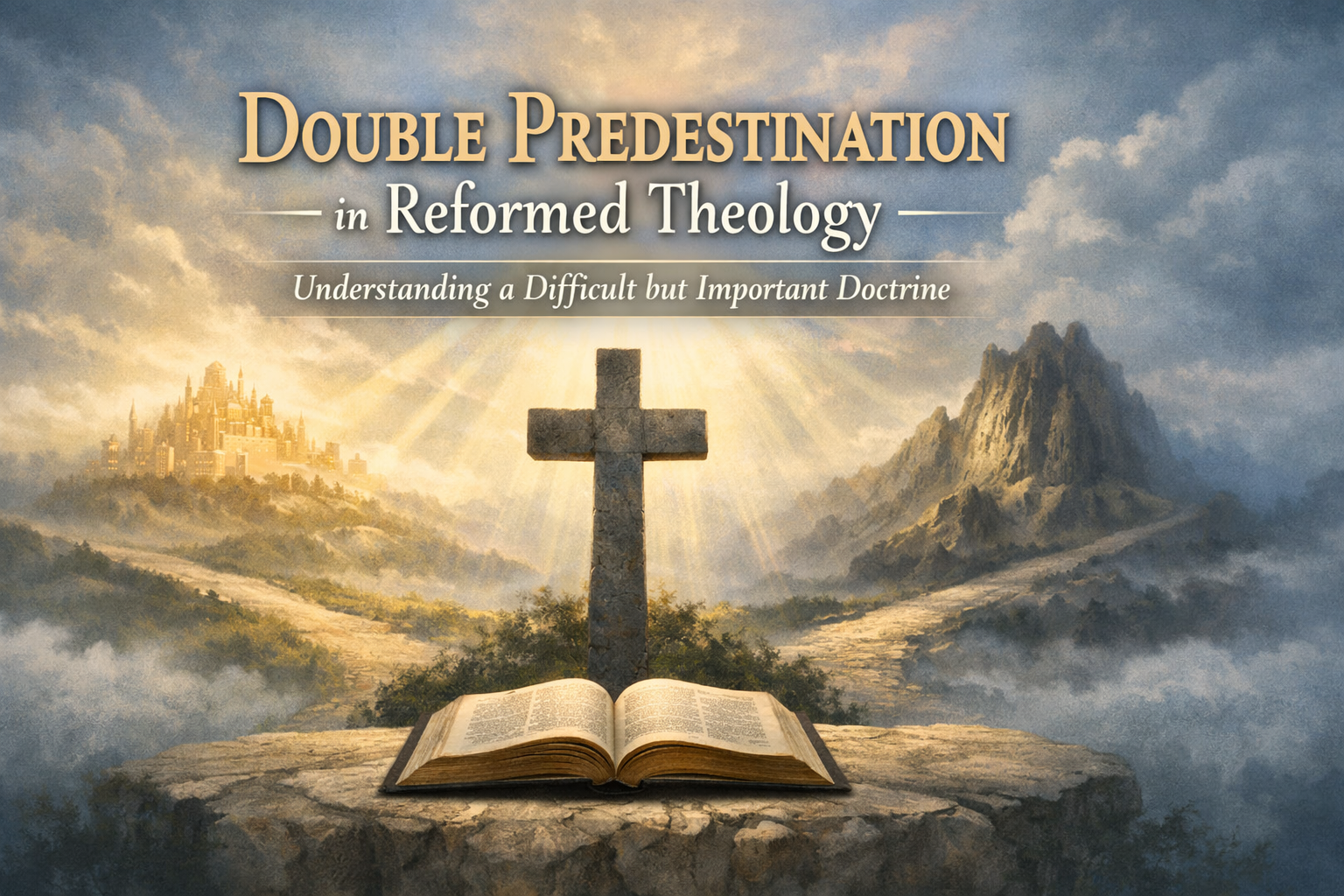
Double Predestination in Reformed Theology: Understanding a Difficult but Important Doctrine
What Reformed Theology Teaches About God’s Eternal Decree — and Why It Inspires Worship, Not Fear
Few doctrines stir as much conversation — and sometimes controversy — as the Reformed teaching on double predestination. It is one of those doctrines that can feel heavy, even unsettling, at first glance. Yet for those who hold to the Reformed tradition, it is also one of the clearest demonstrations of God’s absolute sovereignty and perfect justice.
This post presents the doctrine as Reformed theology actually teaches it — fairly, carefully, and with the pastoral humility the Westminster Confession itself requires.
“Oh, the depth of the riches and wisdom and knowledge of God! How unsearchable are his judgments and how inscrutable his ways!” — Romans 11:33
What Double Predestination Actually Means
Definition
Double predestination teaches that in God’s eternal decree, He has predestined some individuals to salvation (election) and has passed over others, leaving them to just condemnation (reprobation). Both decrees were made before the foundation of the world, unconditionally, according to God’s sovereign will.
As Calvin himself wrote in the Institutes: “By predestination we mean the eternal decree of God, by which he has determined in himself what he would have to become of every individual of mankind. For they are not all created with a similar destiny; but eternal life is foreordained for some, and eternal damnation for others.”
✅ Election
God’s unconditional choice of certain individuals to receive salvation through Christ — made before creation, not based on any foreseen merit or faith in the individual.
⚠️ Reprobation
God’s passing over of others, leaving them in their sin to face just condemnation. This is not God forcing anyone to sin — it is God withholding the grace He is under no obligation to give.
The Potter and the Clay — Romans 9
A potter shapes clay into whatever vessels he wills. Some he forms into vessels for honor; others for common use. The clay does not instruct the potter. Paul uses exactly this image in Romans 9 to describe God’s sovereign freedom over His creation.
The Biblical Foundations
Double predestination is not a philosophical invention — it is drawn from specific texts that Reformed theologians argue cannot be read otherwise.
Romans 9:10–24
“Jacob I loved, but Esau I hated… So then he has mercy on whomever he wills, and he hardens whomever he wills… vessels of wrath prepared for destruction… vessels of mercy, which he has prepared beforehand for glory.”
Paul’s most direct treatment of God’s sovereign freedom in election and reprobation — not based on human choice or foreseen behavior.Ephesians 1:4–11
“He chose us in him before the foundation of the world… having been predestined according to the purpose of him who works all things according to the counsel of his will.”
Election is traced to God’s eternal purpose and sovereign will — not to foreseen faith or merit.1 Peter 2:8
“They stumble because they disobey the word, as they were destined to do.”
Peter includes reprobation — though the stumbling is their own genuine disobedience, not divine coercion.Proverbs 16:4
“The LORD has made everything for its purpose, even the wicked for the day of trouble.”
God’s sovereign purpose encompasses all things — including the destiny of the wicked.Historical Development
Augustine (354–430)
Emphasized humanity’s total inability to save itself and God’s free, sovereign choice to show mercy to some — the foundation of Reformed soteriology.
John Calvin (1509–1564)
Made the double decree explicit. Yet he warned Christians not to pry into God’s secret counsel beyond what Scripture reveals. This doctrine is for worship, not speculation.
Synod of Dort (1618–1619)
Formally rejected Arminianism and codified election and reprobation, stressing that God’s decree is just and merciful — not capricious or cruel.
The Active/Passive Distinction — This Matters
Reformed theology insists on a crucial asymmetry between election and reprobation that is often missed by critics of the doctrine.
How the Decree Works Differently for Each Group
- ActiveGod intervenes to save the elect — He regenerates, calls effectually, justifies, and glorifies (Romans 8:30). The elect believe because God changes their hearts.
- PassiveGod does not force the reprobate to sin. He withholds saving grace, leaving them in the rebellion they freely and willingly choose. Their condemnation is just because it is genuinely their own doing.
“The reprobate are not coerced into sin; they sin because they want to. God simply withholds His saving grace.” — R.C. Sproul
The Two Fields
A farmer cultivates one field — clearing, planting, watering, tending. The other field he leaves alone. The cultivated field bears fruit because he actively worked it. The other stays barren not because he cursed it, but because he left it untouched. Both outcomes reflect his sovereign decision. He cursed neither field — he simply chose to tend one and not the other.
A Brief Note on Supra- vs. Infralapsarianism
Within Reformed theology, there is an internal debate about the logical order of God’s decrees:
- Supralapsarianism — God decreed election and reprobation before decreeing the fall. The fall was the means by which the decree would be executed.
- Infralapsarianism — God decreed election and reprobation after (logically) decreeing the fall. Election and reprobation are responses to humanity as already fallen.
Most Reformed confessions — including the Westminster Confession and the Canons of Dort — favor the infralapsarian order. Both positions affirm the same practical doctrine; the debate is about logical sequence, not about God’s knowledge or intent.
Three Strengths of the Doctrine
It Magnifies God’s Sovereignty
Salvation is entirely of God — from beginning to end. No one can boast of earning, choosing, or deciding their way to grace (Ephesians 2:8–9). The Reformers saw this as the only consistent reading of Scripture’s consistent message: God saves, not man.
It Honors Total Depravity Honestly
If humanity is genuinely spiritually dead — not just sick, but dead (Ephesians 2:1) — then God must choose to bring life. A dead person cannot choose God. Election is the only coherent response to true total depravity.
It Produces Genuine Assurance
Believers can rest knowing their salvation rests on God’s eternal, unchanging purpose — not on their fluctuating performance, their consistency of feeling, or their ability to maintain faith on their worst days (Philippians 1:6).
The Anchor in the Storm
A fishing boat in a storm with its anchor secured deep in the ocean floor. The boat rocks — sometimes violently — but never drifts away. Election is that anchor. It holds firm not because of how well the boat rides the waves, but because of where the anchor is set.
Common Objections — and Reformed Answers
❓ “Doesn’t this make God arbitrary and unjust?”
Romans 9:14 addresses this directly: “Is there injustice on God’s part? By no means!” God owes mercy to no one. The remarkable thing is not that He passes over some, but that He saves any. Grace, by definition, is undeserved. Those who are condemned are condemned justly — for their own sin.
❓ “Doesn’t 1 Timothy 2:4 say God wants all to be saved?”
Reformed theology distinguishes between God’s revealed will (what He commands and what He desires in terms of His moral character) and His decreed will (what He sovereignly brings about). God genuinely commands all people to repent and believes. His decreed will encompasses all things. Both are real; neither cancels the other.
❓ “Doesn’t this make our choices meaningless?”
No — and this is critical. Human choices are real, genuine, and morally consequential. Reformed theology does not teach that God programs robots. The reprobate sin because they truly want to. The elect believe because they genuinely choose to — choices God has worked in them. God’s sovereignty and human responsibility operate on parallel tracks throughout Scripture (Philippians 2:12–13).
Pastoral Implications
The Westminster Confession wisely warns that this doctrine must be taught “with special prudence and care.” Here is what that looks like in practice:
- Preach the gospel freely to everyone. We do not know who is elect — so we preach to all. Every sinner who repents and believes will be saved (John 3:16; Romans 10:13). God’s secret decree is no obstacle to genuine gospel invitation.
- Offer real comfort to the struggling. Believers who doubt can be reminded: if you are genuinely fleeing to Christ, your salvation rests on His unchanging decree, not on your variable feelings.
- Hold the doctrine with humility. Calvin himself warned against prying into God’s secret counsel. This is not a doctrine for boasting or for calculating who is or isn’t elect. It is a doctrine for worship.
Double predestination is not intended to paralyze believers with fear or make us fatalistic about the lost. It is meant to drive us to our knees in gratitude that we are among the objects of God’s mercy — and to fuel bold evangelism, knowing that God will gather His people through the proclamation of His Word.
We may not fully understand the depths of God’s purposes. But we can trust His heart, rest in His promises, and leave what is hidden in the secret counsel of the One who is both sovereign and good.
“How unsearchable are his judgments and how inscrutable his ways! For who has known the mind of the Lord, or who has been his counselor?” — Romans 11:33–34
🙏 Closing Prayer
Lord, You are sovereign and wise. Your judgments are perfect, and Your mercy is unsearchable. Help us to trust You when we cannot trace Your ways. Fill us with gratitude for Your saving grace, humility toward others, and zeal to proclaim the gospel to every soul. In Christ’s name, Amen.
Key Scriptures: Romans 9:10–24; 11:33–34 · Ephesians 1:4–11; 2:1, 8–9 · 1 Peter 2:8 · Proverbs 16:4 · Romans 8:30 · Philippians 1:6; 2:12–13 · John 3:16 · Romans 10:13 · 1 Timothy 2:4
Want to Go Deeper?
This post is part of an ongoing series on the theological traditions that have shaped Protestant Christianity. To get the full picture of this debate, read these companion posts:
- Why Arminians Reject Double Predestination — MVM’s presentation of the Arminian response to this doctrine.
- What Is Calvinism? TULIP Explained — The full five-point overview of Reformed soteriology.
- Reformed Theology: Rooted in Scripture — The broader framework of Reformed thought — covenant, sovereignty, vocation, and worship.
- Subscribe to get new posts delivered straight to your inbox — gospel-rooted, plain-spoken truth for the week ahead.
“For those whom he foreknew he also predestined to be conformed to the image of his Son… And those he predestined, he also called; those he called, he also justified; those he justified, he also glorified.” — Romans 8:29–30
Mountain Veteran Ministries
Find Your Next Bearing
Every journey needs a direction. If you're wondering where to go from here, choose the path that best fits where you are today.
⚒️ I Want to Live Faithfully
Discover practical wisdom for following Christ in today's world.
→ Living as a Christian Today✝️ I Want to Understand the Gospel
Learn what salvation means and why Jesus came.
→ Understanding Salvation📖 I Want to Understand the Bible
Explore why Christians trust Scripture and how to read it well.
→ Understanding the Bible❓ I Still Have Questions
Explore thoughtful answers to some of Christianity's hardest questions.
→ Hard Questions