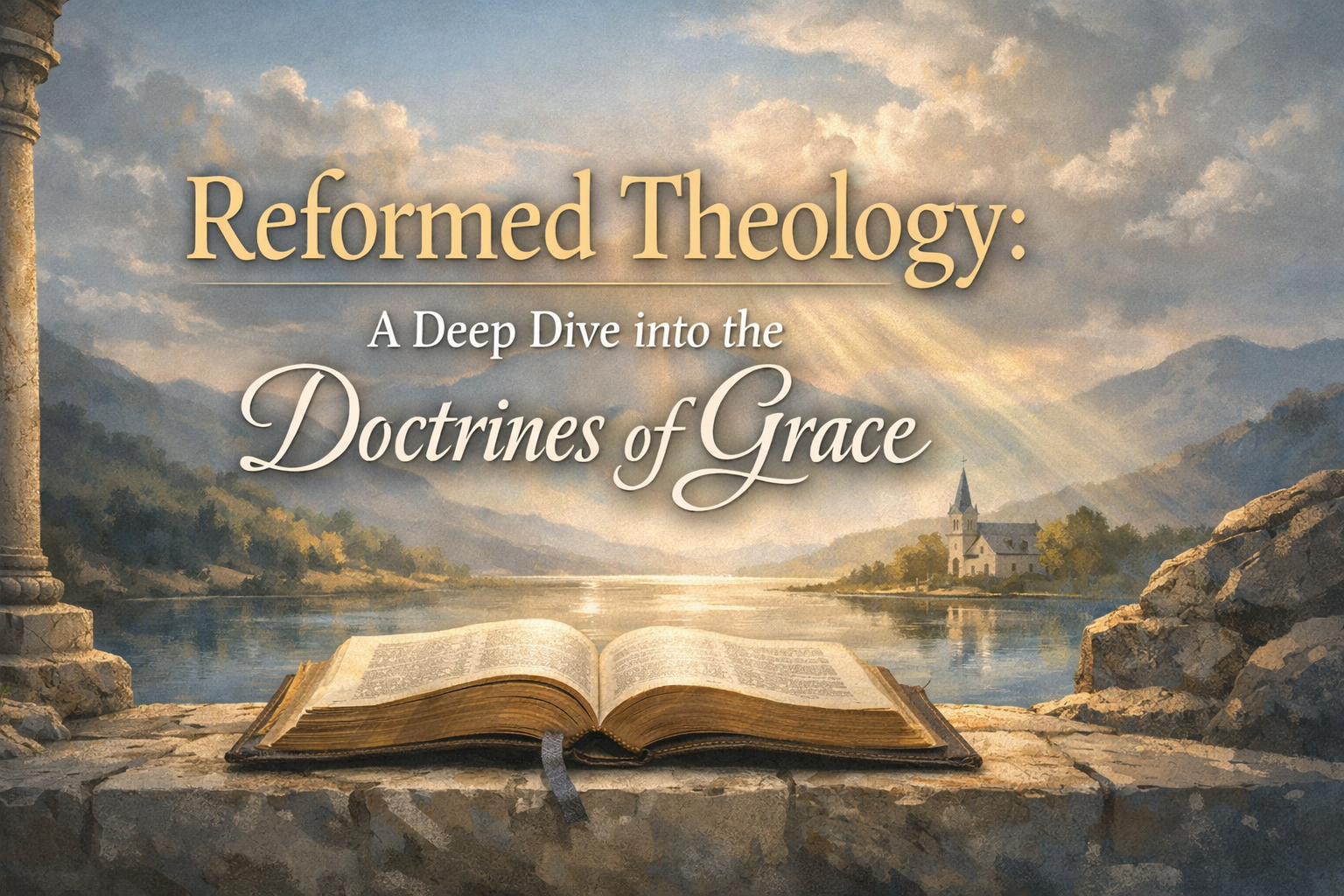
Reformed Theology: A Deep Dive into the Doctrines of Grace
Rooted in Scripture. Centered on Christ. Lived for the Glory of God.
Imagine walking into a small, white-steepled church tucked along a gravel road. Inside, a faithful pastor opens his Bible to Ephesians 1 and proclaims: “Before the foundation of the world, God chose you in Christ!” Some sit in awe. Others wonder what that even means.
This is the heartbeat of Reformed Theology — a robust, God-centered way of understanding the Christian faith that reaches deep into Scripture and into daily life. It is not a dusty set of doctrines for seminary students. It is a living, practical understanding of who God is, how He saves, and how we walk with Him in every part of life.
“From him and through him and to him are all things. To him be glory forever. Amen.” — Romans 11:36
Historical Roots
The Protestant Reformation of the 1500s was a cry for the Church to return to the Bible. Men like Huldrych Zwingli in Switzerland and John Calvin in Geneva insisted that God’s Word — not church tradition — should govern worship and salvation. In 1519, Zwingli preached verse-by-verse through the entire Bible, a revolutionary act at the time. Calvin published his Institutes of the Christian Religion in 1536, a systematic explanation of the Christian faith grounded in God’s sovereignty and grace.
A century later, the Synod of Dort (1618–1619) clarified and consolidated the Reformed understanding of salvation in response to the Arminian challenge. Out of that gathering came what we now call the Five Points of Calvinism — the “Doctrines of Grace” that remain a cornerstone of Reformed theology today.
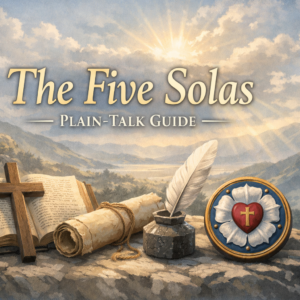
The Five Solas — Anchors of the Faith
At the heart of Reformed Theology stand five Latin phrases that sum up what the Reformers recovered from Scripture. These aren’t academic novelties — they are the load-bearing walls of the Christian faith.
Sola Scriptura
Scripture Alone
The Bible is our ultimate authority — above tradition, above church councils, above human reason (2 Timothy 3:16–17)
Sola Fide
Faith Alone
We are justified by faith, not works. No merit, no ritual, no track record earns standing before God (Romans 3:28)
Sola Gratia
Grace Alone
Salvation is God’s free gift — entirely unearned, entirely undeserved, entirely His to give (Ephesians 2:8–9)
Solus Christus
Christ Alone
Jesus is the only mediator between God and man. No priest, no program, no personal performance bridges that gap (1 Timothy 2:5)
Soli Deo Gloria
To God Alone Be the Glory
All of life — every vocation, every decision, every moment — exists for His glory (1 Corinthians 10:31)
Together
Five phrases. One conviction.
Salvation is entirely God’s work — from start to finish, for His glory alone.
God’s Sovereignty — the Foundation of Everything
Reformed Theology exalts the absolute sovereignty of God. Nothing — no political upheaval, no personal trial, no human choice, not even our own sin — falls outside His plan or purposes.
“My counsel shall stand, and I will accomplish all my purpose.” — Isaiah 46:10
The Farmer and the Harvest
A farmer plants wheat each spring. He cannot control the rain or the sun, yet he trusts God to bring the harvest. Reformed Theology teaches that the same God who governs the weather also governs salvation and the details of every life — and He can be trusted with both.
Covenant Theology — One Story, Not Two Books
Reformed Theology views the entire Bible as one continuous story — a series of covenants (sacred promises) revealing God’s single, unified redemptive plan. The Old Testament is not a failed experiment; it’s the foundation of everything the New Testament builds on.
- With Adam — God promised life for obedience; the fall established the need for redemption.
- With Noah — God promised to preserve the world through grace, not destruction.
- With Abraham — God promised to bless all nations through his seed. Every Gentile believer is part of this promise.
- With Moses — God gave the law to show His holiness and reveal human need.
- With David — God promised a King whose throne would last forever.
- In Christ — God fulfilled every one of these promises (Luke 24:44). He is the Yes to all of them (2 Corinthians 1:20).
This covenantal lens is what keeps Scripture from becoming a disjointed anthology of ancient stories. It is one story of grace — with one Author, one thread, and one climax.
The Doctrines of Grace — TULIP
The five points that emerged from the Synod of Dort are often remembered by the acronym TULIP. Each one answers a crucial question about how God saves sinners.
Total Depravity
Humans are not merely wounded by sin — we are spiritually dead apart from God (Ephesians 2:1). Our minds, wills, and desires are all affected. We cannot save ourselves or choose God without His prior work.
Like a sheep trapped at the bottom of a pit — it cannot climb out on its own. God must come down to rescue it.
Unconditional Election
God chooses people to be saved not because of anything good in them but purely because of His mercy and sovereign will (Romans 9:16). This removes all boasting and grounds assurance entirely in God’s faithfulness.
A farmer doesn’t choose which seeds to plant based on how they look. He plants according to his plan for the harvest.
Limited Atonement — Particular Redemption
Christ’s death actually accomplished salvation for those the Father gave Him (John 10:11). His sacrifice is sufficient to save the whole world, but it was designed to effectively secure the redemption of His elect.
A shepherd doesn’t just open the gate and hope the sheep wander in — he lays down his life for his sheep, specifically and personally.
Irresistible Grace
When God calls someone to salvation, His Spirit opens their heart so they willingly come to Christ (John 6:37). God doesn’t override the will — He transforms it. He changes what we want.
Like a magnet drawing metal — the pull isn’t force against resistance; it transforms the response itself.
Perseverance of the Saints
Those whom God saves, He will keep to the end — not because of their own strength, but because of His faithfulness (Philippians 1:6). Genuine believers may stumble, but they will not ultimately fall away.
A shepherd doesn’t abandon his flock in a storm — he carries them through safely. The security is in his grip, not theirs.
All of Life Is Sacred
Worship, Work, and the World
No Sacred-Secular Divide
In Reformed Theology, there’s no partition between “sacred” work and “secular” work. Whether you’re preaching a sermon, teaching school, running a business, or baling hay — all of it is done unto the Lord (Colossians 3:23).
Dutch theologian Abraham Kuyper put it plainly: “There is not a square inch in the whole domain of our human existence over which Christ, who is Sovereign over all, does not cry, ‘Mine!'” This worldview leads believers to care about justice, beauty, and truth in the public square — not to earn God’s favor, but to glorify Him.
Evangelism and Assurance
Reformed Theology doesn’t make evangelism pointless — it makes it powerful. Because God is sovereign in salvation, we can share the gospel boldly, knowing He will save His people (Acts 13:48). Our job is faithfulness; the results belong to Him.
It also produces deep personal assurance. If God is the one who saves — and His election is unconditional, His grace irresistible, and His keeping power certain — then nothing can separate you from His love (Romans 8:38–39). Your worst failures cannot undo what He has done.
The Child Learning to Walk
Picture a child learning to walk. She stumbles constantly. But her father holds her hand tightly — and the security doesn’t depend on the strength of her grip. It depends on his.
That’s how God keeps His children. Not by their performance, but by His promise.
Why Reformed Theology Still Matters
🧭 Clarity
It gives clear answers in a world of theological fog — grounded in Scripture, tested by centuries of faithful exposition.
⚓ Hope
When life is uncertain and circumstances are hard, knowing God governs all things brings a stability that circumstances alone can never provide.
📖 Depth
In a culture of shallow, feeling-driven faith, Reformed theology offers roots — doctrinal substance that holds when the emotional weather changes.
🙏 Worship
When you grasp how great God truly is — sovereign, holy, gracious, faithful — you can’t help but worship. Doctrine feeds doxology.
Reformed Theology is not about winning theological arguments. It’s about knowing God, resting in His grace, and living for His glory in every sphere of life.
Whether you’re a pastor preaching in a rural church, a mother discipling children, or a mechanic fixing engines — God calls you to live with this truth in mind: your life belongs to Him, your salvation is secure in Him, and His glory is the point of everything.
Rooted in Scripture. Centered on Christ. Lived for the glory of God. That’s what Reformed Theology is — and why it still matters.
“From him and through him and to him are all things. To him be glory forever. Amen.” — Romans 11:36
Key Scriptures: Romans 11:36 · Isaiah 46:10 · Ephesians 2:1, 8–9 · Romans 9:16 · John 10:11 · John 6:37 · Philippians 1:6 · Colossians 3:23 · Acts 13:48 · Romans 8:38–39 · 2 Timothy 3:16–17 · 1 Corinthians 10:31 · Luke 24:44
Want to Go Deeper?
This post is part of an ongoing series on the theological traditions that have shaped Protestant Christianity. If it helped you understand what Reformed theology is actually about, here are a few next steps:
- Read the companion posts — MVM’s posts on John Calvin, Martin Luther, and the Protestant Reformation provide the historical and biographical detail behind everything covered here.
- Read further — R.C. Sproul’s What Is Reformed Theology? is the most accessible modern introduction; the Heidelberg Catechism is one of the most beautiful summaries of Reformed faith ever written.
- Subscribe to get new posts delivered straight to your inbox — gospel-rooted, plain-spoken truth for the week ahead.
“For by grace you have been saved through faith — and this is not your own doing; it is the gift of God.” — Ephesians 2:8
Mountain Veteran Ministries
Find Your Next Bearing
Every journey needs a direction. If you're wondering where to go from here, choose the path that best fits where you are today.
⚒️ I Want to Live Faithfully
Discover practical wisdom for following Christ in today's world.
→ Living as a Christian Today✝️ I Want to Understand the Gospel
Learn what salvation means and why Jesus came.
→ Understanding Salvation📖 I Want to Understand the Bible
Explore why Christians trust Scripture and how to read it well.
→ Understanding the Bible❓ I Still Have Questions
Explore thoughtful answers to some of Christianity's hardest questions.
→ Hard Questions