The Vision of New Creation
Revelation 21–22 doesn’t just describe heaven. It describes the destination of all God’s promises — and it changes how we live today.
“Behold, I am making all things new.” — Revelation 21:5
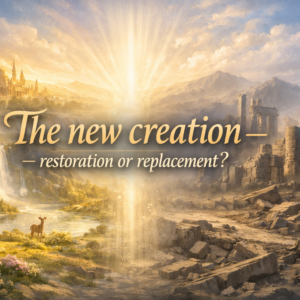
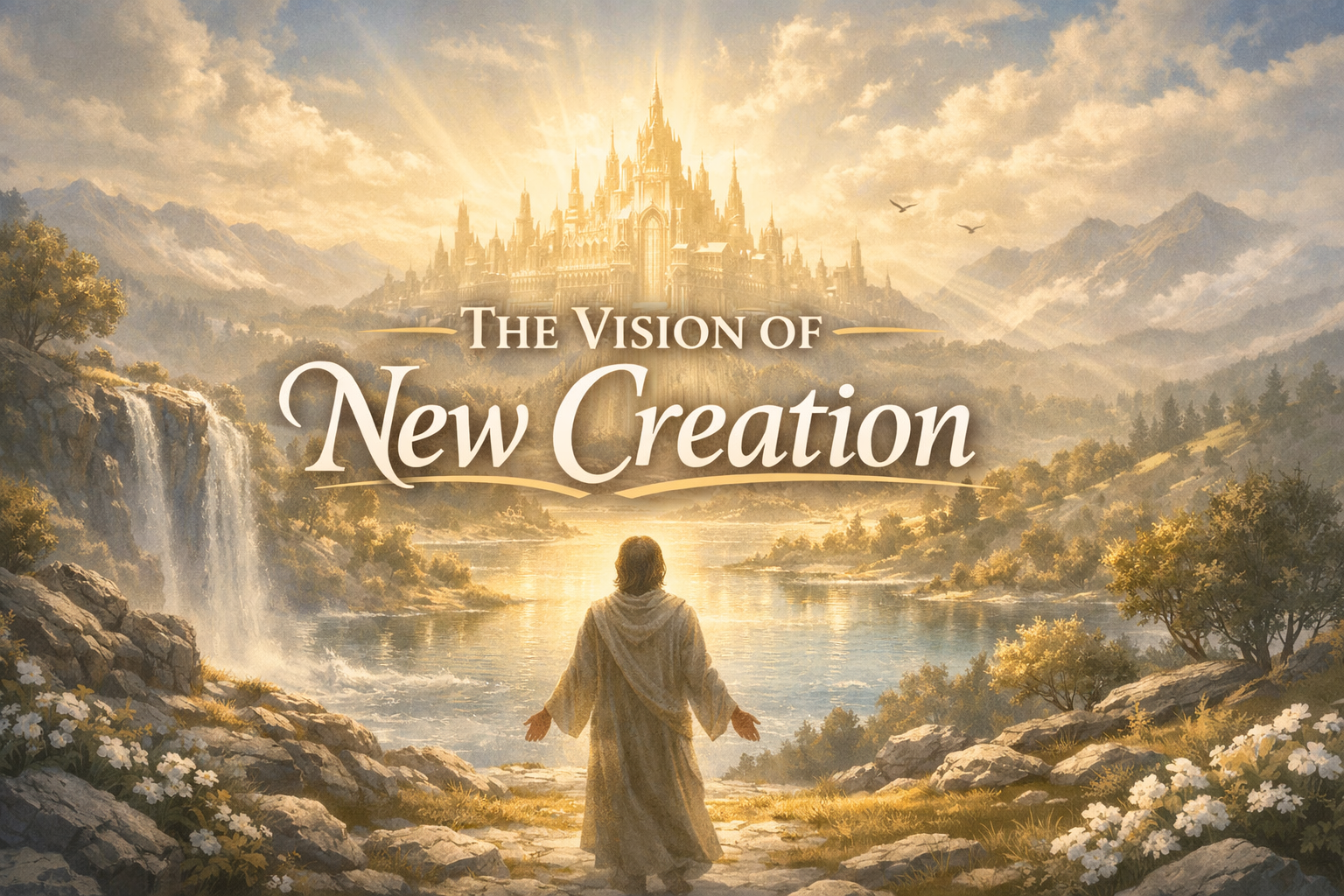
Of all the images in Scripture, few are more misunderstood than the new creation. Most people picture heaven as clouds, harps, and an eternal Sunday service floating somewhere above the earth. But the final chapters of Revelation paint something far more concrete, more earthy, and more magnificent than that — a renewed cosmos where God himself has come down to dwell with his people, where the river of life runs clear and cold through a city whose gates are never shut, and where the curse that entered at Eden is finally, completely, forever undone.
This vision isn’t just a distant destination. It’s the interpretive key to the whole Bible — the answer to every question the story raises, the resolution of every longing the human heart carries. Understanding it changes not only what we hope for, but how we live right now.
Scriptural Foundation
The vision of new creation reaches its fullest expression in three interconnected passages at the end of Revelation. Revelation 21:1–8 introduces the new heaven and new earth, with the New Jerusalem descending from God. Revelation 21:9–27 describes the city itself in stunning detail. And Revelation 22:1–5 brings the vision to its quiet, breathtaking close — the river of life flowing from the throne, the tree of life bearing fruit for the nations, and God’s servants reigning with him forever.
These passages do not stand alone. They echo themes woven through Genesis, Isaiah, Ezekiel, and the Psalms — threads that have been building across the entire arc of Scripture, now drawn together in final fulfillment.
1. A New Heaven and a New Earth
“Then I saw a new heaven and a new earth, for the first heaven and the first earth had passed away.” — Revelation 21:1
The first thing to notice is what this is not. This is not the destruction of the material world followed by the rescue of disembodied souls into an immaterial heaven. The Greek word translated “new” here — kainos — means new in quality, renewed, transformed. Not replaced from scratch, but made what it was always meant to be. G.K. Beale captures it well: the new creation is not the annihilation of what was made, but its transformation into the glory God intended from the beginning.
“It is not the annihilation of creation, but the transformation of creation into its intended glory.” — G.K. Beale
This matters theologically because it connects new creation directly to redemption. Paul writes in Romans 8 that the whole creation groans, waiting for the revealing of the sons of God — that creation itself will be set free from its bondage to decay. The Fall in Genesis 3 introduced brokenness not just into human souls but into the fabric of the physical world. The new creation is the answer to that brokenness — complete, cosmic, final. God is not abandoning his original project. He is completing it.
The theological themes at work here are rich: the redemption of the physical creation, God’s faithfulness to every promise he has made, and his ultimate victory over death and evil. None of this is accidental. All of it was planned before the first words of Genesis were spoken.
2. The New Jerusalem — God Dwelling With His People
“Look, God’s dwelling is with humanity, and He will live with them.” — Revelation 21:3
The New Jerusalem descends from heaven like a bride adorned for her husband. It is a city of impossible light and beauty — gates made from single pearls, foundations of precious stones, streets of gold so pure it appears transparent. But John is at pains to tell us something striking about this magnificent city: there is no temple in it.
In the ancient world, the temple was the place where heaven and earth met — the dwelling of the divine, the location of God’s presence. Its absence from the New Jerusalem is not a loss. It is the fullest possible fulfillment. “I did not see a temple in the city,” John writes, “because the Lord God Almighty and the Lamb are its temple” (21:22). The entire city has become what the holy of holies was always pointing toward: the unmediated, unobstructed presence of God.
The gates of the city stand open permanently. No enemies threaten. No darkness encroaches. God’s glory lights the city so thoroughly that sun and moon are unnecessary. There is no more death, no more mourning, no more crying, no more pain — the old order of things, the order inaugurated by the Fall, has been entirely and permanently swept away (21:4).
“This is the heart of heaven: not golden streets, but the presence of God Himself.” — Jonathan Edwards
Edwards understood something that our imaginations often miss. The most stunning feature of the new creation is not its architecture. It is its inhabitant. Every other blessing flows from a single fact: God is there, fully present, forever accessible, dwelling with his people face to face.
3. The River and the Tree of Life
“Then the angel showed me the river of the water of life, as clear as crystal, flowing from the throne of God and of the Lamb.” — Revelation 22:1
The final scene in Revelation deliberately mirrors the opening scenes of Genesis. In Genesis 2, a river watered the garden of Eden and the tree of life stood at its center. In Revelation 22, that same river — now flowing from the throne of God itself — runs through the middle of the city, and the tree of life stands on both its banks, bearing twelve kinds of fruit, its leaves bringing healing to the nations.
The echo is intentional and profound. This is not coincidence. This is an Author tying together the beginning and end of his story with a single thread. But notice: what Revelation describes is not a simple restoration of Eden. It is something greater. The garden has become a city. The tree of life, once guarded by cherubim with a flaming sword, now stands open and fruitful for all. The curse of Genesis 3 — “cursed is the ground because of you” — is specifically and completely reversed: “No longer will there be any curse” (22:3).
“The Bible begins with a garden and ends with a city. It’s the story of paradise lost and paradise restored — only better.” — Timothy Keller
Keller’s observation points to something important about how God works. He does not merely undo what went wrong. He takes the story somewhere it could never have reached without the Fall and the redemption — to a city, a community, a multitude drawn from every nation, gathered around a throne, drinking from a river that never runs dry. Eden was a beginning. The New Jerusalem is a fulfillment that exceeds what the beginning could have imagined.
4. Humanity’s Role — Reigning and Worshiping
“They will reign forever and ever.” — Revelation 22:5
One of the most important correctives the new creation vision offers is to the idea that eternity is passive. Believers are not described as floating spirits in an endless worship service. They are described as servants who reign — active, purposeful, engaged, and glorified human beings living in the full presence of God with meaningful work to do.
The original mandate of Genesis 1 — to fill the earth and exercise dominion over it as image-bearers of God — is not cancelled by redemption. It is consummated. What humanity failed to do under the conditions of sin and mortality, redeemed humanity will do perfectly and joyfully in the new creation, under the direct reign of the King of kings. This is not a consolation prize. It is the fullest expression of what it means to be human.
This vision should reframe how we think about the resurrection body, about work, about creativity, about culture. Eternity is not the end of everything we love about being human. It is the beginning of being fully human for the first time.
The Bible’s Full Circle: Genesis to Revelation
The structural symmetry between the opening and closing chapters of Scripture is one of the most compelling arguments for the unity of the Bible as a single, divinely authored story. The themes that are introduced in Genesis find their resolution — and their transformation — in Revelation.
| Theme | Genesis | Revelation |
|---|---|---|
| Creation | Genesis 1–2 | Revelation 21–22 |
| Tree of Life | Genesis 2:9 | Revelation 22:2 |
| River of Life | Genesis 2:10 | Revelation 22:1 |
| God dwelling with man | Genesis 3:8 | Revelation 21:3 |
| The curse | Genesis 3:17 (entered) | Revelation 22:3 (removed) |
| Death | Genesis 3:19 (enters) | Revelation 21:4 (no more) |
This is not the product of editorial cleverness. Forty authors, fifteen centuries, and one coherent story — with a beginning that sets up everything the ending resolves. The new creation vision is the final proof that God knew exactly what he was doing from the very first word.
What It Means for Us Today
Eschatology — the study of last things — is never meant to be mere speculation about the future. In Scripture, what God will do always shapes what his people do now. The vision of new creation carries at least three practical imperatives for those who believe it.
Live with Genuine Hope
No matter the chaos of the present moment, God is preparing something better. The vision of Revelation 21–22 is not wishful thinking — it is the promised destination of all history, guaranteed by the resurrection of Jesus as the firstfruits of the new creation. Evil and suffering do not win. They do not even get the last chapter. For veterans who have seen the worst of what human beings do to one another, this is not a platitude. It is a rock. The story ends well. Specifically, irreversibly, and permanently well.
Be a New Creation Now
“If anyone is in Christ, he is a new creation” (2 Corinthians 5:17). Paul’s declaration means that the future has already broken into the present. The life of the age to come — characterized by purity, love, justice, worship, and the presence of God — is available now, in part, through union with Christ and the work of the Holy Spirit. The new creation vision is not just a destination to be reached. It is a reality to be inhabited. We are called to live as people of the future in the present.
Yearn for His Coming
The last prayer in all of Scripture is two words: “Come, Lord Jesus” (Revelation 22:20). After everything John has seen — the seals, the trumpets, the bowls, the beast, the battle, and finally the city — that is the cry that rises from his heart. Not curiosity. Not relief. Longing. The vision of new creation is meant to produce in us a deep, active, patient yearning for the one who promised it. Let that longing shape our prayers, our priorities, and our sense of what truly matters.
The vision of new creation in Revelation is not a consolation prize for a world gone wrong. It is the destination toward which all of God’s purposes have been moving since before the first sunrise. From creation to re-creation, from loss to restoration, from God walking with man in the cool of the day to God dwelling forever among his people in a city of eternal light — this is where the story ends.
And “He who was seated on the throne said, ‘Behold, I am making all things new.'” — Revelation 21:5
Not new and empty. New and full. Full of life, full of purpose, full of beauty, and full of God.
Study This Further
The new creation theme runs through the entire Bible. If you want to trace it more deeply, start with Romans 8:18–25 and Isaiah 65:17–25 alongside Revelation 21–22. G.K. Beale’s commentary on Revelation and N.T. Wright’s Surprised by Hope are both outstanding guides to this territory.
If this vision stirred something in you — hope, longing, or questions — we’d welcome the conversation. Mountain Veteran Ministries exists to walk alongside people who are working through the big questions of faith and eternity.
“Behold, I am making all things new.” — Revelation 21:5
Key Scriptures: Revelation 21:1–8 • Revelation 21:9–27 • Revelation 22:1–5 • Romans 8:19–23 • 2 Corinthians 5:17 • Genesis 2:9–10 • Genesis 3:17 • Isaiah 65:17–25
Mountain Veteran Ministries
Find Your Next Bearing
Every journey needs a direction. If you're wondering where to go from here, choose the path that best fits where you are today.
✝️ I Want to Understand the Gospel
Learn what salvation means and why Jesus came.
→ Understanding Salvation📖 I Want to Understand the Bible
Explore why Christians trust Scripture and how to read it well.
→ Understanding the Bible🎓 I Want to Grow Deeper
Go beyond the basics and strengthen your understanding of the faith.
→ Learning the Christian Faith⚒️ I Want to Live Faithfully
Discover practical wisdom for following Christ in today's world.
→ Living as a Christian Today❓ I Still Have Questions
Explore thoughtful answers to some of Christianity's hardest questions.
→ Hard Questions