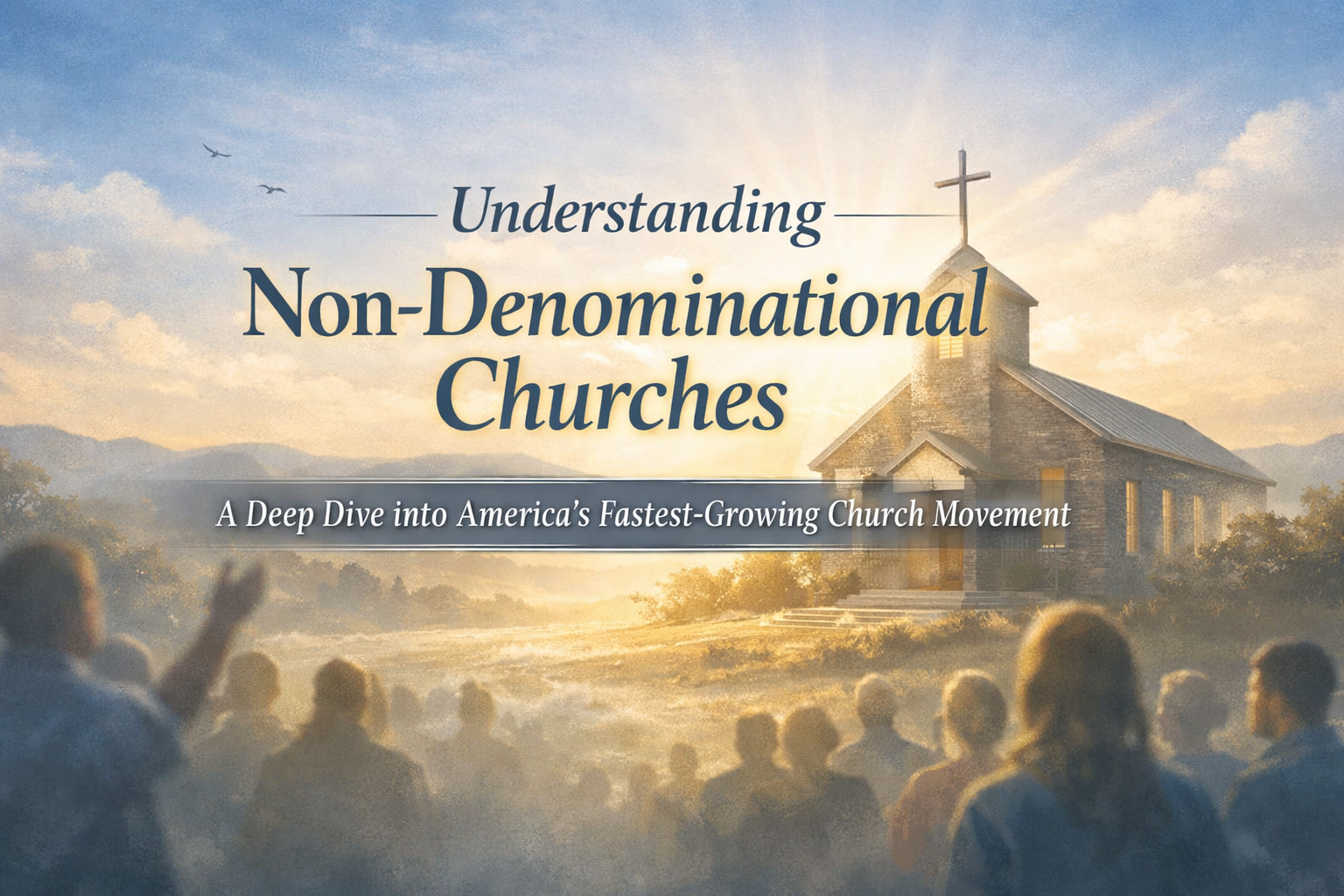
Understanding Non-Denominational Churches: A Deep Dive into America’s Fastest-Growing Church Movement
What They Are, Why They Grew, and What Every Church Can Learn from Them
Walk through any community today and you’ll likely find a congregation called something like “Grace Community Church,” “New Life Fellowship,” or “The Bridge” — simple, accessible names that deliberately avoid traditional denominational markers. Non-denominational churches are one of the fastest-growing segments of American Christianity, representing roughly 13% of all congregations. But what exactly does it mean to be “non-denominational,” and what does their rise tell us about the church in our time?
“That all of them may be one, Father, just as you are in me and I am in you.” — John 17:21
What Is a Non-Denominational Church?
At its core, a non-denominational church operates independently of any formal denominational structure or hierarchy. Unlike a Methodist church that answers to a district superintendent or a Presbyterian church governed by a presbytery, non-denominational congregations function autonomously — typically governed through elder councils or elected boards.
This independence isn’t merely administrative; it’s deeply theological. Most non-denominational churches position themselves as returning to New Testament Christianity, arguing that denominational structures are human additions to what should be a simple, biblical faith. They often cite Jesus’s prayer in John 17:21 as evidence that denominational divisions work against Christ’s desire for unity among believers.
Historical Roots
The non-denominational impulse has deep roots in American religious history — it didn’t begin with electric guitars and projection screens.
-
1
Stone-Campbell Restoration Movement (early 1800s)
Sought to restore New Testament Christianity without denominational creeds — one of the earliest organized expressions of the non-denominational instinct.
-
2
Early Pentecostalism (early 1900s)
Many Pentecostal churches emerged with an explicitly non-denominational identity, emphasizing direct experience of the Spirit over institutional structure.
-
3
Calvary Chapel Movement (1965)
Chuck Smith’s Calvary Chapel in Costa Mesa, California — grown from 25 to over 25,000 — became the modern model: verse-by-verse Bible teaching, contemporary worship, no denominational baggage.
-
4
Megachurch Era (1980s–present)
Non-denominational megachurches like Joel Osteen’s Lakewood Church (Houston) and Rick Warren’s Saddleback Church (California) established this model as a dominant force in American Christianity.
Core Characteristics
📖 Biblical Authority
Scripture alone as the ultimate guide for faith and practice. Rather than denominational confessions, these churches lean on expository preaching through books of the Bible.
🏛️ Simplified Governance
Elder-led models or congregational governance. Biblical accountability without denominational bureaucracy — or so the aim goes.
🎵 Contemporary Worship
Non-denominational churches pioneered modern Christian worship. Think Hillsong, Bethel Music. Electric guitars, projection screens, and informal atmosphere are the norm.
🌍 Evangelistic Focus
Church names, architecture, and service styles are often deliberately chosen to lower barriers for unchurched visitors. Accessibility is a core value.
Strengths and Challenges
✅ Strengths
- Flexibility. Without denominational policies, these churches adapt quickly to local community needs — a real advantage in rapidly changing cultural contexts.
- Biblical clarity. Many believers find genuine freedom in churches that emphasize Scripture over human tradition, offering a fresh start without inherited conflicts.
- Reach. Without labels that carry negative associations, and with contemporary styles, these churches have proven remarkably effective at reaching previously unchurched people.
- Agility. They can launch new ministries, shift strategies, or plant daughter churches faster than institutional structures allow.
⚠️ Challenges
- Accountability gaps. Without denominational oversight, churches are more vulnerable to pastoral abuse or theological drift. When problems arise, there’s often no higher authority to intervene.
- Informal orthodoxies. Despite claiming simplicity, most non-denominational churches develop their own unspoken norms — worship style, sermon format, building design — creating an informal denomination without acknowledging it.
- Theological preparation. Denominational churches typically require extensive pastoral training. Non-denominational churches may prioritize charisma over formation, which can lead to error.
- Rootlessness. Without connection to the broader historic church, congregations can lack the theological depth and communal wisdom that centuries of tradition provide.
The Honest Irony
Here’s something worth sitting with: most successful non-denominational churches eventually create the very structures they sought to avoid. Networks like Acts 29, the Gospel Coalition, or Vineyard USA provide fellowship, accountability, and theological oversight — which is to say, they provide the benefits of a denomination while calling it something else.
This isn’t necessarily a failure. It may be wisdom. The church has always needed both freedom and accountability, both local autonomy and broader community. The most effective non-denominational churches have discovered that complete independence isn’t the same as biblical faithfulness.
What Every Church Can Learn
- 1 Accessibility matters. The non-denominational movement correctly identified that unnecessary barriers can keep people from hearing the gospel. Every church — regardless of tradition — should ask whether its forms serve mission or simply preserve comfort.
- 2 Scripture must be central. The commitment to expository preaching — working through books of the Bible — is a gift that any church can embrace. God’s Word is the primary tool of formation, not programs or personalities.
- 3 Accountability is not optional. The scandals that have struck several high-profile non-denominational churches are a warning for all of us: no pastor is above accountability, and no church is healthy without it — whether that accountability comes from a denomination or a trusted network of peers.
- 4 History is a gift, not a prison. The broader church has two thousand years of hard-won wisdom on Scripture, doctrine, worship, and discipline. A church that cuts itself off from that history to feel “fresh” is impoverishing itself. Honor your heritage — then bring it into the present.
- 5 Unity is the goal, not uniformity. Jesus prayed “that all of them may be one” — not “that all of them may look identical.” The non-denominational movement is right that denominational divisions can wound the body of Christ. It’s wrong when it mistakes independence for unity.
The non-denominational movement represents both a genuine recovery of some New Testament instincts and a thoroughly modern response to institutional distrust. At its best, it embodies the unity Jesus prayed for — focusing on essential gospel truths rather than divisive secondary debates, and reaching people who might never have walked into a traditional church building.
At its worst, it trades one set of human traditions for another while claiming to have none — and sacrifices accountability, historical depth, and theological rigor on the altar of accessibility.
In the end, the church’s ultimate identity isn’t found in its organizational structure — denominational or otherwise. It’s found in our shared commitment to following Jesus Christ, preaching the gospel, loving our neighbors, and making disciples. Whether a congregation carries a denominational name or not, that is the work.
“There is one body and one Spirit — just as you were called to one hope when you were called — one Lord, one faith, one baptism; one God and Father of all.” — Ephesians 4:4–6
Key Scriptures: John 17:21 · Ephesians 4:4–6 · Acts 2:42 · 1 Timothy 3:1–13 · Hebrews 13:17 · 1 Corinthians 12:12–27 · Matthew 28:19–20 · 2 Timothy 3:16–17 · Titus 1:5–9
Want to Go Deeper?
This post is part of an ongoing conversation about how the church can be faithful, healthy, and effective in our time. If it stirred something in you, here are a few next steps:
- Share it with a pastor, elder, or church member wrestling with questions about church structure, accountability, or identity.
- Read further — Tim Keller’s Center Church is one of the best books on how to think about church structure, culture, and mission without sacrificing theological depth.
- Subscribe to get new posts delivered straight to your inbox — gospel-rooted, plain-spoken truth for the week ahead.
“That all of them may be one, Father, just as you are in me and I am in you.” — John 17:21
Mountain Veteran Ministries
Find Your Next Bearing
Every journey needs a direction. If you're wondering where to go from here, choose the path that best fits where you are today.
⚒️ I Want to Live Faithfully
Discover practical wisdom for following Christ in today's world.
→ Living as a Christian Today✝️ I Want to Understand the Gospel
Learn what salvation means and why Jesus came.
→ Understanding Salvation📖 I Want to Understand the Bible
Explore why Christians trust Scripture and how to read it well.
→ Understanding the Bible❓ I Still Have Questions
Explore thoughtful answers to some of Christianity's hardest questions.
→ Hard Questions